A Critical Analysis of Kurdistan Movement Leadership in Iran
Abstract
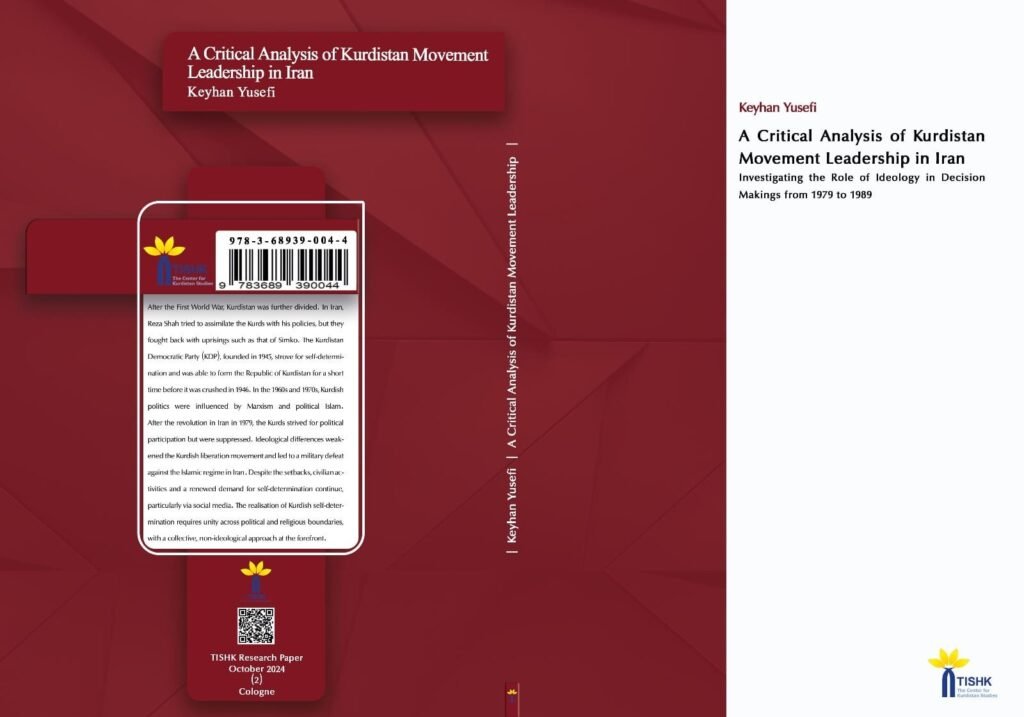
The Research Paper, titled "A Critical Analysis of Kurdistan Movement Leadership in Iran", authored by Keyhan Yusefi explores the complex history of Kurdish movements in Kurdistan following World War I. He examines Reza Shah's assimilation policies and the subsequent resistance, including the uprising of Simko and the founding of the Kurdistan Democratic Party (KDP) in 1945. Despite brief successes, such as the short-lived Republic of Kurdistan, Yusefi highlights the challenges posed by ideological divisions and political repression during and after the 1979 Iranian Revolution. This study underscores the need for a united Kurdish front to achieve self-determination, illustrating how modern technologies and social media serve as platforms for ongoing resistance and demands for political rights.
Publication record
- Author
- Keyhan Yusefi
- Type
- TISHK Research Paper
- Publisher
- TISHK Center for Kurdistan Studies
- Editor
- TISHK Center for Kurdistan Studies
- Date
- 21/10/2024
- Volume
- 1
- Issue
- 2
- DOI
- https://doi.org/10.69939/TISHK9039
- ISBN
- 978-3-68939-004-4
- e-ISBN
- 978-3-68939-005-1
- ISSN
- 2943-7237
- Language
- En
- Pages
- 1 – 128
Keyhan Yusefi (2024). A Critical Analysis of Kurdistan Movement Leadership in Iran. TISHK Center for Kurdistan Studies. https://doi.org/10.69939/TISHK9039
TISHK Research Paper
A Critical Analysis of Kurdistan Movement Leadership in Iran
Published by TISHK Center for Kurdistan Studies: 21 October 2024
DOI :https://doi.org/10.69939/TISHK9039
Abstract
The Research Paper, titled “A Critical Analysis of Kurdistan Movement Leadership in Iran”, authored by Keyhan Yusefi explores the complex history of Kurdish movements in Kurdistan following World War I. He examines Reza Shah’s assimilation policies and the subsequent resistance, including the uprising of Simko and the founding of the Kurdistan Democratic Party (KDP) in 1945. Despite brief successes, such as the short-lived Republic of Kurdistan, Yusefi highlights the challenges posed by ideological divisions and political repression during and after the 1979 Iranian Revolution. This study underscores the need for a united Kurdish front to achieve self-determination, illustrating how modern technologies and social media serve as platforms for ongoing resistance and demands for political rights.
- Place of publication:Cologne, Germany
- Author/Contributor: Keyhan Yusefi
- Publisher:: TISHK Center for Kurdistan Studies
- Institution: TISHK Center for Kurdistan Studies
- Language: English
- ISSN (Print) 2943-7245
- ISSN (Online) 2943-7237
- DOI:10.69939/TISHK9039
- ISBN: 978-3-68939-004-4
- E-ISBN: 978-3-68939-005-1
-
Copyright: © 2024 by TISHK Center for Kurdistan Studies is licensed under CC BY-NC 4.0


