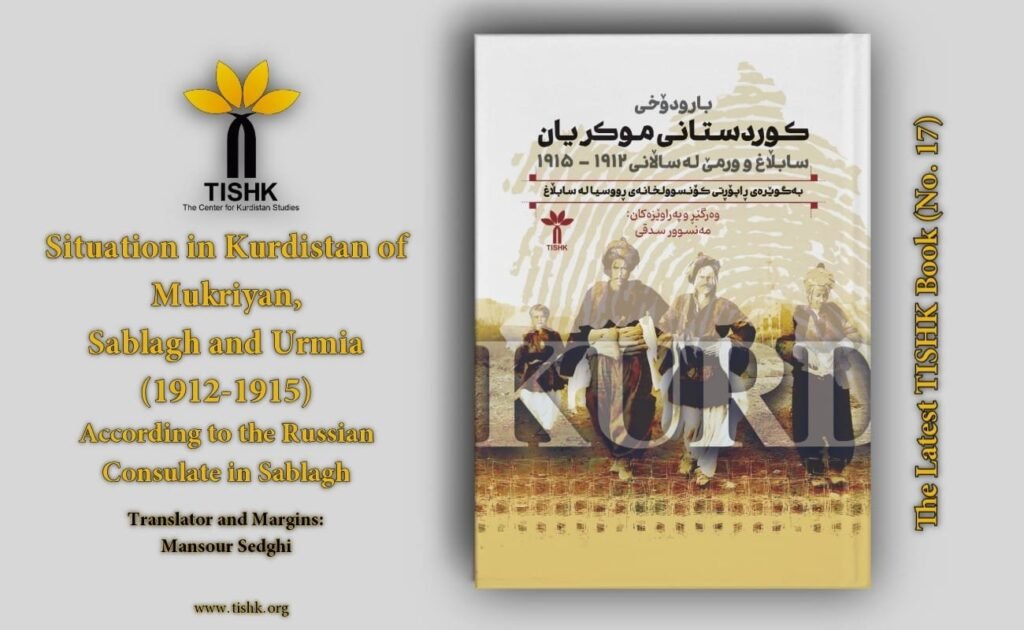
Situation in Kurdistan of Mukriyan, Sablagh and Urmia (1912-1915)
Publication record
- Author
- According to the Russian Consulate in Sablagh
- Translator
- Mansour Sedghi
- Type
- Book
- Published in
- TISHK Books
- Publisher
- TISHK Center for Kurdistan Studies
- Editor
- TISHK Center for Kurdistan Studies
- Date
- 19/02/2026
- Volume
- 17
- DOI
- https://doi.org/10.69939/TISHK0017
- ISBN
- 978-3-68939-038-9
- e-ISBN
- 978-3-68939-039-6
- ISSN
- 3052-2242
- Language
- Ku, En
According to the Russian Consulate in Sablagh (2026). Situation in Kurdistan of Mukriyan, Sablagh and Urmia (1912-1915). TISHK Books 17. https://doi.org/10.69939/TISHK0017
TISHK Book
Situation in Kurdistan of Mukriyan, Sablagh and Urmia (1912-1915)
Published by TISHK Center for Kurdistan Studies: 23 February 2025
https://doi.org/10.69939/TISHK0017
Is there anyone among us Kurds who knows how many kilometers lie between Mahabad and Erbil, or how much it costs to transport one kilogram and one ton of goods between Mahabad and Baghdad? Or how many households and how many shops there are in Bukan, Sardasht, and Saqqez? Today, Google and artificial intelligence are readily available, yet how many Kurdish writers and researchers still know how many varieties of grapes, pears, and mulberries are produced in the mountains, forests, and fields of Kurdistan; what their names are; how many tons of them are harvested annually; what their prices are; and which traders transport them and to where?
This book addresses these vital questions by bringing to light two remarkable historical reports that offer a detailed, data-driven portrait of the Mukriyan region of Kurdistan from over a century ago. Written by Alexander Iyas, a Russian consul stationed in Sablagh (modern-day Mahabad) 115 years ago, the text serves as a sobering reminder of the importance of documenting one’s own land. The core of the study covers the comprehensive landscape of Mukriyan, documenting its geography, geology, and natural resources, alongside its demography, tribal structures, and urban industry.
By recording the exact volume and value of imports and exports, the reports provide a rare economic map of the region’s historical trade relations and markets. In addition to the statistical data, the book features two unique appendices: two poetic texts titled “The Bull and the Lion,” which are connected to an ancient archaeological site from the era of Hulagu Khan, and a collection of 22 original photographs taken by Iyas. Together, these elements transform a diplomatic archive into an essential resource for understanding the historical socioeconomic foundations of Eastern Kurdistan.
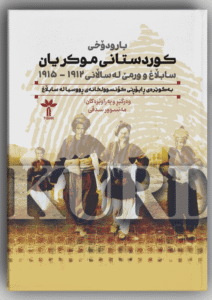
- Place of publication:Bonn, Germany
- Author/Contributor: According to the Russian Consulate in Sablagh
- Translated from Persian by: Mansour Sedghi
- Institution: TISHK Center for Kurdistan Studies
- Language: Kurdish
- ISBN (Print) 978-3-68939-038-9
- ISBN (Online) 978-3-68939-039-6
- DOI: 10.69939/TISHK0017
- ISSN: 3052-2242
- E-ISSN: The book is catalogued in the German National Library under ISSN 3052-2242 and can be accessed via the following link: https://d-nb.info/1390896536
- Copyright: © 2026 by TISHK Center for Kurdistan Studies is licensed under CC BY-NC 4.0