December 21 – Yalda Night – Şevçile
Publication record
- Author
- TISHK Team
- Type
- Kurdish Memory Days
- Publisher
- TISHK Center for Kurdistan Studies
- Editor
- TISHK Zentrum für Studien über Kurdistan
- Date
- 21/12/2025
- Language
- En
TISHK Team (2025). December 21 – Yalda Night – Şevçile. TISHK Center for Kurdistan Studies.
21 December – Yalda Night (Şewi Yelda / Şevçile)
21 December holds a special place in the cultural memory of the Kurdish people. It marks Yalda Night (Kurdish: Şewî Yelda or Şevçile), the longest night of the year, and the turning point when light gradually overcomes darkness. This night coincides with the winter solstice and traditionally signifies the beginning of winter. In Kurdish memory, Yalda represents not only an astronomical event but also a deeply rooted symbolic order in which nature observation, cosmology, religion, and social practice are closely intertwined.
Historical and Religious Origins
The history of Yalda Night reaches back to the pre-Islamic belief systems of the Kurds and other peoples of the region. In Mithraism, a central religious tradition of the ancient Kurdish cultural sphere, the sun (Xor / Roj) was regarded as a manifestation of divine order and life-giving energy. Mithra, as a divine being of light, truth, and covenant, symbolized the overcoming of darkness.
According to Mithraic beliefs, Mithra revealed his power on 21 December by proclaiming the return of light. The longest night of the year was thus understood not as a threat but as a moment of light’s birth. The term Yalda itself derives from Aramaic and means “birth.” In this context, the night was interpreted as a cosmic transition, embedding hope, renewal, and continuity.
Cosmology and Symbolism
Yalda Night embodies a fundamental cosmological idea: the cyclical triumph of light over darkness. After the solstice, the days begin to lengthen—a natural process that has been symbolically interpreted in Kurdish culture for millennia. The sun with 21 rays, a central symbol in Kurdish tradition, signifies completeness, order, and spiritual balance.
Natural phenomena such as snow or rain on Yalda Night are traditionally considered omens of a fertile year. The close connection between nature, seasonal cycles, and social life makes Yalda a cultural reference point, comparable to Newroz, the Kurdish spring and New Year festival.
Social Practice and Regional Traditions
Yalda Night is celebrated in diverse ways across Kurdistan, with local customs playing a central role. In Eastern and Southern Kurdistan, families gather after sunset around tables laden with traditional foods, including pomegranates, walnuts, grapes, raisins, dried figs, watermelon, tea, and sweets. Fires or candles are lit to symbolically preserve the light.
In some towns of Eastern Kurdistan, the night is called Şevçile (“Night of Forty”), referring to the start of a forty-day winter period in the traditional calendar. Common to these practices are collective gatherings, storytelling, singing, and recitation of classical poetry. Musical instruments such as the Tambûr and Def accompany the celebrations.
Yalda Night also occupies a special place in Kurdish literature. The poet Nalî (1800–1856) dedicated a famous poem to this night, which continues to be recited, reflecting its emotional and symbolic depth. Collections of classical poems (Diwane) are traditionally placed on the table and read collectively.
Across many regions, Yalda is therefore understood as a night of reunion, a time for renewing familial and social bonds. Among the Kurdish diaspora, the celebration has experienced a deliberate revival in recent years.
Yalda Night also represents an early scientific and philosophical engagement with the world. Through careful observation of nature, seasons, and celestial bodies, the people of Kurdistan developed a complex system of timekeeping and symbolic interpretation. These insights laid the foundation for cultural festivals such as Yalda and Newroz. The spiritual essence of this tradition persists today, especially in some communities of Yezidi, Alevi, and Yarsani, embodying a living cultural continuity that intertwines religious, social, and scientific elements.
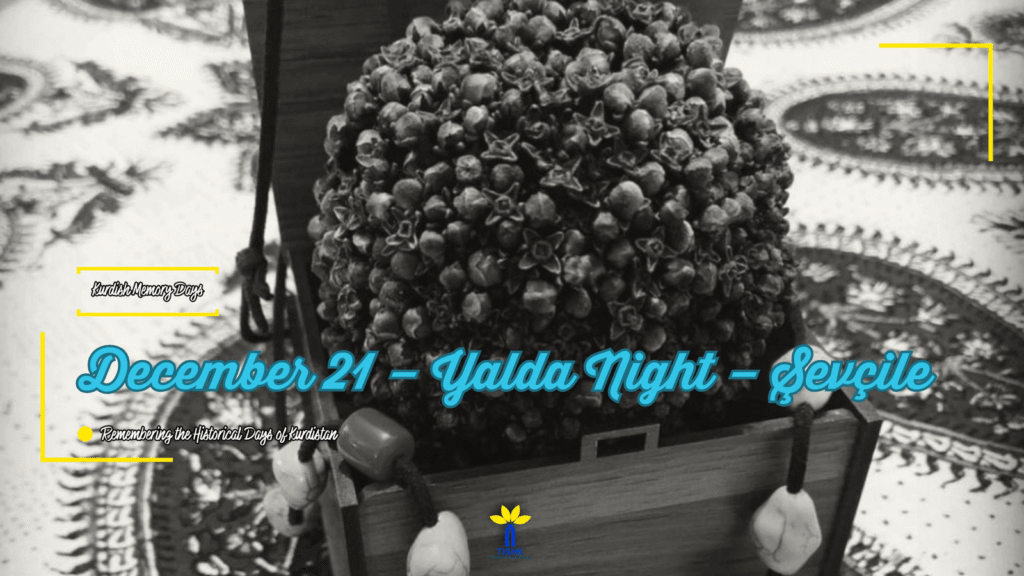
The Clove Apple (Sêwî Mêxekrêj) – Love, Peace, and Symbolism
A distinctive custom in Eastern Kurdistan is the clove-covered apple, known as Sewî Mêxekrêj. Families and friends prepare apples by inserting individual cloves into the fruit. This practice serves multiple purposes:
- Symbol of Love – Lovers exchange clove apples when words are insufficient to express their feelings.
- Sign of Reconciliation – In times of conflict or separation, the apple can act as a bridge for forgiveness and closeness.
After the cloves are inserted, the apple dries over several weeks but remains preservable for years. The clove apple thus becomes a tangible carrier of emotion, passed down through generations. It connects love, peace, and hope with the community and remains a visible symbol of Kurdish folk culture.
Concluding Remarks
Within the framework of Kurdish Memory Days, Yalda Night represents a remembrance that extends far beyond folklore. It embodies the historical depth of Kurdish culture, the resistance against forgetting, and the intimate relationship between nature, knowledge, and collective identity. 21 December reminds us that even in the longest night, light is never lost but reborn.