
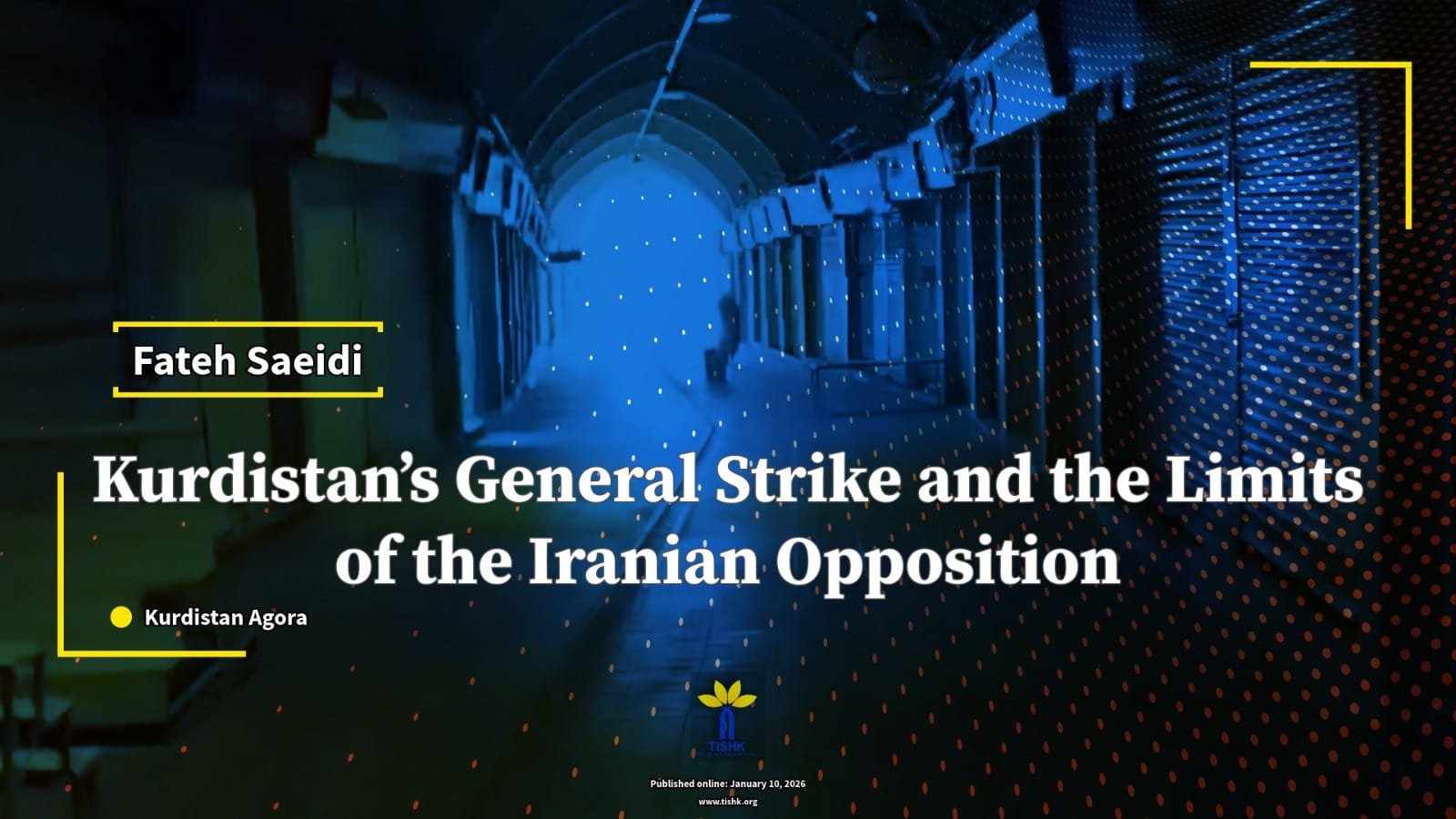
Fateh Saeidi
Published online by TISHK Center for Kurdistan Studies: 10.01.2026
Summary
This article examines the January 8 general strike in Kurdistan as a collective response to state violence during the latest wave of protests in Iran. It argues that the strike reflects a long-standing Kurdish political tradition rooted in organized party structures, national consciousness, and claims to sovereignty. The analysis highlights the limits of the broader Iranian opposition, particularly monarchist currents, which lack commitments to pluralism, decentralization, and national rights. In contrast, Kurdish mobilization operates through established party networks and an anti-colonial framework that challenges deeper structures of domination. The strike ultimately underscores Kurdish insistence on self-determination beyond a mere change of rulers in Tehran.

On Thursday, January 8, a general strike took place in more than fifty towns and cities across Kurdistan, following a call by Kurdish opposition parties in Iran. The strike was organized in response to the violent suppression of protests in western Iran, particularly in Ilam and parts of Kermanshah and Lorestan, where security forces used live ammunition against demonstrators. Despite its scale and coordination, the strike received little attention in Western media, which tends to focus on short-term unrest rather than sustained political mobilization. Yet this strike was not an isolated event. It reflected a long-standing Kurdish political struggle grounded in cultural resistance, national identity, and demands for sovereignty.
The current wave of protests in Iran is now entering its third week and represents a sustained rejection of a regime that has imposed decades of suffering on the peoples of Iran. Demonstrators demand rights, dignity, freedom, and an end to systematic denial, discrimination, and violence. Kurdish society, with a long record of resistance, once again stands at the forefront of these demands.
Kurdistan’s role in Iranian politics cannot be understood only through recent events. For nearly half a century, Kurdish regions have been among the most consistent centers of opposition to the Islamic Republic. Even before 1979, Kurdish movements challenged the centralized and authoritarian structure of the Pahlavi monarchy. After the revolution, Kurdish demands for autonomy, cultural rights, and political recognition were met with military campaigns, executions, and long-term securitization. This historical experience explains why Kurdish opposition is not limited to rejecting a particular regime, but targets the deeper structures of domination that have governed the Kurdistan–Iran relationship.
The general strike in Kurdistan was called directly in response to the state violence. Its immediate goal was to express solidarity with protesters in Malekshahi and Abdanan (Ilam) and to condemn the killings, arrests, and threats of execution. However, the political meaning of the strike went far beyond this immediate context. Kurdish society has repeatedly used general strikes over recent decades as a collective political instrument, whether in response to executions, mass arrests, or nationwide protest waves. The strike therefore followed a well-established Kurdish political tradition.
The strike also carried a clear message of unity. Seven Kurdish political parties, despite their ideological differences, jointly supported the action. This unity demonstrated that Kurdish national rights function as a shared political foundation, even amid internal diversity. It also reinforced a principle that has become increasingly important in recent years: repression in one part of Kurdistan is treated as a collective issue, prompting solidarity across the region. This dynamic has contributed to a deeper national awareness stretching from Maku in the north to Ilam in the south.
At the same time, the strike highlighted why Kurdish political movements cannot simply merge into the broader Iranian opposition, particularly monarchist currents outside Iran. In recent years, the name of Reza Pahlavi has gained visibility among parts of the diaspora and, to a limited extent, among protesters inside Iran. Yet he has never presented a concrete political program for a pluralist and multi-party Iran. His discourse remains general and future-oriented, postponing fundamental questions of power-sharing, decentralization, and national rights.
In practice, both Reza Pahlavi and monarchist groups aligned with him have repeatedly shown intolerance toward dissent and little willingness to recognize political pluralism or the rights of non-Persian nations. This became especially clear during the aftermath of the Jina/Mahsa Amini, known as “Woman, Life, Freedom,” uprising. In March 2023, a document known as the “Solidarity and Organization Charter for the Freedom of Iran” was signed at Georgetown University by Pahlavi and several political and media figures. Initially presented as a unifying framework, the charter quickly collapsed. Its critics accused Pahlavi of unilateral decision-making and hostility toward criticism. By May 2023, the charter had effectively ceased to exist after Pahlavi withdrew from it, and other signatories refused to continue legitimizing his leadership.
A deeper problem underlying this failure is the absence of a genuine tradition of party politics within the broader Iranian opposition. Under the Pahlavi monarchy, the political system lacked a real party structure, and independent multi-party activity was effectively prohibited. Political participation was organized from above, and opposition parties were excluded from public life. Under the Islamic Republic, the situation has not fundamentally changed. The regime formally accepts only Islamic ideology and has allowed the creation of nominal parties that function primarily to legitimize its theocratic authority. These organizations lack independent structures, operate within strict ideological boundaries, and do not represent genuine political competition. Most importantly, the very concept of opposition parties is excluded from the political system.
Kurdistan presents a fundamentally different political experience. Kurdish political parties emerged as mass actors in Eastern Kurdistan during the revolutionary period of 1978–1979, when they operated openly and developed deep social roots. After the consolidation of the Islamic Republic, these parties were forced to relocate their organizational centers to Southern Kurdistan in Iraq/KRG. This displacement, however, did not sever their relationship with Kurdish society. On the contrary, Kurdish parties continued to function as political reference points through sustained social, cultural, and organizational ties. Over time, a distinctive form of party-based politics took shape, in which political demands are articulated through parties that remain in continuous and dynamic interaction with civil society. This has normalized political plurality among the Kurdish public and made collective actions such as general strikes both intelligible and legitimate.
For Kurds, this episode confirmed a long-standing concern. Kurdish society cannot place its future in the hands of any individual or movement that fails to accept political plurality and national diversity. Kurds are not willing to participate in a process that risks reproducing another centralized and authoritarian system in Tehran, whether under a monarchist or republican banner. Kurdish political demands are not limited to regime change. They center on the recognition of Kurdish national identity and the right to self-determination within within a plurilingual and multicultural political framework.
Kurdish society itself is internally diverse. Eastern Kurdistan can broadly be divided into Sunni and Shiʿi regions. Sunni Kurds, particularly in northern areas, have historically been more deeply involved in organized resistance and have paid a high cost in their confrontation with both the monarchy and the Islamic Republic. Shiʿi Kurds, concentrated in provinces such as Kermanshah and Ilam, share similar experiences of economic marginalization and political exclusion, even though their religious affiliation differs.
During the protests of late December 2025 and early January 2026, Sunni Kurdish regions acted with greater caution, observing developments in major Iranian cities before fully mobilizing. In contrast, the violent suppression of protests in Ilam and Kermanshah led Kurdish parties to act decisively by declaring a general strike. This response underscored an important political reality. Kurdish movements do not passively follow events in Tehran or abroad. They act independently when Kurdish lives, rights, and dignity are directly threatened.
What distinguishes Kurdish political mobilization today is its explicitly anti-colonial character. Kurdish opposition challenges not only the Islamic Republic but also the historical structures that have denied Kurdish language, culture, and political agency. While much of the Iranian opposition imagines political change as a simple replacement of rulers at the center, Kurdish movements insist that pluralism, decentralization, and national recognition must form the basis of any future political order.
The general strike in Kurdistan was therefore more than a reaction to immediate repression. It was a declaration of political agency and national determination. At a moment when many observers focus on short-lived protests, the Kurdish strike reminds us that liberation struggles are long-term processes shaped by history, memory, and collective organization. For Kurds, the objective remains clear: genuine self-determination, political pluralism, and the sovereign recognition of Kurdish national identity, not merely a change of rulers in Tehran.
Other Research
There Is No Need for Kurds to Condemn a War Against the Islamic Republic
Exclusive interview with Mustafa Mauludi Interviewer: Shna Pasbar Published online by TISHK Center for Kurdistan Studies, Kurdistan Agora: Bonn, Germany: 2026 Interview In an exclusive interview with [...]
Why the PDKI Must Immediately Sever Ties with the Iran Freedom Congress
Sharif Behruz Why the PDKI Must Immediately Sever Ties with the Iran Freedom Congress Published online by TISHK Center for Kurdistan Studies: Bonn, Germany: 2026 Summary The [...]
Broken and Suspended
Shahin Modarres Broken and Suspended Iranian Political Society Between the State's Atrocities, External Destruction, and the Bankruptcy of Opposition Published online by TISHK Center for Kurdistan Studies: Bonn, Germany: 2026 [...]