22 January – The Republic of Kurdistan and the Political Memory of Kurdish Statehood
22 January 1946 marks one of the most significant turning points in the modern political memory of the Kurdish people: the proclamation of the Republic of Kurdistan in Mahabad. Even though it existed for only eleven months, the Republic has retained a central place in collective remembrance. It is widely regarded as the first modern attempt to realize Kurdish political self-determination in the form of an institutionalized state, with its own political bodies, symbols, and security structures.
Within the framework of the Kurdish Memory Days, the Republic of Kurdistan represents not merely a historical event, but a paradigmatic moment in which political vision, national mobilization, and international power constellations converged.
Historical Context and Political Preconditions
The founding of the Republic of Kurdistan took place within an exceptional geopolitical context. After the Second World War, Iran entered a phase of weakened state sovereignty, particularly in its northern regions, which for a period fell under Soviet influence. This constellation created political room for maneuver for marginalized national movements, among them the Kurds.
Against this background, the clandestine organization Komeley Jiyanewey Kurd was founded in Mahabad in the autumn of 1942, an association of nationalist intellectuals pursuing the goal of a Kurdish nation-state. This organization formed the structural and ideological foundation for the later establishment of the Kurdistan Democratic Party (KDP) in July 1945. With the KDP, a decisive break occurred with clan-, tribal-, and region-based forms of organization in favor of an all-Kurdish, national-democratic project. Kurdish identity thus became, for the first time, the central reference point of political programmatic thinking.
Proclamation of the Republic and Institutional Order
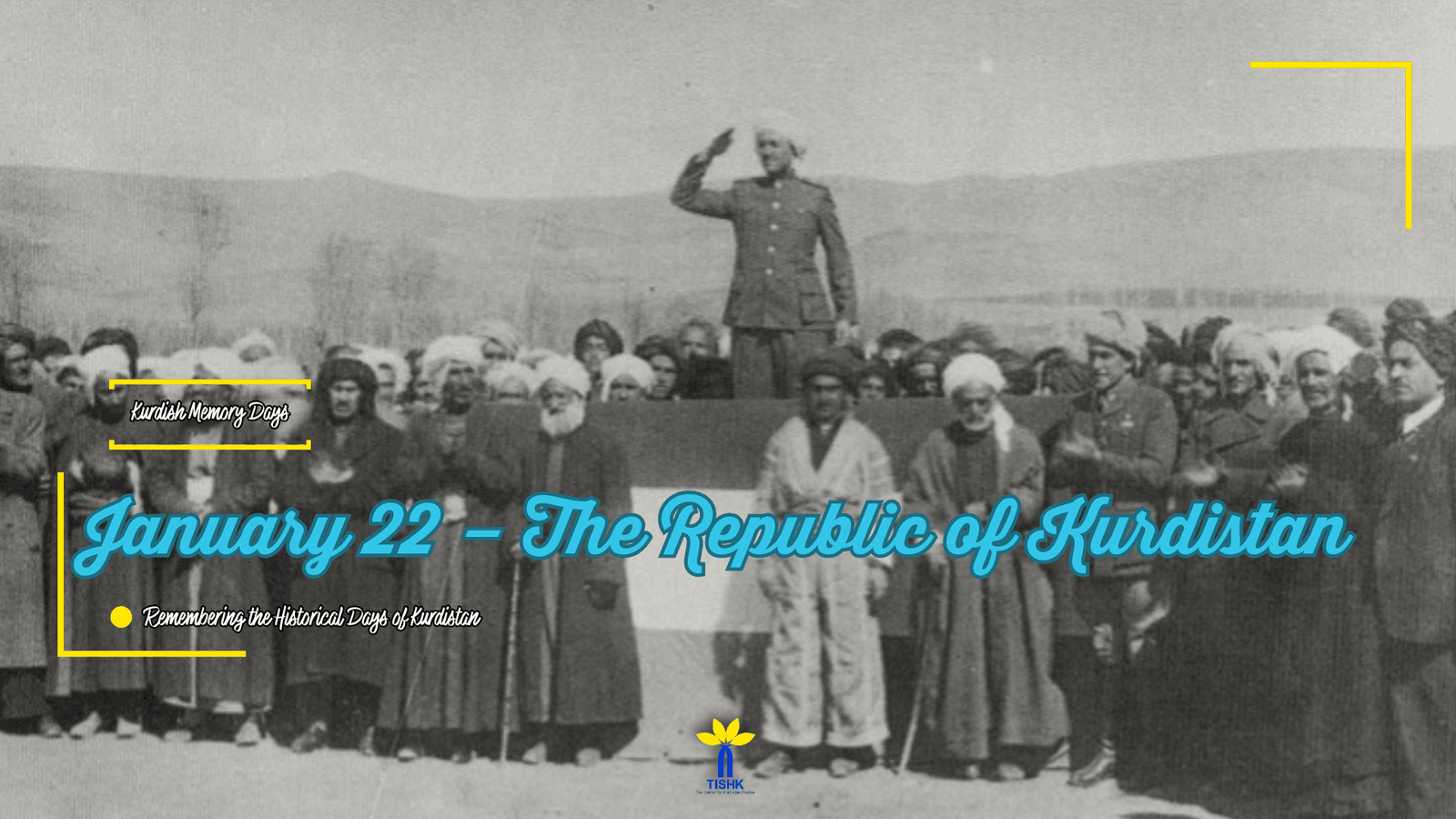
On 22 January 1946, Qazi Muhammad proclaimed the Republic of Kurdistan on Çiwar-Çira Square in Mahabad. In his declaration, he defined the Kurds as a distinct people with their own history, language, and culture, and committed himself to building an independent political polity. The Republic did not present itself as a threat to other nations, but as an expression of the legitimate right to national self-administration, democratic participation, and peaceful coexistence.
Within a short period, key state structures emerged: a parliament, a government, an administration operating in Kurdish, an education system, press organs, and cultural institutions. Kurdish was declared the official and educational language; compulsory schooling was introduced; and teaching materials were produced in Kurdish for the first time. Radio Kurdistan began broadcasting, printing houses and theaters were founded, and women’s and youth organizations were established. Girls’ schools were opened—an expression of a remarkably progressive understanding of social participation.
Particular importance was attributed to the role of the Peshmerga, who functioned as the protective force of the Republic. Their task was not limited to military defense, but also included safeguarding political order and social stability. In this way, an early connection was forged between political sovereignty and collective self-defense, a motif deeply embedded in Kurdish political memory.
The Failure of the Republic and Its Consequences
Despite its political ambitions, the Republic of Kurdistan was structurally fragile. The withdrawal of Soviet support, international pressure, and the military intervention of the Iranian state led to the dissolution of the Republic in December 1946. The execution of Qazi Muhammad in March 1947 marked the violent end of this first modern Kurdish state project.
In historical retrospect, however, the Republic’s failure is not understood as a definitive defeat. Rather, Mahabad transformed into a central site of memory; a symbol of both the possibility and the vulnerability of Kurdish statehood. The experience of political autonomy, as brief as it was, became identity-forming and mobilizing for subsequent generations.
The Republic of Kurdistan in Collective Memory
In Kurdish memory discourse, the Republic of Kurdistan occupies a dual role: it stands, on the one hand, for hope, institutional experience, and political maturity; on the other hand, for betrayal, international indifference, and the limits of external alliances. This ambivalence continues to shape Kurdish political strategies and self-understandings to this day.
Mahabad thus serves as a historical point of reference where questions of sovereignty, legitimacy, and resistance are repeatedly renegotiated. The Republic is less a closed chapter than an enduring space of remembrance in which past and present remain intertwined.
Concluding Remark
In the context of the Kurdish Memory Days, the Republic of Kurdistan represents the historical anchoring of Kurdish statehood in the twentieth century. It reminds us that political self-determination is not only a future vision, but was once a lived reality, albeit under precarious conditions. Commemorating Mahabad is at the same time a critical reflection on power, memory, and the conditions of political existence.
The Republic of Kurdistan therefore remains a central reference point for the Kurdish people’s ongoing pursuit of dignity, self-determination, and historical recognition.