
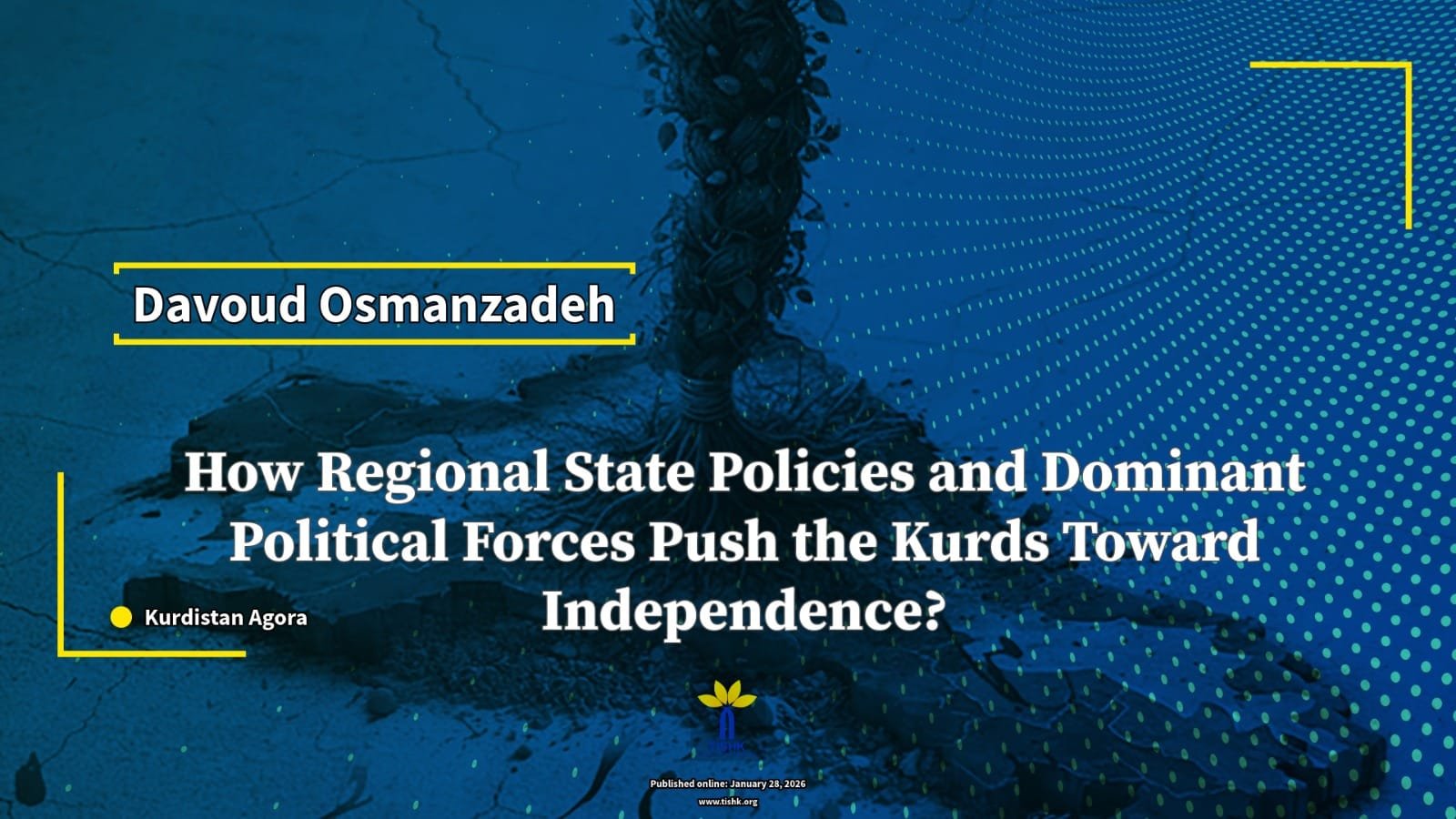
Davoud Osmanzadeh
PhD candidate in Sociology and social Anthropology at CEU
Published online by TISHK Center for Kurdistan Studies: Bonn, Germany: 28 January 2026
The Point
As a result, a shift is underway. More Kurds are beginning to argue that the pursuit of peaceful coexistence within current political borders is a dead end. If every form of self-rule is blocked, independence appears less like an extreme option and more like the only remaining one. Kurdish sovereignty over Kurdistan is increasingly proposed as a practical necessity.

How Regional State Policies and Dominant Political Forces Push the Kurds Toward Independence?
For decades, Kurdish politics in the Middle East has been shaped by a difficult question: can Kurds secure their collective rights through coexistence within existing states, or does justice ultimately require an independent Kurdish state? Recent events in northern Syria have brought this question back to the center of public debate.
The attack by Syrian government forces on the Kurdish-led Syrian Democratic Forces and on Rojava triggered a wave of reactions among Kurds across the region. In these reactions, a striking question repeatedly appeared: is there any real alternative between democratic coexistence and statehood? Or, after a century of repression, has coexistence reached its limits?
This debate has also revived criticism of the idea often described as the “brotherhood of peoples”, a political approach associated with the Kurdistan Workers’ Party and some other Kurdish movements. This approach emphasizes coexistence within existing states and openly rejects the goal of an independent Kurdish state. While it presents itself as a progressive alternative to nationalism, many Kurdish activists and intellectuals now question whether this strategy has delivered anything other than continued vulnerability.
The experience of Rojava is central to this reassessment. When Kurdish forces established an autonomous administration in northern Syria during the civil war, they did not declare independence. They explicitly framed their project as decentralized self-rule within Syria. Yet this did not prevent repeated military attacks, particularly by Turkey. These attacks did not only target armed forces but also civilian infrastructure, towns, and livelihoods. Turkish officials made it clear, time and again, that even limited Kurdish autonomy was unacceptable.
This pattern is not unique to Syria. Across the region, resistance to Kurdish self-rule has come not only from states but also from dominant political forces that are secular and religious, left and right, and located in both government and opposition, within the ruling ethnic groups of countries such as Turkey, Iran, Iraq, and Syria, where autonomy, federalism, and power sharing remain broadly rejected. The message has been consistent: Kurds may exist as individuals, but not as a political community with collective rights.
Over the past century, regional states have used every available tool to enforce this position. Education systems, media, security forces, demographic engineering, environmental destruction, mass imprisonment, and even chemical weapons have all been deployed against Kurdish society. While borders were redrawn and resources extracted, Kurdish demands did not disappear. Despite enormous costs, the Kurdish question remains unresolved.
In response, Kurdish political movements have repeatedly moderated their demands. Especially since the late twentieth century, most dominant Kurdish parties shifted away from independence and toward proposals such as autonomy, federalism, or democratic decentralization. They argued that they were not seeking to dismantle states but to democratize them. Power-sharing, cultural recognition, and local self-government were presented as reasonable and realistic solutions.
Yet these demands were still met with repression. Even when Kurdish movements framed their claims in the language of democracy and coexistence, they were treated as existential threats. This has produced a growing sense of exhaustion and disillusionment, especially among younger generations. Many now doubt that existing states can ever be reformed in a way that genuinely accommodates Kurdish collective rights.
This growing skepticism has intensified in recent years. The repeated attacks on Rojava have reinforced a conclusion: if autonomy within existing states is treated as unacceptable, then coexistence itself becomes meaningless. From this perspective, Kurdish demands do not constitute a problem; the crisis is produced by states and political forces that categorically refuse to recognize Kurdish collective rights or engage in any meaningful form of power sharing.
As a result, a shift is underway. More Kurds are beginning to argue that the pursuit of peaceful coexistence within current political borders is a dead end. If every form of self-rule is blocked, independence appears less like an extreme option and more like the only remaining one. Kurdish sovereignty over Kurdistan is increasingly proposed as a practical necessity.
Until the early twentieth century, much of the world was ruled by a small number of empires. Few believed those empires would dissolve into dozens of nation-states, yet they did. Political borders that once appeared permanent proved surprisingly fragile under pressure from social movements, wars, and changing global norms.
Regional states may insist that a Kurdish state is impossible. But movements are not shaped by what states consider acceptable; they are shaped by lived experience. When denial and repression persist, they often radicalize political horizons rather than suppress them. The longer Kurdish collective rights are rejected, the more independence becomes imaginable, and eventually unavoidable.
The Kurdish people have the right to challenge their subordinate position and to claim full and equal participation in all dimensions of social, political, economic, and cultural life. If this cannot be achieved within existing states, the idea of voluntary and peaceful coexistence will lose its meaning. As the Kurdish leader Abdul Rahman Ghassemlou once said, his generation demanded autonomy, but future generations might demand independence.
That future may already be arriving; not because Kurds rejected coexistence, but because regional policies steadily closed every other path.
Other Research
There Is No Need for Kurds to Condemn a War Against the Islamic Republic
Exclusive interview with Mustafa Mauludi Interviewer: Shna Pasbar Published online by TISHK Center for Kurdistan Studies, Kurdistan Agora: Bonn, Germany: 2026 Interview In an exclusive interview with [...]
Why the PDKI Must Immediately Sever Ties with the Iran Freedom Congress
Sharif Behruz Why the PDKI Must Immediately Sever Ties with the Iran Freedom Congress Published online by TISHK Center for Kurdistan Studies: Bonn, Germany: 2026 Summary The [...]
Broken and Suspended
Shahin Modarres Broken and Suspended Iranian Political Society Between the State's Atrocities, External Destruction, and the Bankruptcy of Opposition Published online by TISHK Center for Kurdistan Studies: Bonn, Germany: 2026 [...]