
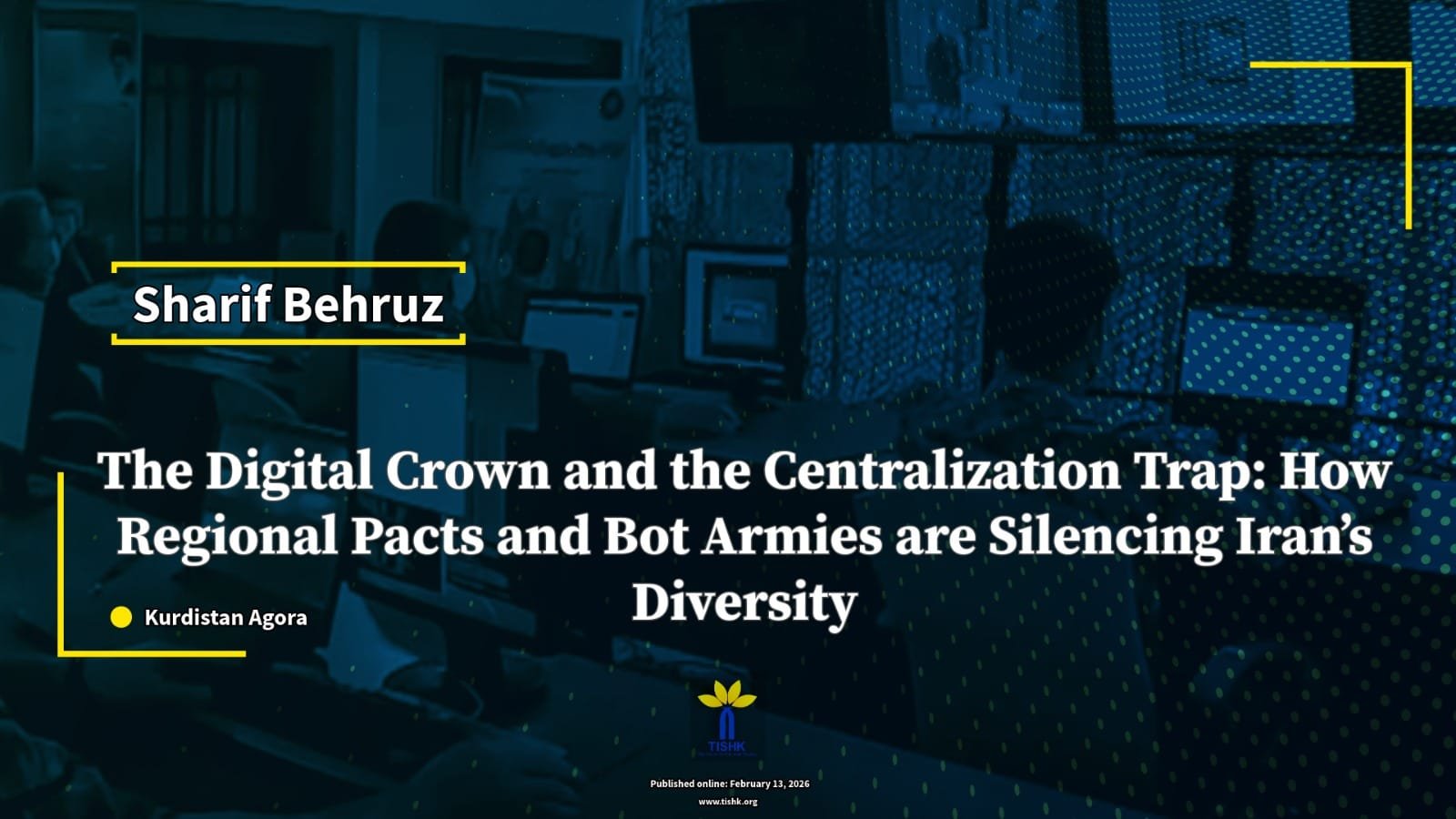
Sharif Behruz
Strategic Policy Analyst.
Published online by TISHK Center for Kurdistan Studies: Bonn, Germany: 13 February 2026
The Point
By flooding digital spaces with rigid “Pahlavi or Chaos” narratives, the regime’s cyber army reinforces the monarchist camp’s own efforts to monopolize the opposition. This is not a sign of regime support for Pahlavi; it is a calculated effort to use him as a wedge. By elevating the most exclusionary version of the monarchy ‒ one that demands absolute loyalty to a single flag and leader ‒ the regime successfully alienates ethnic minorities like the Azeri Turks, Kurds, Arabs, Turkmens and Baluch. The goal is clear: to convince the Iranian people and the international community that the only alternative to the current theocracy is a return to a centralized autocracy of the past, thereby killing the hope for a pluralistic, federal democracy.

The Digital Crown and the Centralization Trap: How Regional Pacts and Bot Armies are Silencing Iran’s Diversity
The Islamic Republic’s survival has long depended on one of the many cynical tactics: divide and conquer. Today, that strategy has moved into the digital realm. As a February 2026 report by the Washington Free Beacon reveals ‒ citing experts like Richard Goldberg ‒ the regime has deployed a sophisticated “bot army” to conduct digital assassinations of its critics. According to the report, “The Iranian regime is waging an online disinformation campaign against the Trump administration’s most senior-ranking Persian-American official, Mora Namdar, painting her as a pro-regime stooge and opponent of the dissident movement.” The investigation further notes that “The operation is meant to sow discord within the State Department and the Iranian dissident community at a time when the hardline regime is fighting to stay in power.”
These attacks are carried out through the mass creation of fraudulent profiles on X and Telegram that use AI-generated imagery to blend in with genuine opposition groups. In a particularly deceptive move, these state-run bots paint Namdar—who is not Kurdish—as a radical Kurdish activist. The goal is calculated: by manufacturing this ethnic identity, the regime seeks to discredit officials like Namdar and Ortagus among Persians, who in turn can be manipulated to put public pressure on the administration to distance itself from them. Simultaneously, because Namdar does not belong to the monarchist ranks, she is paradoxically accused of being “pro-regime”—a classic “pincer” maneuver designed to leave no middle ground for independent voices.
This mirrors a campaign orchestrated by monarchists to oust Ali Javanmardi, a prominent Iranian Kurdish media activist and now a senior media advisor within the US Agency for Global Media. By smearing these figures as “separatists” or “regime agents,” both the regime and monarchist hardliners work in tandem to purge diverse voices from the halls of power.
This raises a critical question: How many of these so-called monarchist members are actually regime agents? These accounts weaponize the “separatist” label to attack non-Persian figures and those they falsely claim are affiliated with ethnic minorities. By manufacturing these identities, the regime effectively uses the mask of the monarchy to destroy the credibility of those advocating for an inclusive transition.
Regional Agendas and the Erosion of Iranian Pluralism
However, the manipulation is not one-sided. Claims have emerged from investigations by outlets like Haaretz that state actors in Israel have provided their own bot armies to artificially inflate Pahlavi’s popularity. While Israel’s motives for supporting a monarchic return remain opaque, its strategic calculus is clear: any regime change that removes the current existential threat is a victory. For Israel, a return to the “Periphery Doctrine” of the Shah’s era is the ideal outcome, prioritizing regional realignment regardless of how representative or democratic the new Iranian regime actually is.
Similarly, Saudi Arabia’s preference for a kingdom in Iran stems from its own governing structure; as an absolute monarchy, it is fundamentally opposed to democratic movements that could inspire similar demands within its own borders. Riyadh’s influence is primarily exerted through the media landscape, where Saudi-funded outlets like Iran International have been accused of acting as a megaphone for Pahlavi, prioritizing his narrative over more diverse, grassroots voices.
This exclusionary vision even extends to the Saudi support for the new Syrian regime under Ahmed al-Sharaa, which has wildly suppressed Kurds and other minorities. This Saudi policy is part of a coordinated pact with Turkey; together, they have even lobbied heavily against any American attack on Iran. Turkey’s motivation is clear: to prevent any domestic shift that could grant the Kurds of Iran meaningful rights similar to their peers in Iraq‒a prospect Ankara views as an existential threat.
Turkey’s proactive stance is driven by the reality of Iran’s demographics: the Iranian Kurdish population is estimated to be around 15 million. Ankara understands that in a truly democratic Iran, a population of this size would wield significant political power and have a major say in the country’s future. To prevent such a shift ‒ which Turkey views as a catalyst for its own Kurdish population ‒ Ankara is working to ensure any transition in Iran remains centralized and exclusionary.
Consequently, the situation for Kurds in Iran remains starkly different from those in Syria. In Syria, the Kurdish leadership ‒ embodied by the SDF and the PYD ‒ frequently prioritized a specific ideological framework over broader Kurdish national interests. This ideological rigidity, often perceived as an extension of the PKK, led to a deep-seated lack of trust from the U.S. and regional powers, who ultimately viewed them as a temporary, tactical ally in the fight against ISIS rather than a long-term strategic partner. This miscalculation was laid bare in early 2026 with the partial collapse of Kurdish self-rule in Rojava and Washington’s pivot toward the new central government in Damascus.
In sharp contrast, the Kurdish movement in Iran operates as a strategic national force with a clear, pragmatic focus on Kurdish national interests and the democratization of the Iranian state. While the U.S. has often remained passive to accommodate strategic ties with Turkey ‒ which views the 15 million Kurds in Iran as a demographic threat to its own borders ‒ the sheer scale of the Iranian Kurdish movement, combined with its decades of struggle and extensive international outreach, means that major global powers will eventually be forced to come to terms with this rising political reality.
The Digital Pincer: How Regime Bots Fuel Monarchist Monopolization
This geopolitical passivity is further complicated by a deceptive digital synergy. While the Iranian regime officially labels Reza Pahlavi a “Zionist puppet,” its cyber apparatus ‒ orchestrated by the Basij Cyberspace Organization and units like MATNA ‒ frequently pivots to a more subtle strategy: the “Decoy Defense.” Recent investigations into the January 2026 protests have uncovered a startling pattern where regime-linked bot swarms, operating through privileged “White SIM” cards, pivot from attacking protesters to aggressively amplifying monarchist slogans.
By flooding digital spaces with rigid “Pahlavi or Chaos” narratives, the regime’s cyber army reinforces the monarchist camp’s own efforts to monopolize the opposition. This is not a sign of regime support for Pahlavi; it is a calculated effort to use him as a wedge. By elevating the most exclusionary version of the monarchy ‒ one that demands absolute loyalty to a single flag and leader ‒ the regime successfully alienates ethnic minorities like the Azeri Turks, Kurds, Arabs, Turkmens and Baluch. The goal is clear: to convince the Iranian people and the international community that the only alternative to the current theocracy is a return to a centralized autocracy of the past, thereby killing the hope for a pluralistic, federal democracy.̶ ̶
This manufactured consensus has a toxic effect on the ground. During the late 2025 and early 2026 rallies, these digital “swarms” transitioned into physical intimidation. Protesters who carried symbols of ethnic identity or advocated for decentralized governance were swamped by coordinated online attacks ‒ often branding them “separatists” ‒ which then served as a pretext for their physical exclusion from diaspora marches in London, Berlin, and Washington.
Crucially, this polarization thrives primarily in the diaspora. Many ethnic Persians in exile, often naive about complex domestic political realities, become easy targets for simplistic nationalist narratives. Many are descendants of the previous regime who have lived in the West for decades, inheriting a rose-tinted nostalgia for the dark era of the Pahlavi Monarchy ‒ a rigid “One Nation, One Flag, One Language” ideology. In contrast, inside Iran, there is often a profound sense of unity among various ethnicities, and others facing the same daily oppression.
Many blame Pahlavi himself for this fragmentation, citing his transition plan as a testament to his divisive approach. Critics argue that his roadmap reinforces the very authoritarian structures it claims to replace. At an upcoming rally in Germany, organizers have sparked further outrage by calling for a “no separatist flag” policy in their banner. This isn’t just about flags; it’s a calculated attempt to frame Pahlavi as the sole savior of Iran’s territorial integrity while boosting support among Persians ‒ the primary beneficiaries of the status quo.
This pattern is a stark departure from the unity of the 2022 “Woman, Life, Freedom” uprising. That movement, emanating from Kurdistan, saw rare harmony when Pahlavi was not in the center. In early 2026, many have stayed away, alienated by monarchist monopolization. By forcing a binary choice between the current regime or a restoration ‒ an ultimatum reminiscent of 47 years ago ‒ Pahlavi and his backers are ensuring the opposition remains fractured, leaving the Iranian people caught between two versions of the same centralized authoritarianism.
The regime is acutely aware that when Iranians abroad speak with one voice ‒ transcending ethnic and ideological lines ‒ the call for regime change in world capitals becomes an existential threat to Tehran. To prevent this, their digital strategy is not just about suppression, but about controlled radicalization. By using bot swarms to amplify the most exclusionary and aggressive elements of the Pahlavi camp, the regime’s cyber-operatives intentionally polarize the political climate. When the monarchist movement is pushed toward a rigid, “zero-sum” nationalism that alienates non-Persians, and secular democrats, it serves the Islamic Republic’s long-term survival. This creates a “scarecrow” effect: it signals to both the ethnic minorities inside Iran and the international community that the only alternative to the current theocracy is a return to a vengeful, centralized autocracy. Consequently, while these digital campaigns might seem to provide a platform for Pahlavi, they are actually designed to fracture the opposition so thoroughly that a unified, internationally recognized alternative can never take root.
The Blood and Betrayal of a Century: The Price of the Nation-State
In a system where centralization is at its highest, the Persian majority has long held a disproportionate share of power. Both the current regime and the monarchists benefit from this, framing any demand for regional autonomy as a threat. This strategy systematically marginalizes the Kurds, who have been the vanguard against this oppressive machinery since 1923.
Indeed, the Kurds have paid a staggering price under this Persian-centric nation-state. The history of the Pahlavi dynasty is marked by the systematic elimination of Kurdish leaders who sought to bridge the gap between their people and the capital. In 1930, the legendary Kurdish national leader Simko Shikak was lured into an ambush in Oshnavieh and assassinated under the order of Reza Shah Pahlavi. Seventeen years later, in 1947, the visionary Qazi Muhammad ‒ the President of the short-lived Republic of Kurdistan ‒ was hanged in the heart of his capital by the government of Mohammad Reza Shah, despite his efforts to avoid bloodshed through negotiation.
This legacy of betrayal did not end with the monarchy. Under the 47 years of the Islamic Republic, the battle for Kurdish rights has only grown more lethal, as the regime has transitioned from domestic execution to transnational state terrorism. The Kurds have lost their most brilliant intellectual and political lights to the regime’s global hit squads. In 1989, Dr. Abdul Rahman Ghassemlou, the Secretary-General of the PDKI, was assassinated in Vienna while sitting at the negotiation table with Iranian envoys ‒ a ultimate betrayal of diplomatic trust. Only three years later, his successor, Dr. Sadegh Sharafkandi, was gunned down in a mafia-style attack at the Mykonos restaurant in Berlin.
Despite these relentless cycles of state-sponsored murder and the loss of such transformative leaders, the battle for Kurdish identity continues with unwavering resolve. Kurdish political forces have shown remarkable historical restraint, consistently keeping their demands within the framework of a unified Iran. Rather than seeking an immediate exit, they have campaigned for a federal, pluralistic state that acknowledges their identity. However, as the regime’s digital bot armies continue to smear these figures as “separatists” to justify further crackdowns, they are testing the limits of this 100-year patience.
Furthermore, Persians must remember that this historical restraint is not a blank check. As long as more than half the population remains denied basic rights, the country will never see the light of democracy. You cannot expect freedom for one group while denying it to the rest. Kurdish local forces will fight tooth and nail for their rightful rights within Iran if possible; but their patience with Tehran is not infinite. If the window for a federal, inclusive Iran closes, they will be forced to look for alternatives beyond the artificial borders drawn after WWI that originally divided their lands.
Other Research
There Is No Need for Kurds to Condemn a War Against the Islamic Republic
Exclusive interview with Mustafa Mauludi Interviewer: Shna Pasbar Published online by TISHK Center for Kurdistan Studies, Kurdistan Agora: Bonn, Germany: 2026 Interview In an exclusive interview with [...]
Why the PDKI Must Immediately Sever Ties with the Iran Freedom Congress
Sharif Behruz Why the PDKI Must Immediately Sever Ties with the Iran Freedom Congress Published online by TISHK Center for Kurdistan Studies: Bonn, Germany: 2026 Summary The [...]
Broken and Suspended
Shahin Modarres Broken and Suspended Iranian Political Society Between the State's Atrocities, External Destruction, and the Bankruptcy of Opposition Published online by TISHK Center for Kurdistan Studies: Bonn, Germany: 2026 [...]