A Brief Derridean Reading of “A Cautionary Manifesto by Iranian Cultural Figures” That Opposes Kurdish Newroz.
Published online by TISHK Center for Kurdistan Studies.
The Point
Since April 9, 2025, more than 900 Iranian intellectuals, artists, and cultural figures have been signing a manifesto condemning the public celebration of Kurdish Newroz—an ancient spring festival widely celebrated in Kurdistan — as a threat to Iran’s “territorial integrity.” Written in the language of nationalist rhetoric, the document questions why the Iranian regime allowed such festivities to take place.

A Brief Derridean Reading of “A Cautionary Manifesto by Iranian Cultural Figures” That Opposes Kurdish Newroz[1]
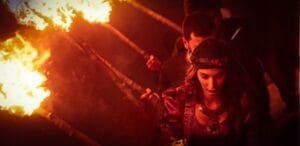 Kurdish celebrants carry flaming torches up Mount Helgurd near the town of Akre to honor Newroz, in a tradition rooted in ancient Kurdish mythology, Başûr ( Kurdistan in Iraq), March 20, 2025. Photo: Rudaw. |
Since April 9, 2025, more than 900 Iranian intellectuals, artists, and cultural figures have been signing a manifesto condemning the public celebration of Kurdish Newroz—an ancient spring festival widely celebrated in Kurdistan — as a threat to Iran’s “territorial integrity.” Written in the language of nationalist rhetoric, the document questions why the Iranian regime allowed such festivities to take place.
Although this manifesto opens by addressing “the historic and great nation of Iran” as “our noble Iranian compatriots,” it is implicitly directed at the authoritarian Iranian regime itself. In this manifesto, many Iranian academics, artists, and other cultural figures question why the Kurdish Newroz celebrations were allowed to proceed “without any reaction from the Iranian authorities.” The signatories of this text appear to be advocating punitive measures against the Kurdish participants, framing the event as a vehicle for “Kurdish separatist sentiment.” However, they must be aware that both the current Iranian regime and the earlier Pahlavi dynasty used the same pretext of “Kurdish separatism” to justify imprisoning, torturing, and executing Kurdish political and cultural figures. By employing this notorious accusation, the signatories of the manifesto provide the regime with yet another pretext to persecute individuals in Kurdistan.
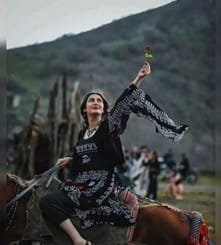
A Kurdish woman from Rojhelat (Kurdistan in Iran) raises a red rose — as a symbol of resistance — during Newroz celebrations in Merîwan, 2023. Photo: Erfan Salehi/Instagram.
To portray Iranian Nowruz as legitimate while framing Kurdish Newroz as illegitimate, this manifesto relies on a series of binary oppositions — civilized/tribal, national/ethnic, among others — that elevate one identity while subordinating the other. Jacques Derrida, the French philosopher, developed the approach of deconstruction to analyze such oppositions, arguing that they are not natural or fixed but constructed and open to reinterpretation. Such oppositions, from this perspective, do not simply describe the world; they shape it. The following offers a brief reading of the Persian manifesto’s six paragraphs through a deconstructive lens:
Kurdish Newroz / Iranian Nowruz
The first paragraph of the manifesto critiques the Iranian regime’s “mismanagement,” claiming that it allowed the “grand national Iranian celebration” of Nowruz to be reduced to an “ethnic Kurdish event” in Kurdistan. It establishes a clear binary between Kurdish Newroz and Iranian Nowruz, portraying the former as a “minor, ethnic, tribal, and local” ritual linked to “Kurdish separatism,” while presenting the latter as a “proud celebration of Iranians.” The text also exposes a deeper paradox. Iranian nationalism consistently frames Kurdistan as an inseparable part of the Iranian nation and cannot define itself without claiming the region as essential to its identity. At the same time, it relies on a kind of logic that seeks to erase cross-border cultural ties between Kurds in Iran and those in Iraq, Turkey, and Syria—connections evident in shared practices such as Kurdish Newroz, which Iranian nationalism interprets as evidence of separatism. This contradiction highlights the fragile foundation of Iran’s imagined national unity. Here, the “difference” represented by the Kurdish language, rituals, and transnational cultural connections must be subordinated to the narrative of Iranian national cohesion. When these differences appear to challenge that cohesion, they reveal that the proclaimed “unity” is not natural but a constructed fiction maintained by Iranian nationalist discourse.
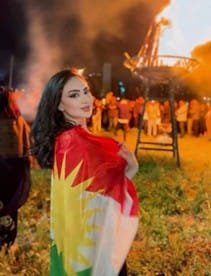
Draped in the Kurdish flag, a young Kurdish woman stands before the Newroz fire in Basur (Kurdistan in Iraq). Photo: Instagram/SA
Owner / Borrower
The second paragraph asserts that “Iran is the birthplace of Nowruz,” implicitly framing the celebration as an “exclusively Iranian” tradition. However, Nowruz is not uniquely Iranian; it is an international celebration with deep historical roots that predate the formation of the Iranian nation-state, and it belongs to multiple cultures and peoples who have long celebrated it across the region. This controversial statement sets up a binary of “owner” versus “borrower,” portraying Iranian culture as the rightful custodian of the tradition. From this position of self-declared ownership, the manifesto criticizes Turkish President Erdogan’s attempt to declare Newroz a national celebration for his “imaginary Turkish world.”
Yet the paradox is striking: the Iranian nationalism that declares Nowruz exclusively Iranian — and also claims that “wherever Kurds live, it is Iran”— fails to account for the approximately 20 million Kurds who live in Bakȗr, the northern region of Kurdistan in Turkey.
National / Ethnic
After addressing Newroz, the manifesto in paragraphs three, four, and five digresses into linguistic politics, among other topics, portraying Persian as a “national, noble, and civilizational” language while reducing Kurdish to a “tribal, ethnic, and divisive” tongue.
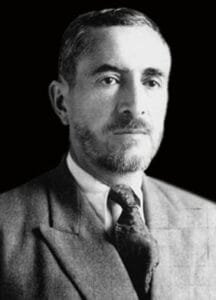
Qazi Muhammad, founding president of the Republic of Mahabad in 1946, remains a central figure in Kurdish collective memory-especially in Eastern Kurdistan (Rojhelat)-as a symbol of sovereignty and resistance. Photo: Creative Commons/wikimedia
The signatories then criticize the regime for employing what they deem “ethnic terminology” in recent official speeches — terms such as “ethnic rights” and “minority rights”— rather than using ostensibly “neutral” phrases like “Iranian citizens’ rights.” This statement is both misleading and historically disingenuous: Kurdish identity has never received official recognition in Iran. What exists today is the result of persistent Kurdish resistance against state-imposed nationalisms —Iranian, Arab, and Turkish — that have systematically suppressed Kurdish rights. In Iran, Persian supremacy justifies this exclusion under the pretext of “national unity,” at the expense of non-Persian identities.
This reveals a contradiction between its rhetoric of “inclusivity” and its discriminatory and punitive practices. The manifesto claims that using non-Persian “unofficial” ethnic languages reduces “grand” national programs to mere “ethnic” events, while ignoring the fact that Kurds in Rojhelat, the eastern region of Kurdistan in Iran, have never had the opportunity to make their own language official — except briefly during the Republic of Kurdistan under Qazi Mohammad, which ended with his execution and the military occupation of the republic by the Iranian regime during the Pahlavi era. The manifesto once again reveals the core contradiction of Iranian nationalism: it demands “unity” by erasing Kurdish identity — even as it simultaneously acknowledges that identity as part of the Iranian nation.
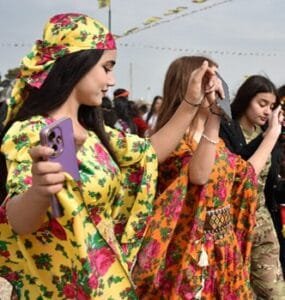
In Rojava (Kurdistan in Syria), Kurds celebrate Newroz 2024, dancing in traditional dress. Group dancing, music, and fire are central elements of the Kurdish Newroz tradition. Photo: ANF/Firat News Agency
Core Issue / Peripheral Issue
The last paragraph of the manifesto frames discussions of “federalism,” “ethnic issues,” and support for “ethno-nationalist figures” as “peripheral distractions” from Iran’s so-called “core challenges.” This binary — core versus peripheral — functions to marginalize Kurdish political and cultural concerns by portraying them as secondary or even obstructive. In doing so, the manifesto disregards the harsh reality that many Kurds have been imprisoned, tortured, and executed under such vague accusations linked to the very issues it deems peripheral.
As demonstrated throughout the text, the manifesto’s central argument rests on the belief that decentralizing Persian culture threatens Iran’s unity. To support this claim, the authors rely on the binary oppositions previously discussed. As Derrida argues, such oppositions “do not reflect a natural order,” but rather a construction — one that, in this case, is shaped and sustained by Iranian nationalism. Within this framework, the figure of the “Iranian citizen” emerges as the privileged, self-evident identity, while Kurdish “ethnicity” is relegated to the margins, framed as peripheral and problematic — tolerated only as a threat, a dangerous psychological deviation capable of disrupting the central logos.
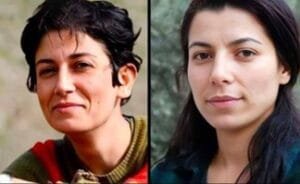
Kurdish activists Pexşan Ezîzî and Vrîşe Muradî from Rojhelat (Kurdistan in Iran) have been sentenced to death by the Iranian regime. Though still alive, they remain at imminent risk of execution, drawing national and international condemnation. Photo: X
Yet, if Kurdish identity is truly as “inferior” and “tribal” as the manifesto claims, how can it simultaneously possess the disruptive power to challenge the “noble Persian ideal” at its sovereign center? Perhaps what they call “Iran” is not a unified historical entity but an imagined totality — precarious, imposed, sustained through suppression, and ultimately dependent on the very elements it seeks to annihilate. Derrida’s insight is decisive here: no ideological system — no matter how meticulously constructed — can achieve absolute self-sufficiency. Every system depends on elements that cannot be fully systematized yet are essential to its existence.
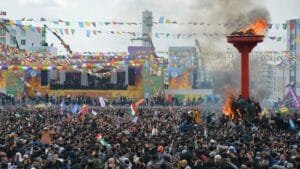
Hundreds of people gathered in Amed, Bakûr (Kurdistan in Turkey), in 2022 to celebrate Newroz. They waved flags of Kurdish political parties and the Kurdish national flag. In Turkey and Iran, publicly displaying the Kurdistan flag can carry serious risks. Photo: ANF/Firat.
For Iranian nationalism, Kurdishness represents the very non-systematized element that can neither be fully incorporated — because it resists assimilation — nor excluded, because the system’s totality depends upon it. And contrary to the assumptions of Iranian nationalism, Kurds across Turkey, Iran, Syria, and Iraq — singing the same songs, dancing the same dances, celebrating the same Newroz, and waving the same Kurdish flag — are not advocating separatism, but expressing a form of Kurdish unionism from their land, Kurdistan, which is already divided and separated.
Robin Fakhari holds an MA degree in American Studies from the University of Turin and is currently specializing in Kurdish Studies.
[1] This article was originally published by The Insight International on May 7, 2025. Due to the closure of the website and with permission from the publisher, it is republished here because of the importance of the topic.
Other Research
Pahlavi-ism: Obscenity, Coercion, and the Virile Display of Rule
Kamal Soleimani Published online by TISHK Center for Kurdistan Studies: Bonn, Germany: 17 February 2026 Abstract Neo-Pahlavism has re-emerged not as a coherent doctrine but as a contemporary regime of [...]
Ecocide and Stateless Nations: Why the Land of the Stateless Becomes the First Target of Destruction
Dawod Rasooli (PhD of Soil & Water Silences; TISHK Center for Kurdistan Studies, Germany), Ali Abdelzadeh (Associate Professor in Political Science at Dalarna University, Sweden) and Evin Adin (Soil Fertility Researcher; TISHK Center for [...]
The Digital Crown and the Centralization Trap: How Regional Pacts and Bot Armies are Silencing Iran’s Diversity
Sharif Behruz Strategic Policy Analyst. Published online by TISHK Center for Kurdistan Studies: Bonn, Germany: 13 February 2026 The Point By flooding digital spaces with rigid "Pahlavi or Chaos" narratives, [...]