
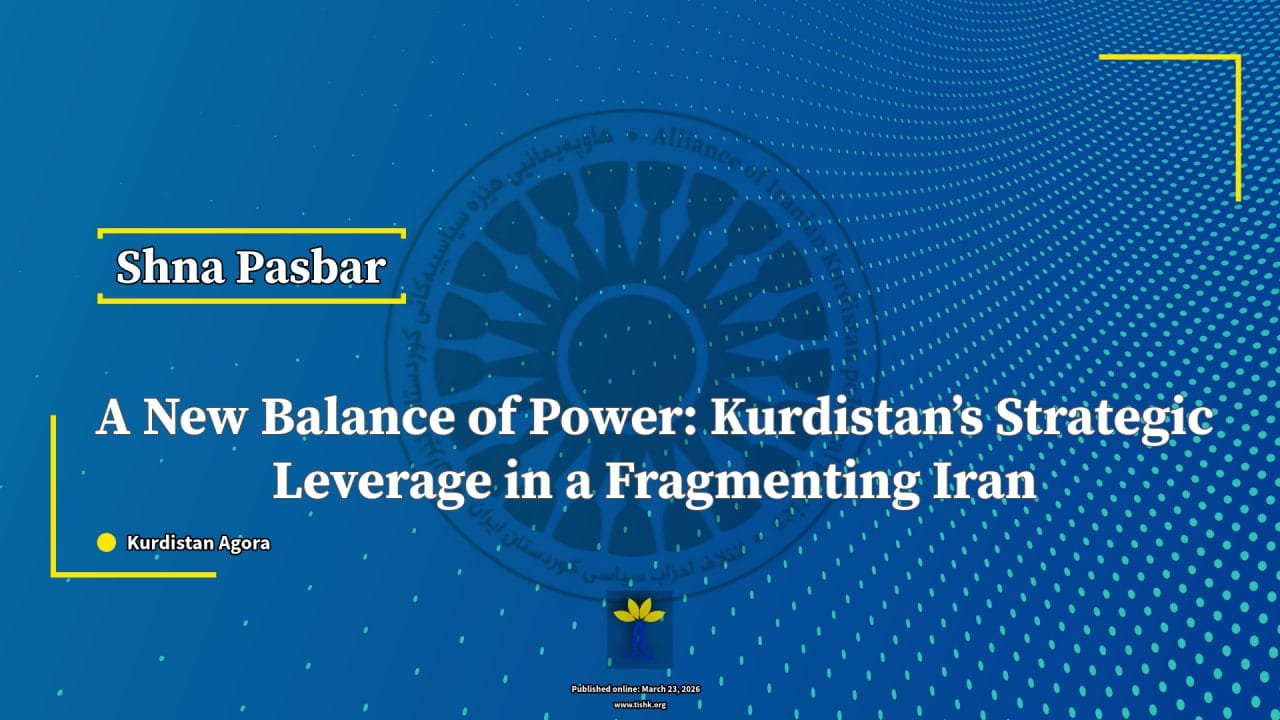
Pasbar, Shna(2026): A New Balance of Power: Kurdistan’s Strategic Leverage in a Fragmenting Iran. Published online by TISHK Center for Kurdistan Studies.
Summary
As the regional conflict involving Iran intensifies, Kurdish borderlands in western Iran have emerged as a pivotal geopolitical front. The February 2026 formation of the Coalition of Political Forces of Iranian Kurdistan (CPFIK)—a unified alliance of major opposition parties—marks a strategic shift, as these actors now coordinate efforts to challenge Tehran’s authority while positioning themselves as indispensable interlocutors for future governance. While this unprecedented consolidation offers the potential to exert meaningful internal pressure, it simultaneously exposes the Kurdish population to severe risks, including retaliatory military strikes, humanitarian crises, and the historical danger of being instrumentalized by external powers for broader regional interests.

A New Balance of Power: Kurdistan’s Strategic Leverage in a Fragmenting Iran
How escalating conflict and shifting alliances are turning Kurdish regions into a decisive geopolitical front
A War Reshaping the map
The escalating confrontation involving Iran, Israel, and the United States is no longer confined to conventional battlefields or predictable arenas of power. Instead, it is rapidly evolving into a conflict shaped by internal fractures, asymmetric pressure, and shifting regional alignments.
Among the most consequential developments is the growing strategic importance of the Kurdish regions.
Long treated as peripheral, Kurdish areas are now emerging as a central pressure point within Iran’s geopolitical landscape. Intensified military pressure, leadership losses within Iran, and the mobilization of Kurdish political actors are converging to reshape the balance of power. What was once a marginalized frontier is increasingly becoming a decisive axis in the future trajectory of the conflict.
Recent developments suggest that Iran is experiencing one of its most vulnerable periods in decades. Sustained military pressure, targeted strikes against key figures, and mounting internal instability have weakened both its operational cohesion and symbolic authority.
The loss of influential individuals within Iran’s political and military structure is not merely tactical—it reflects a deeper erosion of centralized control. Historically, Iran has relied on tightly interconnected leadership networks to maintain internal cohesion and project regional influence. As these networks become disrupted, peripheral regions—especially those with distinct ethnic and political identities—gain new strategic relevance.
In this context, fragmentation does not necessarily mean collapse. Rather, it signals a redistribution of power, where authority becomes uneven, contested, and increasingly localized. It is precisely within this shifting landscape that Kurdish regions are gaining prominence.
Kurdistan From Periphery to Strategic Front
Kurdish regions in western Iran have become focal points of growing military and political significance. Their geography alone makes them critical: bordering Iraq’s Kurdistan Region and positioned along sensitive security corridors, these areas present both vulnerability and opportunity.
Yet geography is only part of the story. The Kurdish population in Iran has long maintained a distinct political identity shaped by decades of marginalization, resistance, and cross-border connections. Today, that identity intersects with broader regional dynamics in ways that elevate Kurdistan from a local concern to a strategic factor.
Heavy bombardment and increased military attention in these areas reflect more than immediate tactical objectives—they underscore their rising importance within the wider conflict. Whether as zones of instability, corridors of influence, or leverage points against Tehran, Kurdish regions are no longer secondary spaces.
Kurdish political actors are also entering a moment of potential transformation. Historically fragmented and often divided across borders, Kurdish groups have struggled to act in coordinated ways. However, the current moment presents a rare convergence of incentives.
The emergence—or even the perception—of greater coordination or coalition-building introduces a significant new variable. A more unified Kurdish political position could strengthen bargaining power with Tehran, create structured internal pressure within Iran, and influence the strategic calculations of regional and global powers.
At the same time, external actors may increasingly view Kurdish groups as potential partners—for intelligence cooperation, indirect influence, or strategic leverage. This dynamic amplifies Kurdistan’s role not only as a battleground, but as an active political force shaping outcomes.
The Regional Implications: A New Strategic Equation
If Iran continues to weaken internally, Kurdish regions may become one of the most consequential variables in the next phase of the conflict. Their importance lies not only in geography, but in their capacity to shape political, military, and symbolic dimensions of a rapidly evolving regional order.
One possible outcome is the expansion of strategic leverage for Kurdish actors. In periods of state fragility, actors located in sensitive border regions often gain increased relevance. For Kurdish groups, this could translate into greater negotiating power—not only with Tehran, but also with regional governments and international actors seeking influence in an unstable environment. Kurdish political actors may increasingly be seen as indispensable interlocutors—forces that cannot be ignored in discussions about security, governance, or territorial arrangements.
A second scenario involves a reconfiguration of security across border regions. As centralized authority weakens, the gap between formal sovereignty and actual control widens. In Kurdish areas, this could lead to a transition from tightly controlled frontier zones to spaces defined by contested authority, localized governance, or fluid power-sharing arrangements. Border crossings, trade routes, mountain corridors, and local institutions would all gain heightened strategic importance. In such a context, Kurdish regions would no longer function merely as peripheral edges of the Iranian state, but as active geopolitical arenas where the future distribution of power is negotiated on the ground.
A third—and more complex—possibility is the intensification of proxy dynamics. External powers may view Kurdish regions as strategic openings through which pressure can be applied to Iran without direct large-scale confrontation. Intelligence cooperation, indirect support, political engagement, or tactical alignment with Kurdish actors could become more likely under prolonged instability.
Yet such engagement is never neutral. While external attention may enhance Kurdish visibility and bargaining power, it also carries the risk of reducing Kurdish aspirations to instruments within broader geopolitical competition. The danger is that Kurdish regions become valued not for their own rights or historical claims, but for their utility in weakening a rival state. This tension between agency and instrumentalization stands as one of the defining risks of the current moment.
Any meaningful shift in Kurdish influence would be closely monitored in Iraq, Turkey, and Syria—contexts where Kurdish issues remain deeply intertwined with national security concerns, territorial sensitivities, and unresolved histories of exclusion.
A reconfiguration of power in Iranian Kurdistan could inspire new waves of political mobilization, trigger preemptive responses from neighboring states, or reshape existing regional alliances. Even limited changes in autonomy, governance, or military presence could reverberate far beyond Iran’s borders. Kurdistan, in this sense, is not an isolated frontier—it is part of a broader, interconnected Kurdish geopolitical space whose developments are closely observed across the region.
At the same time, these emerging possibilities are inseparable from serious risks. Increased militarization of Kurdish regions could lead to humanitarian crises, civilian displacement, economic collapse, and long-term social fragmentation. Communities that have already endured decades of marginalization may once again bear the heaviest costs of a conflict shaped by larger powers.
There is also the danger that instability creates a vacuum without producing genuine political gains—leaving Kurdish regions exposed to violence, external manipulation, and renewed repression. Strategic importance does not automatically translate into justice or stability; it can just as easily attract destruction.
The growing significance of Kurdish regions must be understood with both recognition and caution. Kurdistan may indeed emerge as a decisive factor in the regional balance of power, yet whether this moment leads to meaningful political transformation or deeper vulnerability remains uncertain.
What is clear, however, is that the Kurdish question is no longer a secondary issue within the Iranian crisis. It is becoming one of the central arenas through which the next regional order may be contested, shaped, and potentially redefined.
The unfolding conflict is not only about state-to-state confrontation—it is about how internal fractures reshape the architecture of power. In this evolving landscape, Kurdistan stands as a silent but decisive pivot.
The future balance of power in the Middle East may depend not only on capitals like Tehran, Washington, or Tel Aviv—but on the mountainous borderlands of Kurdistan, where geography, identity, and geopolitics now converge.
Other Research
A New Balance of Power: Kurdistan’s Strategic Leverage in a Fragmenting Iran
Pasbar, Shna(2026): A New Balance of Power: Kurdistan’s Strategic Leverage in a Fragmenting Iran. Published online by TISHK Center for Kurdistan Studies. Summary As the regional conflict involving Iran intensifies, [...]
The Delusions of National Unity: Why Promoting Autocracy Won’t Bring Democracy
Sharif Behruz Strategic Policy Analyst and Managing Editor of Kurdistan Agora Published online by TISHK Center for Kurdistan Studies: Bonn, Germany: 2026 Summary This critique examines [...]
A Brief Derridean Reading of “A Cautionary Manifesto by Iranian Cultural Figures” That Opposes Kurdish Newroz
A Brief Derridean Reading of “A Cautionary Manifesto by Iranian Cultural Figures” That Opposes Kurdish Newroz. Published online by TISHK Center for Kurdistan Studies. The Point Since April 9, 2025, [...]