
Mahsun Oti
PhD student in Anthropology at Rutgers University, USA.
Published online by TISHK Center for Kurdistan Studies: Bonn, Germany: 23 February 2026
The Point
Whether one interprets this as betrayal by “the Arabs” as a whole or—more accurately—by particular armed actors, tribal leaders, and state-aligned militias, the political outcome was the same: Kurdish military, political, and civil units withdrew to Kurdish-majority areas such as Hasakah, Qamishli, and Kobanê to prevent a confrontation with the Arab tribal militias, which would eventually lead to an Arab-Kurdish war. What followed was not merely a military issue but a transformation in self-understanding: Kurds began to describe the struggle less as a shared revolution and more as a fight for national survival.

The word betrayal is often treated as an emotional language. In colonized territories, however, betrayal is not only a feeling; it is a political diagnosis. Under colonial conditions, betrayal indexes the event when the promised “we” collapses. During the “Save Rojava” protests across the World, a similar narrative of betrayal emerged as a central story. The turning point, in this narrative, begins with the January 2026 military attacks on Kurds in Rojava that many Kurds interpret as the moment the “liberated” Arab-majority cities and their armed groups decisively turned against not only the Kurdish military forces but also civilians. An especially disturbing video from the cemeteries in Raqqa, where Kurdish and Arab soldiers of the Syrian Democratic Forces martyred fighting against ISIS, is being separated from each other, has been circulating across Kurdish media. In this widely circulating video, after the withdrawal of the SDF forces from the city, Arab families started removing their relatives’ corpses from the SDF martyr cemetery and destroying many of the Kurdish soldiers’ graves.
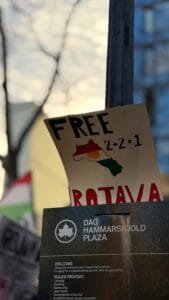
Photo 1. By Mahsun Oti
Whether one interprets this as betrayal by “the Arabs” as a whole or—more accurately—by particular armed actors, tribal leaders, and state-aligned militias, the political outcome was the same: Kurdish military, political, and civil units withdrew to Kurdish-majority areas such as Hasakah, Qamishli, and Kobanê to prevent a confrontation with the Arab tribal militias, which would eventually lead to an Arab-Kurdish war. What followed was not merely a military issue but a transformation in self-understanding: Kurds began to describe the struggle less as a shared revolution and more as a fight for national survival.
This matters because the Kurdish movement in Rojava did not simply fight against ISIS; it attempted to build an alternative political order. For nearly a decade, it experimented with grassroots institutions and a pluralist administration designed to share power across ethnic and religious lines. The project was closely associated with the PKK’s jailed leader, Abdullah Öcalan’s ideological framework, often summarized as the “democratic confederalism,” an aspiration that promised coexistence through radical democracy, local autonomy, and multi-ethnic partnership. As a political project focused on creating a “democratic nation,” it found its most distinctive expression in the motto of “brotherhood of nations.” But when geopolitics changed, and armed alliances shifted, this ideology met the brutal limits of the region’s counterrevolutionary forces. Turkey and its proxy forces, the jihadist Damascus army, and tribal formations confronted Rojava and the Kurds. Yet once again, a call for jihad against the Kurds and a threat of genocide came to the Kurdish door.
This is a tragedy, unfortunately followed by a comedy. It is a tragedy because it carries a specific paradox: a colonized nation is asked by one of its leaders to imagine its freedom through the language of reconciliation with those who deny its existence. It is a comedy because the Kurdish political leaders seem not to be abandoning this ideology even after the “betrayal” and the all-devastating violence against the Kurds in Rojava. The “brotherhood of nations” became a doctrine that called on Kurds to dilute their national claims in the name of a moral-political universalism, while the states colonizing them never diluted anything. Kurdistan’s colonizers continued to centralize, militarize, assimilate, criminalize Kurdish life, and treat Kurdish autonomy as an existential threat. In this asymmetry, “brotherhood” becomes less an ethic of coexistence and more a discipline imposed on the colonized, but unfortunately by a colonized leader. This is why the “betrayal” narrative has had such devastating resonance across the Kurdish nation.
It is not only about losing territory or suffering attacks; it is about the psychic collapse of an imagined political future. It is the feeling of having invested in a moral horizon of coexistence, equality, and shared governance, only to discover that others invested in temporary advantage, revenge, and state-backed restoration. However, it is also a rage against those who claim to be the Kurdish leaders and present this ideology to the Kurds, even when the Kurds are being massacred. The last few weeks have intensified this crisis in ways that are impossible to ignore. A specific rage against this distorted political imagination can be observed during the “Save Rojava” protests across the World. A certain rage is rising within the Kurdish nation, yet it is not only directed outward. It is increasingly redirected inward, toward the ideology that promised a non-national solution to a deeply national question. The protests under the slogan “Save Rojava” illustrate this shift. In demonstrations, people carry placards denouncing “brotherhood of nations” in deliberately obscene terms. These protests and the chants signal that something sacred has been desacralized; that an ideology once treated as a moral compass is now, by some, treated as a political mistake.
This internal rage cannot be dismissed as primitive nationalism, as some of the Kurdish leaders continue to argue. It is the critique of the political language itself: What does it mean for a colonized people to be asked to call their colonizer brother, especially when the colonizer behaves as a master? This patriarchal kinship metaphor transforms hierarchy into intimacy. It invites Kurds to treat their colonization as a family problem rather than a colonial domination.
So, what should Kurds replace the hopefully exhausted language of “brotherhood” with?
The counter-narrative that surfaced in the “Save Rojava” protests is not only a rejection of a single doctrine; it is also an attempt to reorganize Kurdish political time and space, creating a unified time and space. Chants like “Rojava Rojhilat e, Kurdistan Yek Welat e”—Rojava is Rojhilat; Kurdistan is one country—and “Yek e, Yek e, Yek e… Kurdistan Yek e”—One, one, one… Kurdistan is one—, or “2+2=1”, do more than declare unity. These mottos focus on the imagined “we” which was naively denied by the Kurdish political elites in Rojava. These mottos are part of a historical call for the unification of the “imagined we,” not the “brotherhood of nations.” They redraw the map imposed by the colonial states for a century, refusing the colonial boundaries that divide Kurds into four. In this sense, the protest language functions as a reparative geography: it tries to stitch together what colonization dismembered and divided into four. Where “brotherhood” asked Kurds to dilute the national claim in the name of coexistence, these chants insist that coexistence without national autonomy becomes surrender by another name. They are not simply slogans; they are a public demand to restore a Kurdish political imagination that is allowed to name itself as Kurdish: whole, continuous, and future-oriented.
Other Research
Unequal Lands: War, Infrastructure, and Survival in Iran’s Kurdish Regions
Pasbar, Shna(2026): Unequal Lands: War, Infrastructure, and Survival in Iran’s Kurdish Regions. Published online by TISHK Center for Kurdistan Studies. Summary This article argues that the impact of conflict is [...]
Protests, Repression, and Iran’s Uncertain Future: A Look at Iranian Kurdistan
Pezeshk, Kouchar(2026): Protests, Repression, and Iran’s Uncertain Future: A Look at Iranian Kurdistan. Published online by TISHK Center for Kurdistan Studies. Summary In recent years, Iran has witnessed successive waves [...]
A New Balance of Power: Kurdistan’s Strategic Leverage in a Fragmenting Iran
Pasbar, Shna(2026): A New Balance of Power: Kurdistan’s Strategic Leverage in a Fragmenting Iran. Published online by TISHK Center for Kurdistan Studies. Summary As the regional conflict involving Iran intensifies, [...]