
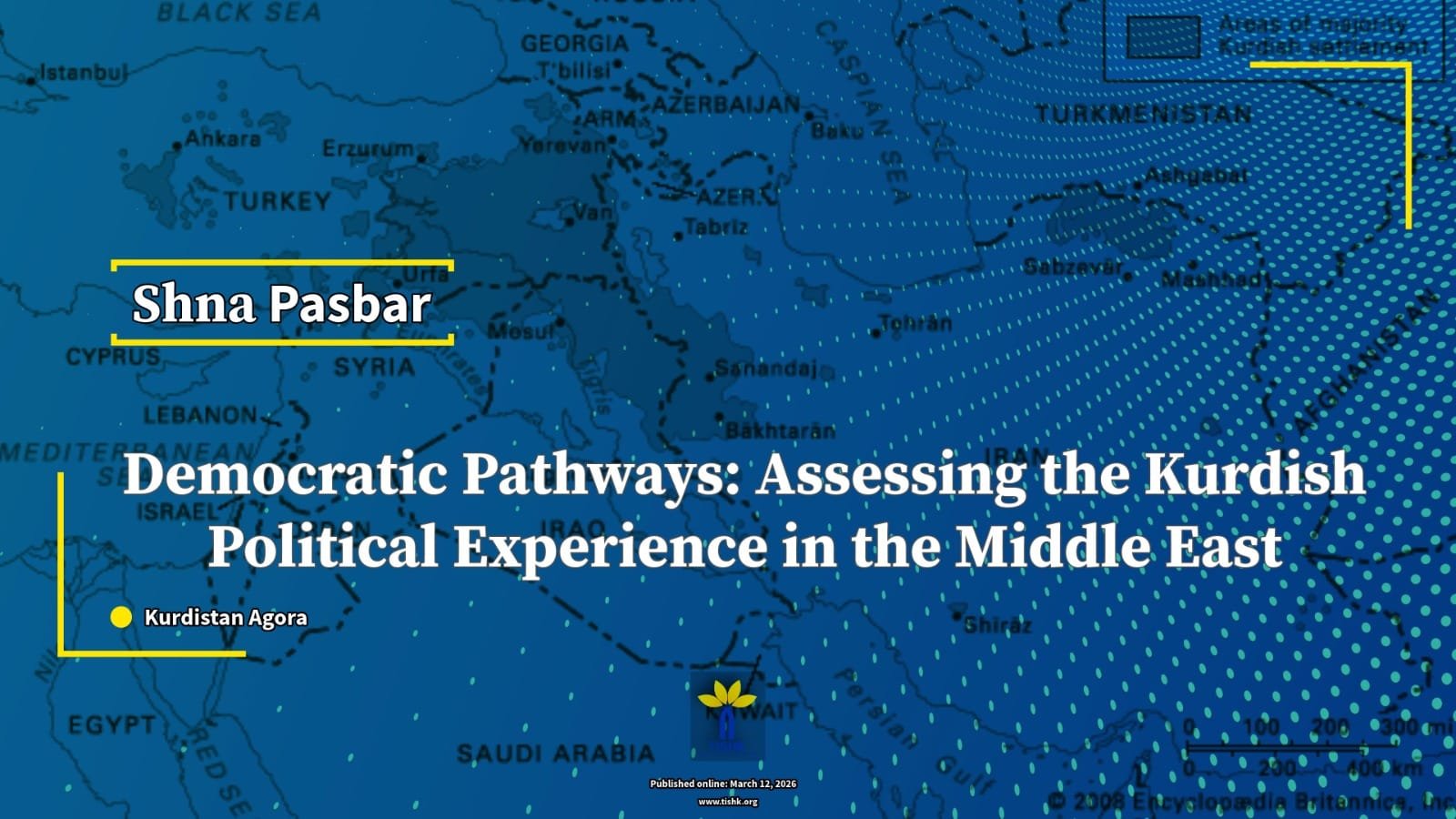
Pasbar, Shna(2026): Democratic Pathways: Assessing the Kurdish Political Experience in the Middle East. Published online by TISHK Center for Kurdistan Studies.
Summary
In this article, Shna Pasbar examines the evolution of democratic governance within the Kurdish regions of Iraq and Iran, positioning the Kurdish movement in Iran as a pivotal emerging democratic force in the Middle East. It explores how these movements have adapted democratic principles—such as decentralization, multi-party competition, and institutionalized power-sharing—to fit unique sociopolitical landscapes.
In the Kurdistan Region of Iraq, the analysis highlights the development of a formal parliamentary system characterized by a functioning opposition and its role in shaping Iraq’s federalist constitution. In the Kurdistan Region of Iran, the focus shifts to the Coalition of Political Forces of Iranian Kurdistan (CPFIK), illustrating how grassroots cooperation and collective leadership can foster democratic norms even in the absence of state authority. Ultimately, the article argues that the Kurdish experience offers a vital blueprint for the region, suggesting that sustainable democracy is built not just through elections, but through a persistent commitment to dialogue, diversity, and inclusive governance.

Democratic Pathways: Assessing the Kurdish Political Experience in the Middle East
Democracy is, by definition, a model of governance where political power is held and exercised by the people. In democratic systems, citizens participate in shaping their government either directly or through elected representatives. Democratic governance relies on a foundation of critical principles: it must ensure political pluralism and fair elections, uphold civil liberties, maintain strict leadership accountability, and operate under the rule of law. Theoretically, this structure ensures government accountability to the citizenry while guaranteeing that a diverse array of perspectives can help shape the trajectory of society. Although democratic governance is a universal ideal, its practical implementation remains highly contingent upon the unique sociopolitical and historical landscapes of each society.
The Middle East offers a uniquely complex landscape for the advancement of democracy. For many states in the region, long-standing governance has been defined by centralized political structures, monarchies, or authoritarian systems. Frequently, the development of stable democratic institutions has been constrained by geopolitical conflicts, security challenges, ethnic diversity, and economic pressures. Given these realities, democratic governance in the Middle East cannot simply mirror Western paradigms. Instead, democratic practices must evolve in ways that align with the region’s distinct social structures, cultural traditions, and political sensitivities. Ultimately, meaningful democratic progress relies on gradual institutional development, inclusive political participation, and a dedicated respect for diversity.
Despite these challenges, certain political experiences in the region demonstrate that democratic practices can emerge even under difficult conditions. A frequently cited example is the Kurdistan Region of Iraq, which has developed its own unique model of regional governance within the Federal republic of Iraq. Over the past few decades, the region has cultivated a political system characterized by multiparty competition, regular parliamentary elections, and a functioning opposition. Within this framework, opposition parties actively scrutinize government policy and hold public officials to account.
Political rivals regularly challenge government performance, investigate public finances, and debate policy decisions through an array of independent media, including newspapers and television networks. The presence of these competing political forces within a parliamentary structure fosters transparency, robust public debate, and a level of political pluralism that remains rare throughout much of the surrounding region.
Beyond its internal development, the democratic experience of the Kurdistan Region has served as a vital blueprint for democracy-building throughout Iraq. By consistently engaging in the Iraqi parliament and the federal government, Kurdish political actors have actively promoted the pillars of federalism, political pluralism, and power-sharing within the nation’s post-2003 governance framework.
A clear example of this influence occurred during the drafting of the 2005 Iraqi Constitution, where Kurdish leaders played a pivotal role in advocating for a federal democratic system. By securing constitutional recognition for regional autonomy, they helped establish a model that encourages broader political participation and institutional accountability across the entire Iraqi state. Furthermore, this emphasis on regional authority underscores a modern shift in political science, where decentralization is now widely recognized as a key index for assessing the health and maturity of democratic development.
By distributing power away from a central authority, such structures often foster greater local responsiveness, protect minority rights, and encourage a more pluralistic political environment—all of which serve as essential pillars for sustainable governance.
Although the democratic experience within the Kurdistan Region of Iraq remains a work in progress—grappling with its own distinct institutional and political hurdles—it stands as a rare Middle Eastern model where competitive party politics and a structured opposition have successfully taken root within a formal framework. For many observers, this trajectory serves as a compelling case study, demonstrating that democratic governance can gradually flourish in the region, provided that political actors remain committed to pluralism and the integrity of institutional rules.
Concurrently, Kurdish political thought and organizational efforts within the Kurdistan Region of Iran offer another vital perspective on democratic advancement. While the Kurdistan Region of Iraq illustrates the efficacy of institutionalized power-sharing, the growing collaboration among political actors in the Kurdistan Region of Iran demonstrates how foundational democratic norms can be fostered even in the absence of formal state authority.
For decades, Kurdish political movements in this area have positioned democratic principles at the core of their political vision. Their discourse consistently emphasizes the necessity of pluralism, civil rights, and inclusive governance for all national and political communities throughout Iran. Kurdish political movements have increasingly integrated their specific national aspirations into a broader framework for democratic shift across all of Iran.
A notable recent development is the formation of the Coalition of Political Forces of Iranian Kurdistan (CPFIK). This alliance unites six distinct political organizations, each possessing its own ideological background, historical narrative, and strategic outlook. Despite their inherent differences, these parties have chosen to align around shared democratic goals. The very existence of this coalition serves as a meaningful democratic exercise; rather than vying for individual dominance, these groups have prioritized dialogue, compromise, and collective decision-making.
In a region where opposition movements are frequently undermined by fragmentation, this initiative represents a substantial effort to forge unity through democratic mechanisms. The coalition embodies political pluralism by demonstrating that diverse perspectives can productively coexist within a unified framework. Member parties acknowledge the validity of differing viewpoints while actively pursuing common ground on essential democratic objectives. Furthermore, the coalition’s reliance on consultation and discussion among representatives fosters a culture of collective leadership, effectively moving away from models of unilateral authority.
Beyond its internal utility, the alliance clarifies a broader vision for the future of Iran’s political architecture. By prioritizing cooperation and democratic dialogue, these Kurdish actors aim to demonstrate that political disagreements can be resolved through negotiation rather than conflict. In this sense, the coalition serves as an effort to cultivate a democratic culture well before the acquisition of formal state power.
The impact of this development reaches well beyond Kurdish politics. It illustrates how democratic norms can take root even amidst restrictive political environments. Through a commitment to cooperation, negotiation, and respect for diversity, the coalition works to build a democratic culture from within. Consequently, these actors are not only advocating for a democratic future but are actively embedding democratic principles into their own organizational operations. Such grassroots efforts are particularly critical for the broader Iranian context; given that the country has lacked a lived experience of functional democracy since its modern inception, these models provide a vital “training ground” for democratic behavior.
This internal dedication to democratic values bolsters the credibility of their wider political vision, suggesting that democracy is not merely a demand placed upon the state, but a guiding principle that shapes the behavior of political movements themselves. At a time when Iran desperately needs a sustainable path toward representative governance, such practices are fundamental to the gradual development of a democratic culture—a process often as vital to sustaining governance as the establishment of formal institutions. By demonstrating that diverse factions can collaborate peacefully, these movements offer a potential roadmap for a nationwide shift toward the pluralistic democracy that has historically remained elusive in Iran.
Democracy in the Middle East remains a complex, evolving process, deeply influenced by historical legacies, contemporary realities, and social diversity. While the region continues to encounter significant obstacles, the political system in the Kurdistan Region of Iraq and the collaborative efforts within the Kurdistan Region of Iran prove that democratic practices can emerge under challenging conditions. These experiences offer a clear lesson: democracy is defined not only by elections and formal structures, but also by a political culture rooted in dialogue, diversity, and cooperation.
By emphasizing pluralism, coalition-building, and collective decision-making, Kurdish political movements add a vital perspective to the ongoing discourse on democratic development in the Middle East. Their work suggests that a democratic culture can grow incrementally through political cooperation and a firm commitment to inclusive governance. Ultimately, the cooperative approach adopted by these Kurdish parties may provide a valuable template for the future development of democratic movements both within Iran and in other regions where pluralism and inclusion remain key aspirations.
Through their emphasis on pluralism, coalition-building, and collective decision-making, Kurdish political movements contribute to an evolving discussion about how democratic principles might take shape in the Middle East. Their experience suggests that democratic culture can grow gradually through political cooperation and a shared commitment to inclusive governance. From this perspective, the democratic practices and cooperative political approach adopted by Kurdish parties may also provide an important example for the future development of democratic movements in Iran and in other regions where political pluralism and inclusive governance remain important aspirations.
Other Research
Pahlavi-ism: Obscenity, Coercion, and the Virile Display of Rule
Kamal Soleimani Published online by TISHK Center for Kurdistan Studies: Bonn, Germany: 17 February 2026 Abstract Neo-Pahlavism has re-emerged not as a coherent doctrine but as a contemporary regime of [...]
Ecocide and Stateless Nations: Why the Land of the Stateless Becomes the First Target of Destruction
Dawod Rasooli (PhD of Soil & Water Silences; TISHK Center for Kurdistan Studies, Germany), Ali Abdelzadeh (Associate Professor in Political Science at Dalarna University, Sweden) and Evin Adin (Soil Fertility Researcher; TISHK Center for [...]
The Digital Crown and the Centralization Trap: How Regional Pacts and Bot Armies are Silencing Iran’s Diversity
Sharif Behruz Strategic Policy Analyst. Published online by TISHK Center for Kurdistan Studies: Bonn, Germany: 13 February 2026 The Point By flooding digital spaces with rigid "Pahlavi or Chaos" narratives, [...]