
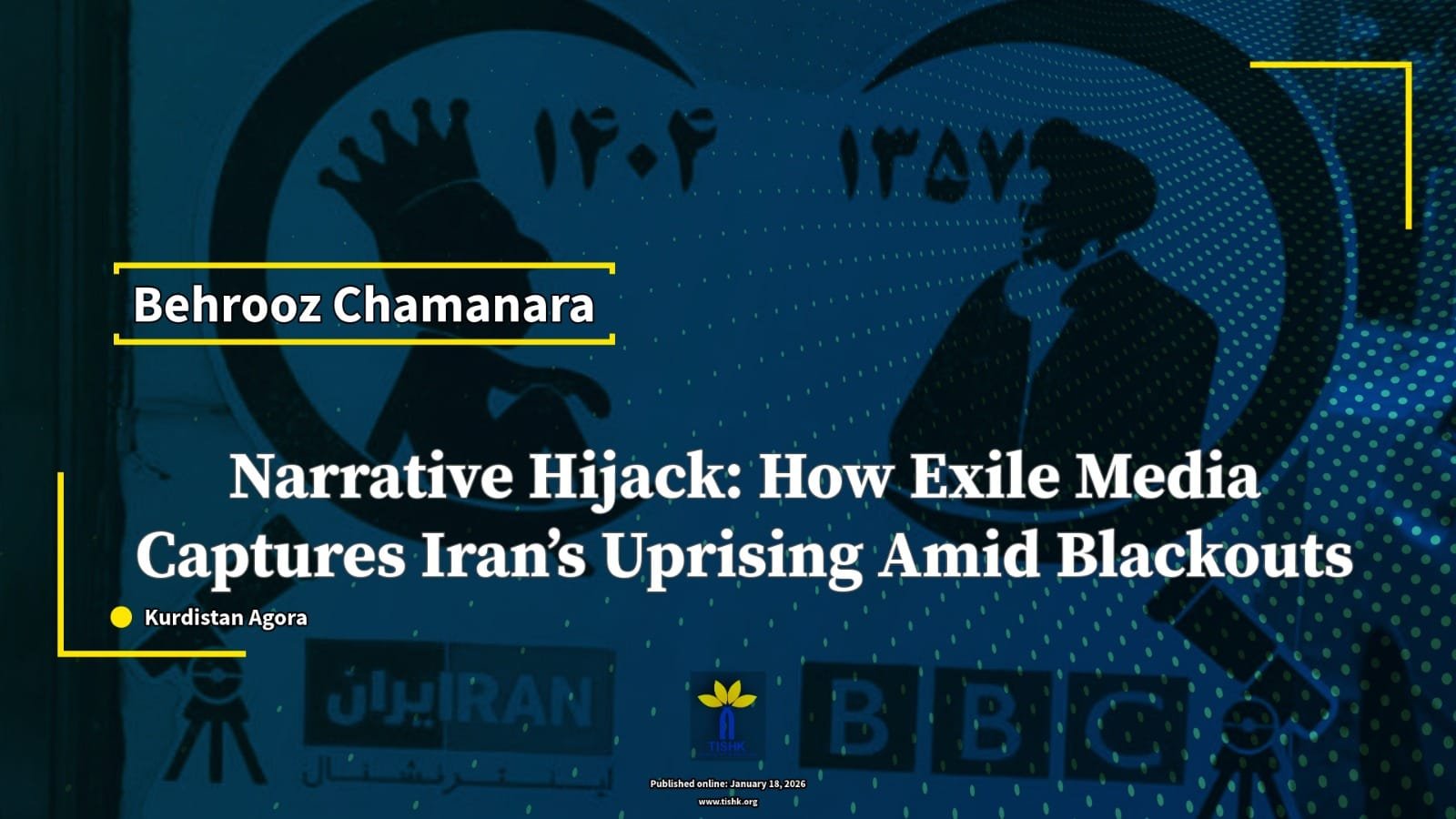
Behrooz Chamanara
Director of IISKS| Germany
Published online by TISHK Center for Kurdistan Studies: Bonn, Germany: 18 January 2026
Summary
Iran has entered a revolutionary moment marked by mass protests, labor strikes, and escalating state violence, compounded by nationwide internet blackouts and digital repression. While repression targets bodies inside the country, a parallel struggle unfolds abroad over control of the uprising’s meaning. This piece examines how segments of exile-based Persian media, operating amid information blackouts, have shifted from reporting to narrative engineering-reframing diverse, plural protests as a monarchist project centered on Reza Pahlavi. Drawing on media analysis and data forensics of online campaigns, it argues that simulated consensus and narrative capture risk hollowing out democratic possibilities and reproducing authoritarian logics within an anti-authoritarian revolt.

Iran stands at the edge of a historic rupture. Mass protests, labor strikes, and relentless state violence have pushed the country into a revolutionary moment whose outcome remains open. The Islamic Republic has responded not only with brute force ‒ nationwide internet shutdowns, power cuts, and telecommunications blackouts ‒ but with a broader architecture of communication control, long refined through media censorship, cyber warfare (Link 1), and digital repression. Reports now indicate that hundreds, possibly thousands, have been killed.
While bullets target bodies in the streets, a subtler war rages abroad: the battle for the uprising’s meaning. Who defines it? Who names its leaders and claims its future? This isn’t mere opposition infighting. It’s a caution that narrative control can turn authoritarian when democracy cracks open. With the internet dark, some exile media outlets fill the void ‒ not with reporting, but by crowning a king in exile.
With nationwide internet blackouts, communication inside Iran shrinks to sporadic satellite signals and smuggled clips. Exile-based Persian TV channels become the main lens for the world, sometimes the only one. This pivotal role demands rigorous reporting. Too often, it delivers something else: relentless promotion of Reza Pahlavi, son of Iran’s last shah, as the uprising’s preordained leader.
These outlets compress diverse protests ‒ over class, gender, ethnicity ‒ into a monarchist narrative. Labor strikes in the oil fields, women’s defiance in Tehran, Kurdish mobilization in the west: all recast as steps toward royal restoration. In the dark of blackouts, this isn’t framing. It’s scripting the revolution’s end before it unfolds.
The problem runs deeper: Reza Pahlavi commands no proven following inside Iran. President Trump himself questioned this recently, calling his support untested (Link 3). Lacking grassroots roots, his backers flood exile media with one message – airtime dominance, looped clips, relentless name-dropping ‒ to feign inevitability.
Campaigns can simulate crowds. They can’t build legitimacy: the trust from strikes, women’s networks, ethnic coalitions, and civic institutions that define real movements. In a revolution, symbols without substance risk hollowing out the street’s plural voice.
Over recent weeks, Persian satellite channels ‒ led by Iran International ‒ show a clear pattern. Strikes, women’s protests, ethnic uprisings: all reframed as steps toward Reza Pahlavi’s royal restoration. Complexity vanishes. Dissenting chants become “noise.” In internet blackouts, this isn’t spin. It’s scripting a single outcome for a plural revolt.
This is no accident. Iran International has crossed from reporting into campaigning, with documented selective editing sparking backlash and fact-checks. Substituting street voices with media-favored scripts isn’t journalism ‒ it’s appropriation.
Take a Tabriz protest video on BBC Persian’s Instagram (Link 2). Crowd chants of “Death to the dictator” dominate, yet the headline spotlights a lone filmer’s whisper: “Yashasin Pahlavi.” One voice defines the many.
This Pahlavi-centrism normalizes across outlets, sidelining democrats while Kurdish strikes, women’s networks ‒ even Nobel laureates ‒ vanish if they don’t fit. Media can’t conjure consensus where none exists.
This narrative machinery is reinforced by a numerical spectacle. Online signature campaigns, dashboards, and live counters are presented as substitutes for civic process. But numbers are cheap. A detailed technical investigation ‒ the IPM Analysis (Link 4), published with open methodology and datasets ‒ examined one such high-profile campaign promoted within the same media ecosystem. The data displayed near-uniform growth, repetitive plateau clusters, strong temporal autocorrelation, and persistently low entropy ‒ patterns inconsistent with organic participation.
In plain terms, the data behaved less like a crowd and more like a machine. Real participation is noisy. It surges, stalls, and reacts. This counter did not. Without verification and independent auditability, “the people’s will” becomes an engineered artifact.
When media framing converges with metric fabrication, simulated consensus emerges ‒ reinforced through coordinated harassment rather than argument. Critics are met with threats, slurs, and conspiracy labeling; pluralism is recoded as sabotage. This is a familiar authoritarian logic: internal difference is intolerable, a single voice must be manufactured and called “the people.” The Islamic Republic enforces this through prisons and bullets; the cluster of exile outlets openly rooting for a return of the monarchy advances it through editing, branding, counters, and intimidation. The tools differ. The authoritarian impulse is uncomfortably similar.
In moments of democratic rupture, revolutions are not only crushed by force but can also be captured through narrative control.
Behrooz Chamanara, an independent Iranian scholar, analyzes media power and narrative control in authoritarian contexts.
Link 2: https://www.instagram.com/reel/DTU‒ScxFTe1/?igsh=MW45Y2h1NHAzazBnYw==
Other Research
Unequal Lands: War, Infrastructure, and Survival in Iran’s Kurdish Regions
Pasbar, Shna(2026): Unequal Lands: War, Infrastructure, and Survival in Iran’s Kurdish Regions. Published online by TISHK Center for Kurdistan Studies. Summary This article argues that the impact of conflict is [...]
Protests, Repression, and Iran’s Uncertain Future: A Look at Iranian Kurdistan
Pezeshk, Kouchar(2026): Protests, Repression, and Iran’s Uncertain Future: A Look at Iranian Kurdistan. Published online by TISHK Center for Kurdistan Studies. Summary In recent years, Iran has witnessed successive waves [...]
A New Balance of Power: Kurdistan’s Strategic Leverage in a Fragmenting Iran
Pasbar, Shna(2026): A New Balance of Power: Kurdistan’s Strategic Leverage in a Fragmenting Iran. Published online by TISHK Center for Kurdistan Studies. Summary As the regional conflict involving Iran intensifies, [...]