
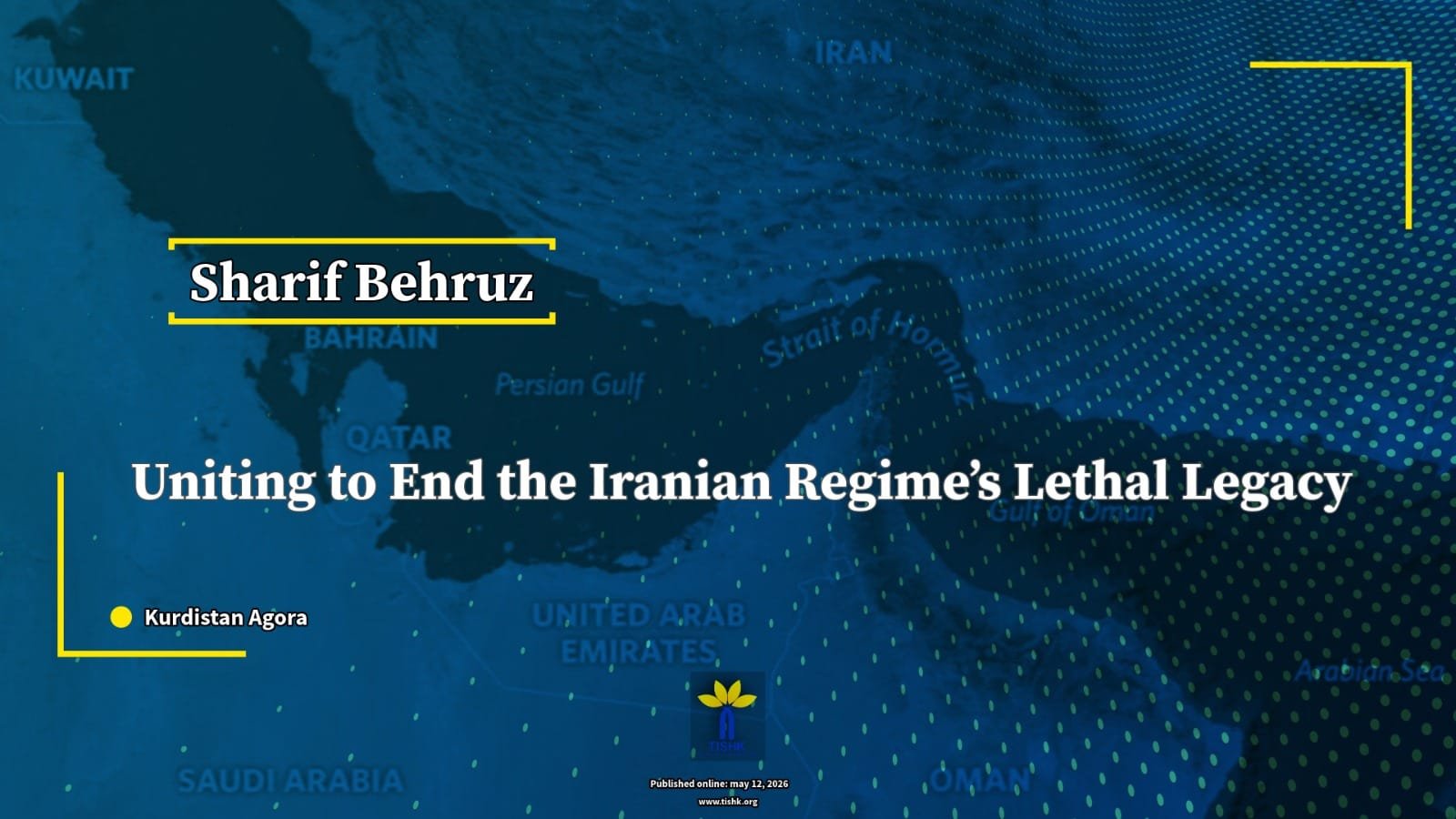
Sharif Behruz
Uniting to End the Iranian Regime’s Lethal Legacy
Published online by TISHK Center for Kurdistan Studies: Bonn, Germany: 2026
Summary
This article presents a scathing indictment of the Iranian regime, arguing that its systematic disregard for human life—from the lethal saturation of its own borderlands with landmines to targeted strikes on civilian infrastructure across the Middle East—has evolved from a domestic tragedy into an existential global threat. By detailing the heartbreaking toll on Kurdish civilians in Iran and the regime’s cynical victim narrative following technical military failures, the text illustrates a leadership that treats its citizens as human shields while prioritizing its own survival in fortified bunkers. The author contends that with the regime currently dragging 90 million Iranians into an unnecessary conflict while enforcing a total communications blackout and economic ruin, the window of opportunity for a decisive international intervention is closing. Ultimately, it issues a final call for the West, the Arab world, and the Iranian people to unite in a moral and strategic imperative to end the regime’s rule, asserting that its removal is the only path to reclaiming ancestral lands, securing global energy corridors, and preventing a future of nuclear-backed fanaticism.

Uniting to End the Iranian Regime’s Lethal Legacy
I still remember the news from a nearby village back in Kurdistan that silenced us all: four children found a strange object in the hills—a remnant of the Islamic Revolutionary Guard Corps (IRGC) military maneuver—and picked it up with the curiosity only children possess. In an instant, one of them was gone and the others were left with life-altering injuries. This wasn’t a ghost of wars past, but a direct consequence of the regime’s reckless military drills in our backyards. Not long after, I lost a friend—a talented young footballer I had played with many times. Driven by the desperation of an economy in ruins, he went into the mountains to collect scrap metal from exploded ordnance to sell for a few dollars. While trying to neutralize a piece of “scrap” left behind by these military exercises to make a living, it exploded, taking a life that belonged on the pitch, not in a casualty report.
These are not isolated tragedies, nor are they limited to a single region. They are the frontline of a broader, systemic danger: the saturation of Iran’s borderlands with explosives. From the Kurdish mountains in the northwest to the Arab plains in the south, the threat is not limited to mapped minefields; it extends to the very hills and fields where the IRGC conducts frequent military exercises. The regime treats these ancestral lands as a firing range, leaving behind unexploded ordnance and munitions that turn the landscape into a graveyard for the innocent. Whether it is the intentional planting of active mines or the reckless abandonment of military debris along the borders, the message from Tehran is clear: the lives of those in the periphery are expendable.
Today, Iran is the second most mine-contaminated country in the world. Approximately 4.2 million hectares of territory remain littered with millions of mines, concentrated heavily in five western provinces: Ilam, Khuzestan, Kermanshah, Kurdistan, and West Azerbaijan. Ilam and Khuzestan alone account for over 3.2 million hectares of this lethal landscape. This is not merely a “remnant of the past,” but a continuing policy of neglect and active endangerment. Exclusive data from Kurdpa Human Rights Organization made available to the Tishk Centre for Kurdistan Studies reveals that the regime continues to plant modern pedal mines along border strips to ensure regime security and provide a lethal barrier against dissidents, while demining efforts remain starkly unequal—prioritizing state-owned oil fields while leaving residential areas, grazing lands, and Kurdish farming villages untouched.
The urgency of this threat is not theoretical. As I was preparing this piece for publication, news broke of another tragedy: Peyman Rahmanpour, a 21-year-old from the village of Khorkhoreh in Saqqez, was killed when a mine exploded in the surrounding highlands. His death is a grim addition to a staggering toll. According to same Kurdpa report compiled since 2012, the Kurdish regions occupied by Iran endured a relentless “silent war” with at least 483 civilians falling victim to landmine explosions. This 14-year span resulted in 130 deaths and 352 injuries, a 73% maiming rate designed to inflict lifelong psychological and economic trauma. These “silent soldiers” strike the most vulnerable: Kolbars (cross-border traders) represent over 20% of the casualties, while 61 children were maimed or killed simply while playing or walking to school. For these civilians, the danger is woven into the fabric of daily survival, yet the regime systematically fails to provide mine-awareness training or specialized medical rehabilitation, leaving victims in a legal and medical vacuum.
The regime’s disregard for human life extends to the very skies above its people. In its haste to project power through missile launches and regional provocations, technical failures frequently turn its own citizens into “accidental” targets. Because military infrastructure is positioned dangerously close to civilian hubs—often using the population as a shield—misfires have had catastrophic consequences. Numerous videos circulating on social media provide undeniable evidence of this technical incompetence, capturing missiles plummeting into local communities and civilian areas shortly after launch.
While independent reports and witnesses suggest these incidents are the result of IRGC ordnance falling short of its target, the regime follows a predictable script: it immediately seals the area and blames the enemy. This pattern of wrongful blame mirrors the tragic incidents seen in other regional conflicts, where the regime and its proxies prioritize the optics of “resistance” over the truth of their own failures. By weaponizing these self-inflicted disasters through its propaganda machine, the leadership exploits these tragedies to play the victim, attempting to garnish domestic and international support while evading any accountability for its own negligence.
Whether it is a sea mine drifting off course, a landmine in a Kurdish pasture, or a failed missile crashing into a local community, the common denominator is a regime that views its population not as citizens to be protected, but as political tools. For the families in the borderlands and beyond, the pain is doubled: they lose their loved ones to the regime’s own weapons, only to have their deaths exploited to manipulate the very public that should be demanding justice.
This pattern of making land and sea uninhabitable extends from the deep mountain passes to the vital global shipping lanes. In regions like Kurdistan and Al-Ahwaz, millions of mines have turned fertile ancestral lands into lethal ‘no-go zones,’ effectively severing the connection between Kurdish communities artificially fragmented by modern borders and stripping them of their only means of livelihood. While the regime uses these fields to choke the survival of its own people—forcing them to choose between a hidden explosion and systemic poverty—it is now applying that same fanatical logic to the world’s most critical maritime artery.
After years of failed appeasement, the regime has evolved from a regional nuisance into a sophisticated global threat. It is no longer just “silently” saturating its borderlands with landmines to control its own people; it now utilizes an arsenal of advanced drones and massive missiles to carry out calculated strikes on civilian targets across neighboring countries. From the bombing of hotels and residential areas to the targeting of desalination plants essential for human survival, the regime’s warfare recognizes no boundaries between the battlefield and the home. Such systematic and widespread attacks on civilian infrastructure—designed to deprive entire populations of water, safety, and basic survival—rightfully fall under the definition of crimes against humanity. This escalation proves that the regime’s disregard for life has scaled upward—moving from the reckless abandonment of military debris and laying mines in Kurdish and Arab villages to the deliberate endangerment of regional and international peace.
In response, the United States has deployed a massive armada to the Strait of Hormuz, marking the largest U.S. Navy buildup in decades. This formidable air and naval fleet are primarily a direct counter to Tehran’s haphazard deployment of sea mines in a maritime artery that carries 25% of the world’s seaborne oil. By combining these lethal traps with drone and missile strikes on international commerce, the regime has created a global nightmare where it even admits it cannot locate its own mines—holding the world’s energy and stability hostage to the same chaotic aggression it once reserved for its own citizens.
As the naval buildup intensifies, the mission serves a dual purpose: it is a critical component of a strategy to neutralize the regime’s regional aggression and a vital effort to ensure international sea navigation remains open. However, with both sides currently far from reaching a meaningful agreement, the risk of escalation remains high. Tehran has shown little interest in diplomacy, preferring to use its propaganda machine to frame the standoff as a struggle against ‘foreign piracy’; even when it does engage in talks, it is merely for the sake of appearances and to buy time, while ignoring, or at best downplaying, the self-inflicted damage to its own economy.
This diplomatic stalling comes at a staggering cost to the Iranian people, whose well-being has been completely sacrificed to the regime’s military ambitions. By dragging the country into an unnecessary and avoidable conflict, the leadership has pushed the domestic economy to the brink of total collapse, with inflation soaring and the national currency in freefall. To maintain its grip on power amidst this crisis, the regime has plunged the country into a near-total communications blackout, with nationwide internet shutdowns now exceeding two months. This “digital siege” not only isolates 90 million people from the world but actively guts the domestic economy, proving that the leadership has far more interest in suppressing its citizens than in resolving a conflict that threatens their very survival.
This international crisis is the mirror image of a long-standing domestic tragedy. While the leadership funnels billions into the very drones, missiles, and naval mines that endanger global peace, it invests almost nothing in the protection of its own population. Unlike in Israel, where advanced siren systems and accessible shelters are a standard for civilian safety, the Iranian regime leaves its people entirely exposed. Instead, the establishment pours its resources into “passive defense” for itself—building fortified bunkers and command centers hundreds of feet beneath the ground to ensure its own survival while providing no modern demining tools or security for those on the surface. Furthermore, the regime’s refusal to sign the Ottawa Convention (the Mine Ban Treaty) is a calculated move to evade international oversight and preserve its right to maintain lethal stockpiles. By remaining outside this global consensus, the leadership ensures that unexploded ordnance remains a permanent fixture of domestic control, effectively holding Kurdish and Arab minorities hostage to a landscape that the regime refuses to clear.
The world must recognize the full scale of this fanaticism. A regime that constructs massive bunkers for its own survival while leaving its civilian population vulnerable and exposed—allowing its own children to be maimed by the remnants of its military games—demonstrates a profound disregard for human life. While it pursues nuclear capabilities and regional dominance, it treats its own citizens as little more than human shields or collateral damage. The international community cannot afford inaction; it is time to support decisive measures to end this cycle of instability and ensure that the people of the region are finally freed from the shadow of these lethal legacies.
Moreover, the Arab world stands at a familiar crossroads, reminiscent of the unity forged in the wake of Saddam Hussein’s invasion of Kuwait. However, the current threat demands an even more urgent response: while Saddam’s expansionism saw him attack a single Arab neighbor, the Islamic Republic has systematically targeted and destabilized multiple countries across the region through direct strikes and proxy warfare. A growing coalition of nations—led by those who refuse to see their sovereignty compromised by Tehran’s “Shia Crescent” ambitions—is essential. By joining a decisive front to neutralize Iran’s capacity for regional sabotage, the Arab world can ensure that the Middle East is no longer defined by the whims of a fanatical regime, but by the collective strength of its neighbors.
However, the window of opportunity for the Arab world is closing fast. For decades, no U.S. administration has had the political courage to fully confront this regime, often settling for containment rather than confrontation. The regional powers must understand that this is a unique window of history; should they falter now, the day may soon come when there is no other leader left with the resolve to undertake such a colossal mission on their behalf. This is a final call to move beyond the era of passive reliance; if the regime is allowed to survive this assault on regional order, it will emerge as an unchecked force of instability that the Arab world will no longer have the power to contain.
The removal of this fanatical regime is not merely a regional necessity but a moral and strategic imperative for the entire international community. For the region, it would signal the end of a multi-billion-dollar export of instability, stopping the flow of sophisticated weaponry to terrorist proxies and allowing the Middle East to transition from a theater of proxy wars to a hub of economic cooperation. For the local populations , especially Kurds and Arabs, the end of this rule means the long-awaited reclamation of their ancestral lands, the demining of their fields, and the restoration of a life free from the shadow of terror and systemic oppression.
Furthermore, the international community would see the securing of the world’s most vital energy corridors, such as the Strait of Hormuz, protecting the global economy from the whims of a regime that uses the threat of chaos as its primary diplomatic tool. Removing a regime that demonstrates such a reckless disregard for human life—from the placement of conventional mines to indiscriminate drone and missile attacks on civilian infrastructure—is the only way to ensure that the world is never forced to confront the catastrophic reality of those same fanatical tactics backed by nuclear capabilities. By supporting the US and Israel in decisively ending this threat, the world is not just choosing a side; it is choosing a future defined by stability, the rule of international law, and the fundamental right of people to live on land—and sail on seas—free from the threat of indiscriminate slaughter.
About the author: Sharif Behruz is the Managing Editor of Kurdistan Agora, the English-language platform for the Tishk Centre for Kurdistan Studies, where he also serves as a contributor. A Political Science graduate from the University of Western Ontario, Behruz has a distinguished career in human rights advocacy and international diplomacy. He has collaborated with various human rights organizations specifically focusing on the rights of Kurds in Iran, and spent several years representing Kurdish interests in the US and Canada. His work offers a critical vantage point on the intersection of Western foreign policy, decentralization and the struggle for a federal, democratic Iran.
Other Research
After “Bratîya Gelan”: Rojava, Betrayal Narrative, and the Need for a Kurdish Political Imagination
Mahsun Oti PhD student in Anthropology at Rutgers University, USA. Published online by TISHK Center for Kurdistan Studies: Bonn, Germany: 23 February 2026 The Point Whether one interprets this as [...]
Pahlavi-ism: Obscenity, Coercion, and the Virile Display of Rule
Kamal Soleimani Published online by TISHK Center for Kurdistan Studies: Bonn, Germany: 17 February 2026 Abstract Neo-Pahlavism has re-emerged not as a coherent doctrine but as a contemporary regime of [...]
Ecocide and Stateless Nations: Why the Land of the Stateless Becomes the First Target of Destruction
Dawod Rasooli (PhD of Soil & Water Silences; TISHK Center for Kurdistan Studies, Germany), Ali Abdelzadeh (Associate Professor in Political Science at Dalarna University, Sweden) and Evin Adin (Soil Fertility Researcher; TISHK Center for [...]