
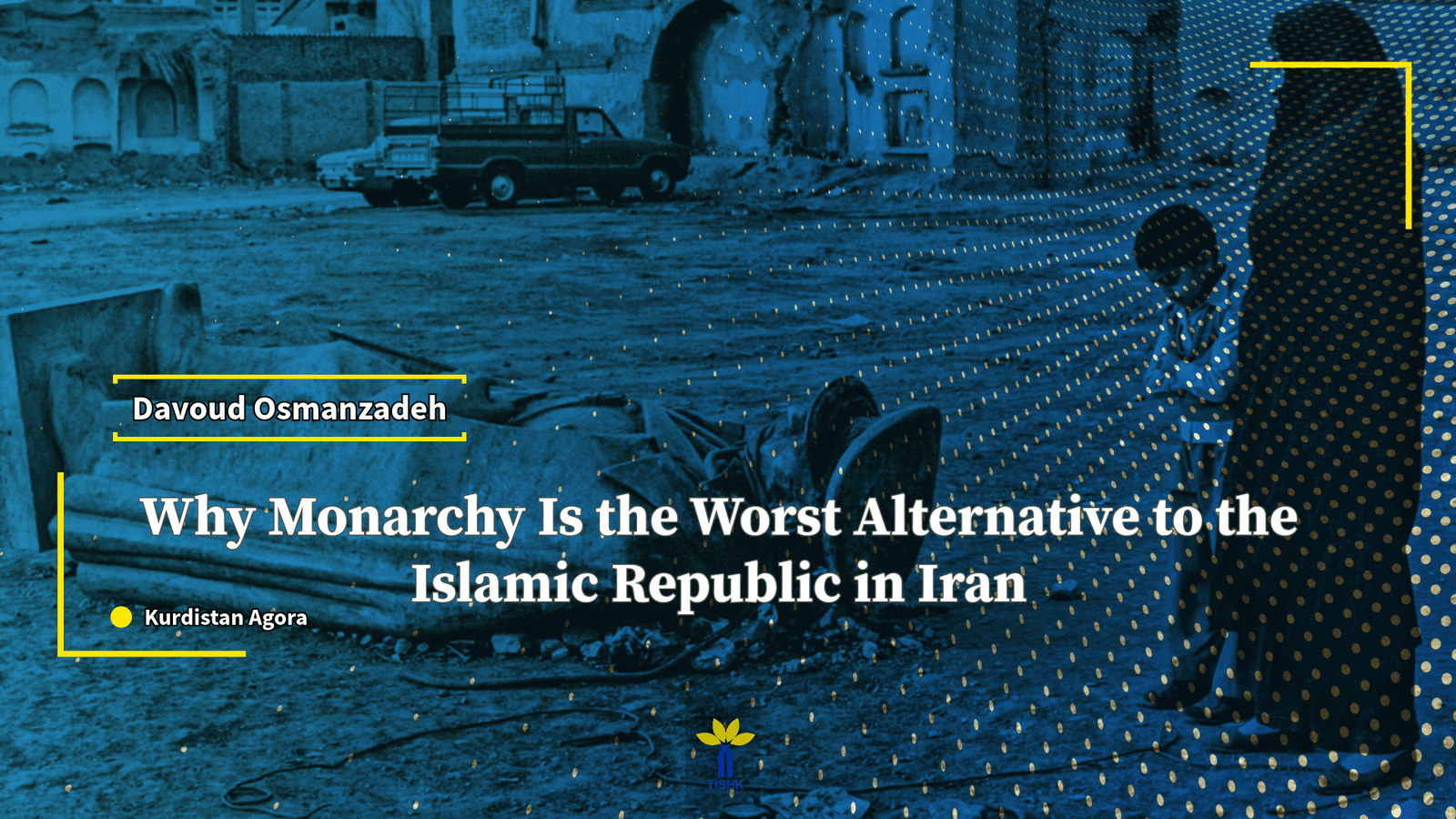
Davoud Osmanzadeh
Published online by TISHK Center for Kurdistan Studies: 06.01.2026
Abstract
This essay discusses that monarchy is not a viable alternative to the Islamic Republic in Iran, but a dangerous continuation of authoritarian rule in a different form. Situating the December 28, 2025 protests within a fifteen-year trajectory of escalating social unrest, it shows that contemporary movements have shifted from reformist demands to radical rejection of imposed authority. Against this background, the promotion of Reza Pahlavi as a unifying alternative appears historically anachronistic and socially disconnected. Drawing on Iran’s experience with dynastic authoritarianism and dictatorship, the essay highlights monarchism’s intolerance of pluralism, neglect of ethno-national and regional rights, and lack of a credible democratic transition plan, warning that it risks reproducing domination rather than dismantling it.
.

Keywords: Iranian protests، Authoritarianism، Monarchism، Political transition in Iran، Ethnic and social pluralism.
On December 28, 2025, a new wave of protests erupted in Iran, beginning with strikes and demonstrations by bazaar merchants in Tehran and rapidly spreading to other cities. Unlike many earlier protest cycles, these mobilizations unfolded in a moment of acute and multiple structural crisis. Iran had just suffered a heavy military setback following a twelve-day war with Israel. The reactivation of United Nations sanctions through the snapback mechanism, combined with renewed “maximum pressure” policies under the Trump administration, pushed the economy into one of its worst conditions in decades. At the same time, political divisions within the ruling elite deepened, while the regime’s already fragile legitimacy further eroded under the weight of sustained repression, economic collapse and corruption.
These protests did not emerge in isolation. They represent the latest expression of a long trajectory of socio-political unrest that has reshaped Iranian political life over the past fifteen years. Yet even as people once again risked their lives in the streets, a parallel narrative was being aggressively promoted outside this country. Persian-language media outlets abroad increasingly framed Reza Pahlavi, the son of the last shah, as the singular alternative to the Islamic Republic. In some cases, protest footage was manipulated, slogans were altered, and popular grievances were rebranded as monarchist demands. This attempt to appropriate a living protest movement highlight why monarchy represents not a solution, but one of the most dangerous alternatives for Iran’s future.
From Reform to Radical Rejection
The Green Movement of 2009 marked a historic rupture within the Islamic Republic. Initially framed around electoral fraud and reform within the system, the movement rapidly expanded after violent repression. Although its leadership remained cautious, its social base increasingly questioned the foundations of the regime itself. Later, the protests of 2017–2018 marked a decisive shift. They emerged from economically marginalized regions, involved working-class participants and ethno-nations minoritized, and rejected the regime outright from the beginning. Economic inequality, Persio-centrism, corruption, political repression, and the Islamic Republic’s regional military interventions were central grievances.
This trajectory culminated in 2022 following the state killing of Jina Amini. The Jin, Jiyan, Azadî (Woman, Life, Freedom) movement was unprecedented in scale, diversity, and radicalism. It centered women, youth, and marginalized communities and challenged not only the Islamic Republic, but the very logic of domination, control, and imposed authority. Against this background, the rebranding of monarchy as a “unifying alternative” appears not only anachronistic but fundamentally disconnected from the lived experience of contemporary Iranian society/ies.
Monarchy and the Logic of Authoritarian Continuity
Iran’s historical experience with monarchy is inseparable from dictatorship and authoritarian rule. Between 1925 and 1979, political power was highly centralized, dissent was systematically suppressed, and political participation was tightly controlled. This was not an accidental feature of monarchy in Iran; it was structural. Furthermore, the ideology and institutions of the state were rooted in Persian supremacy, systematically implementing the Persianization of non-Persian ethno-nation groups to enforce a singular national identity.
Reza Pahlavi has never offered a serious reckoning with this legacy. Rather than critically distancing himself from the authoritarian practices of his father and grandfather, he celebrates that period and draws legitimacy from dynastic inheritance. This is not merely symbolic. It signals a political imagination rooted in hierarchy rather than popular sovereignty.
More troubling still is the conduct of monarchist networks today. Even without formal power, they have engaged in silencing critics, harassing activists, manipulating protest footage, and appropriating popular movements to manufacture consent. A political project that suppresses dissent before taking power is unlikely to tolerate it afterward. Authoritarianism, dictatorship, and Persian supremacy do not disappear when ethno-religious ideology and institutions are replaced by ultranationalist nostalgia; it simply changes its language.
Monarchy in Iran has historically relied on aggressive centralization and cultural homogenization. Non-Persian ethno-nations were treated as obstacles to national unity. Linguistic rights, regional autonomy, and collective political claims were denied or criminalized. Contemporary monarchism has failed to break with this legacy. Calls for “territorial integrity” and “national unity” are repeatedly invoked without any concrete commitments to decentralization, collective rights, or power-sharing. For Kurds, Baluchis, Arabs, Turks, and other non-Persian ethno-nations, this rhetoric echoes a familiar pattern of exclusion. A political transition that ignores these realities risks reproducing internal colonial relations rather than overcoming them.
The political culture emerging around monarchism online is itself revealing. Monarchist digital spaces are often characterized by cult-like loyalty, misogyny, harassment, and coordinated attacks on feminists, republicans, leftists, and ethnic activists. This behavior is not marginal. It reflects a broader intolerance toward pluralism. Digital practices are not separate from political reality. They are rehearsals for it. A movement that cannot tolerate disagreement in virtual space is unlikely to do so in a democratic political order.
Perhaps most critically, monarchy offers no credible roadmap for transition. There is no clear position on constitutional design, transitional justice, accountability for past crimes, or mechanisms of inclusive power-sharing. Vague appeals to “national unity” function as placeholders rather than plans. History shows that transitions led by symbolic figures without institutional backing often end in either chaos or renewed authoritarianism.
A Step Backward, Not Forward
As of January 6, 2026, the current protests once again demonstrate that Iranian societies continue to resist authoritarian rule under conditions of extreme pressure. Replacing the Islamic Republic with monarchy would not represent progress; it would be a regression. Iran has already experienced dynastic authoritarianism and paid the price for it.
The demands emerging from contemporary movements are not for a return to a pre-1979 order, but for democracy, equality, dignity, and collective self-determination. The worst alternative to an authoritarian theocracy is not uncertainty; it is another form of authoritarianism disguised as salvation.
Other Research
Unequal Lands: War, Infrastructure, and Survival in Iran’s Kurdish Regions
Pasbar, Shna(2026): Unequal Lands: War, Infrastructure, and Survival in Iran’s Kurdish Regions. Published online by TISHK Center for Kurdistan Studies. Summary This article argues that the impact of conflict is [...]
Protests, Repression, and Iran’s Uncertain Future: A Look at Iranian Kurdistan
Pezeshk, Kouchar(2026): Protests, Repression, and Iran’s Uncertain Future: A Look at Iranian Kurdistan. Published online by TISHK Center for Kurdistan Studies. Summary In recent years, Iran has witnessed successive waves [...]
A New Balance of Power: Kurdistan’s Strategic Leverage in a Fragmenting Iran
Pasbar, Shna(2026): A New Balance of Power: Kurdistan’s Strategic Leverage in a Fragmenting Iran. Published online by TISHK Center for Kurdistan Studies. Summary As the regional conflict involving Iran intensifies, [...]