
Shahin Modarres
Broken and Suspended
Iranian Political Society Between the State’s Atrocities, External Destruction, and the Bankruptcy of Opposition
Published online by TISHK Center for Kurdistan Studies: Bonn, Germany: 2026
Summary
In the essay “Broken and Suspended,” international security analyst Shahin Modarres explores the paralyzed state of Iranian political society following the devastating Israeli and American military strikes of June 2025. Modarres argues that while the Islamic Republic is militarily shattered, the Iranian people remain in a “state of suspension,” a liminal condition where they are dispossessed by a repressive regime and bypassed by external actors. Central to this analysis is the “conceptual failure” of the organized opposition, which has historically internalised a permanent state of exception—indefinitely deferring democratic deliberation in favor of perpetual emergency. Through a game-theoretic lens, the author diagnoses a “coordination failure” where mutual fixation on the divisive figure of Reza Pahlavi has created a political void. Ultimately, the essay contends that true liberation must be an act of sovereign political construction by Iranians inside the country, rather than a gift from foreign militaries or diaspora factions.

Broken and Suspended
Iranian Political Society Between the State’s Atrocities, External Destruction, and the Bankruptcy of Opposition
“The state of exception is not a special kind of law (like the law of war); rather, insofar as it is a suspension of the juridical order itself, it defines law’s threshold or limit concept.”
— Giorgio Agamben, State of Exception (2005)
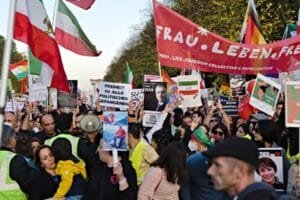
Iran solidarity demonstration, Berlin, October 2022 — the internal contradictions of the diaspora opposition made visible: Pahlavi signs alongside Woman, Life, Freedom banners at the same march.
I. Introduction: The Republic That Would Not Die, and the People Who Cannot Celebrate
There is a particular cruelty reserved for political situations in which one is robbed not only of one’s oppressor but also of one’s liberation. The Islamic Republic of Iran — a theocratic architecture responsible for forty-seven years of systematic repression, executions, torture, economic strangulation, and regional destabilisation — entered the summer of 2025 militarily broken. Between June 13 and June 24, 2025, Israeli and American strikes demolished Iran’s nuclear enrichment facilities at Natanz, Isfahan, and Fordow, killed senior military commanders and scientists, dismantled missile stockpiles, and punctured the mythology of the regime’s invincibility. Hundreds of billions of dollars invested across decades in a strategic deterrent evaporated in seventy-two hours. The Islamic Republic survived. But something was irrevocably taken — not from the regime, but from the Iranian people.
What was taken was the possibility of a dignified end. What remained was suspension.
This essay does not celebrate the strikes. It refuses to mourn the destruction of a genocidal regime’s weapons. But it insists on sitting with the profound political disorientation that followed: a population constitutionally against the Islamic Republic, politically leaderless, structurally demobilised, and now subject to geopolitical forces whose stated concern for Iranian sovereignty is, at minimum, contested. The Iranian people find themselves in a position of double disinheritance — dispossessed by a regime they reject and bypassed by the external actors who presume to act in their interest.
This essay argues that the Iranian opposition’s structural failure is not merely tactical or contingent. It is conceptual. For forty-seven years, the organised political opposition to the Islamic Republic has inhabited what Giorgio Agamben would recognise as a permanent state of exception — a political temporality defined by perpetual emergency, in which democratic deliberation, coalition-building, and long-term institutional imagination are indefinitely deferred in the name of the more pressing crisis. The result is a political movement chronically unprepared for the future it claims to be struggling towards.
The argument proceeds through four movements: a diagnosis of the current moment of suspension; a genealogy of the opposition’s structural failure; a critical analysis of the Pahlavi question and its consuming effect on Iranian political energy; and, finally, a game-theoretic reframing of the strategic choices available to an opposition that wishes to remain sovereign over its own political project.
II. The State of Suspension: Neither War nor Peace, Neither Hope nor Despair
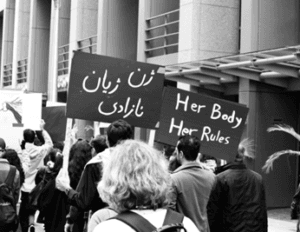
Diaspora protest, 2022 — ‘Zan, Zian, Azadi / Her Body Her Rules.’ The Zan, Zendegi, Azadi movement was the
most politically mature expression of Iranian civil society in the regime’s lifespan. The organised opposition
largely failed it
The sociological condition of the Iranian people in the spring of 2026 is best described not as crisis but as suspension — a liminal state in which the coordinates of political desire have become incoherent. Survey data from GAMAAN reveals a population whose political will is measurable but whose political vision is fractured. Approximately 70% of Iranians opposed the continuation of the Islamic Republic as of 2024, a number that reached 81% at the height of the Zan, Zendegi, Azadi (Woman, Life, Freedom) uprising in 2022. Support for the Islamic Republic’s ideological foundation declined from 18% in 2021 to 11% by 2024. Electoral turnout in presidential elections fell from approximately 85% in 2009 to around 40% in July 2024 — a democratic strike of remarkable scale conducted entirely in silence.
The desire to be rid of the Islamic Republic is, therefore, not in question. What is in question is what comes next, and more disturbingly, who decides. The population is divided between at least two incoherent camps, neither of which possesses genuine political agency. The first camp desires regime change by any available means. The second recoils from the same external forces whose strikes produced over a thousand Iranian casualties — not in defence of the Islamic Republic, but out of a conviction that no liberation worthy of the name can arrive on the wing of a foreign bomber.
The bitter irony is that both camps are correct, and both camps are impotent. Neither possesses the instruments to determine outcomes. Both have become spectators to their own political future. This is a structural condition of political subjectivity — what Hannah Arendt identified in The Origins of Totalitarianism as the destruction of the political person: the reduction of a people from actors in their own history to objects of others’ decisions. This suspension is the Islamic Republic’s most enduring achievement.
III. Forty-Seven Years in the State of Exception: The Opposition’s Conceptual Failure
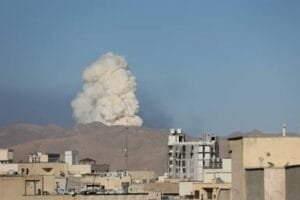
Smoke rises over an Iranian city following Israeli and US strikes, June 2025. A regime militarily broken — a people politically suspended.
Giorgio Agamben’s theorisation of the state of exception describes a juridico-political structure in which normal legal and constitutional frameworks are suspended in response to emergency, and in which this suspension — ostensibly temporary — becomes normalised, extended, and eventually constitutive of political reality itself. The sovereign is precisely the one who decides the exception.
The Islamic Republic has governed through a permanent state of exception since 1979. What has been insufficiently theorised, however, is the internalisation of this logic by the Iranian opposition itself. For forty-seven years, the structural grammar of oppositional politics has been the same argument: ‘We are in a critical juncture. Now is not the time for ideological divisions. We must unite around ending the Islamic Republic. Democratic deliberation will come after.’
This argument has been made in 1979. In 1981. After the Iran-Iraq War. After the Green Movement in 2009. After the 2019 uprising. After Zan, Zendegi, Azadi in 2022. After the June 2025 strikes. It is always now, and the future is always deferred. The critical juncture is permanent.
The political consequence is devastating. It produces a politics of pure negation — united only in what it opposes, incapable of articulating what it proposes. It structurally disadvantages actors who wish to think seriously about constitutionalism, pluralism, and the long-term architecture of a post-Islamic Republic Iran. It concentrates political authority in whoever can most credibly claim urgency — which historically advantages demagogues and the loudest voice in the room rather than the most politically competent actors.
The Zan, Zendegi, Azadi movement was a radical departure from this logic. It was leaderless by design, horizontally structured, and driven by a generation that had internalised neither the pre-revolutionary mythology of the Pahlavis nor the post-revolutionary disillusionment of the reformist left. It was a politics of embodied refusal. It was crushed. The organised opposition watched, squabbled, and largely failed it.
IV. The Pahlavi Problem: Delegitimisation by Consumption
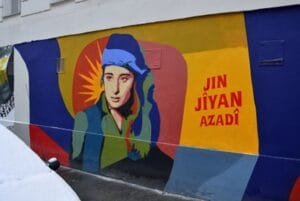
Jin Jiyan Azadi mural, Vienna, 2022 (artist: Btoy). The Woman, Life, Freedom movement was leaderless by design — a horizontal politics the diaspora establishment never understood. (Wikimedia Commons, CC BY-SA 4.0)
No honest analysis of the Iranian opposition’s structural failure can avoid the question of Reza Pahlavi, the son of the last Shah, who has emerged — through a combination of diaspora nostalgia, sustained media promotion, reported external backing, and the opposition’s own vacuum of alternatives — as the most recognised figure in the anti-Islamic Republic landscape.
GAMAAN’s 2024 data records Pahlavi as the most popular named opposition figure at 31% — a figure that reflects name recognition as much as political endorsement, and which must be read alongside the fact that the second and third most popular figures — rapper Toomaj Salehi at 6% and Nobel laureate Narges Mohammadi at 5% — are both, at various points, imprisoned inside Iran. The asymmetry is itself diagnostic.
Pahlavi’s interference in the Zan, Zendegi, Azadi movement was, by multiple analyses, counterproductive. His insertion into a structurally leaderless movement imposed a retrograde framework of monarchist symbolism onto a post-monarchist generation. His online support infrastructure systematically attacked other prominent opposition figures: activist Hamed Esmaeilion, Nobel Prize winner Narges Mohammadi, journalist Masih Alinejad, and rapper Toomaj Salehi were all targeted. His chief political advisor reportedly promoted labelling non-monarchist
dissidents as ‘leftists,’ ‘separatists,’ and ‘terrorists.’
The remainder of the organised opposition, for its part, made the Pahlavi question the almost exclusive site of its political activity. A project of delegitimisation that has largely succeeded — but at the cost of having built nothing in its place. This is the structural trap: the Pahlavists consumed the opposition’s positive energy by monopolising the symbolic space; the anti-Pahlavists consumed the opposition’s critical energy by making Pahlavi the primary referent of their politics. Both sides collaborated, through this mutual fixation, in the production of a political void.
V. Game Theory and the Architecture of the Political Blockade
The condition described above — multiple actors in a political field, none able to achieve their objectives unilaterally, each making decisions that systematically worsen collective outcomes — is precisely the object of game-theoretic analysis. The Iranian opposition’s deadlock has a structure, and structures, unlike personalities, are susceptible to analysis and redesign.
The dominant game being played is what game theorists recognise as a coordination game with multiple equilibria: the payoff to any individual actor depends heavily on what other actors do, but the actors cannot agree on which equilibrium to coordinate upon. The relevant equilibria are: (1) monarchist transition, (2) secular republican transition, (3) federal/decentralised transition, and (4) continued Islamic Republic with reforms. Each coalition prefers one equilibrium and refuses to coordinate on any other, even when that alternative is superior to indefinite Islamic Republic rule.
The result is a multipolar coordination failure — each actor playing rationally given their expectations, but the collective outcome suboptimal for virtually all parties. This is the predictable product of a political field without credible commitment mechanisms, shared information, or institutions capable of binding agreements.
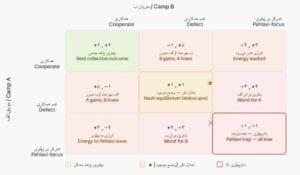
Figure 1. Coordination failure payoff matrix for the Iranian opposition. The Nash equilibrium (★, status quo,
+1/+1) is stable but deeply suboptimal relative to the cooperative outcome (+4/+4). The Pahlavi trap (✕) is worse than the status quo for all parties. (Original diagram, May 2026)
Thomas Schelling’s analysis of focal points in The Strategy of Conflict (1960) is instructive here. In coordination games without explicit communication, actors tend to coordinate on ‘salient’ options — outcomes particularly visible or symbolically resonant, regardless of whether they represent the collectively optimal solution. Reza Pahlavi’s prominence functions as a Schelling focal point: actors who cannot agree on anything else can at least agree on whether to support or oppose Pahlavi, and this negative salience has become the organising principle of Iranian diaspora politics to the exclusion of almost everything constructive.
The strategic escape from this blockade requires what Elinor Ostrom called polycentric institutional design — multiple overlapping frameworks allowing actors with divergent preferences to coordinate on specific, bounded objectives without requiring comprehensive agreement on ultimate political outcomes. Applied to the Iranian opposition, this means a reorientation away from the question ‘what political system will replace the Islamic Republic?’ — which activates all points of maximum disagreement — toward more tractable coordination problems: shared human rights standards, international legal mechanisms, transitional justice frameworks, and governance structures for a post-regime transitional period that do not predetermine the outcome of a free referendum.
Both the pro-war and anti-war positions, as currently configured, represent dominated strategies — strictly inferior to available alternatives once one accounts for the full strategic environment. The interventionist position treats external actors as reliable instruments of Iranian liberation. The anti-interventionist position implicitly treats the Islamic Republic as a lesser evil. The dominated strategy for both camps is the same: passivity. The superior strategy — available but unchosen — is active political construction.
VI. The Iranian People as Political Subjects, Not Geopolitical Objects
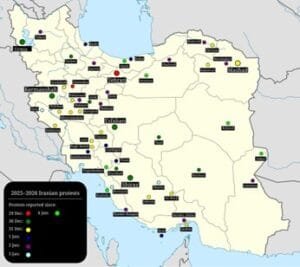
Map of 2025–2026 Iranian protests. The will to end the Islamic Republic is measurable and geographically widespread — the political architecture to replace it remains unbuilt. (Wikimedia Commons, CC BY-SA 3.0)
This essay has argued that the Islamic Republic is a criminal enterprise responsible for systematic crimes against the Iranian people and the people of the broader Middle East over forty-seven years. It has argued that the opposition has failed structurally, not merely tactically. It has argued that the current moment of suspension represents a particularly acute instance of a long-standing pattern of political disinheritance.
The Iranian people are not a problem to be solved. They are a political subject with a forty-seven-year history of resistance — through the Green Movement, through the 2019 uprisings, through Zan, Zendegi, Azadi — that has repeatedly demonstrated extraordinary courage in conditions of extreme repression. The regime’s survival has not been a product of popular consent. It has been a product of violence, institutional entrenchment, and the systematic exploitation of the opposition’s structural weaknesses.
What is required is not a saviour — not a charismatic leader, not a foreign military campaign, not a diaspora coalition that speaks for Iranians while insulated from the consequences of its prescriptions. What is required is the construction of a political framework that takes the heterogeneity of Iranian society seriously: its ethnic plurality, its generational divides, its divergent visions of secularism and religiosity, its legitimate regional and class grievances.
The Islamic Republic must end. That is not a preference; it is a moral conclusion from the evidence of four and a half decades of systematic inhumanity. But the ending of the Islamic Republic is not, by itself, the beginning of justice. The beginning of justice requires that the Iranian people be the agents, not the objects, of their own political transformation. That the right to determine Iran’s political future belong to Iranians inside Iran — the people who have borne the actual cost of
resistance — rather than to diaspora factions, foreign governments, or the sons of deposed kings.
This position is not neutrality. It does not bend the knee to the Islamic Republic, whose crimes are documented and whose legitimacy is exhausted. It does not bend the knee to external actors whose interest in Iranian sovereignty is, at best, instrumental. It is the assertion of a political standard: that liberation without sovereignty is not liberation, and that any political project worthy of the name must be accountable, first and finally, to the people in whose name it is conducted.
The state of exception must end. Not by the arrival of the right strongman or the right foreign intervention. It must end by the Iranian people and their representatives making a deliberate, collective decision to exit the temporality of permanent emergency and begin the slow, difficult, unglamorous work of political construction. The political future of Iran cannot be wished into existence. It must be built. And it must be built by Iranians.
References
Agamben, G. (2005). State of Exception. University of Chicago Press. https://philpapers.org/rec/AGASOE
Arendt, H. (1951). The Origins of Totalitarianism. Schocken Books.
Azizi, A. (2024). What Iranians Want: Women, Life, Freedom. Oneworld Publications. https://oneworld-publications.com/work/what-iranians-want/
Abdorrahman Boroumand Center. Iran Human Rights Monitor (annual). https://www.iranrights.org/newsletter
Golkar, S. (2025). Humiliation and Transformation: The Islamic Republic After the 12-Day War. Foreign Policy Research Institute. https://www.fpri.org/article/2025/10/humiliation-and-transformation-the-islami c-republic-after-the-12-day-war/
GAMAAN (2025). Iranians’ Political Preferences in 2024: Analytical Report.
https://gamaan.org/2025/08/20/analytical-report-on-iranians-political-preferences-in-2024/
Journal of Democracy (2025). The Islamic Republic’s War on Iranians (Boroumand, L.). https://www.journalofdemocracy.org/articles/the-islamic-republics-war-on-iranians/
Middle East Forum (2025). Has Reza Pahlavi Become the Opposition to Iran’s Opposition? https://www.meforum.org/mef-observer/has-reza-pahlavi-become-the-opposition-to-irans-opposition
Middle East Forum (2026). After the Protests: Who Can Lead Iran? https://www.meforum.org/mef-reports/after-the-protests-who-can-lead-iran
Ostrom, E. (1990). Governing the Commons. Cambridge University Press.
Schelling, T. (1960). The Strategy of Conflict. Harvard University Press.
Other Research
The Delusions of National Unity: Why Promoting Autocracy Won’t Bring Democracy
Sharif Behruz Strategic Policy Analyst and Managing Editor of Kurdistan Agora Published online by TISHK Center for Kurdistan Studies: Bonn, Germany: 2026 Summary This critique examines [...]
A Brief Derridean Reading of “A Cautionary Manifesto by Iranian Cultural Figures” That Opposes Kurdish Newroz
A Brief Derridean Reading of “A Cautionary Manifesto by Iranian Cultural Figures” That Opposes Kurdish Newroz. Published online by TISHK Center for Kurdistan Studies. The Point Since April 9, 2025, [...]
Democratic Pathways: Assessing the Kurdish Political Experience in the Middle East
Pasbar, Shna(2026): Democratic Pathways: Assessing the Kurdish Political Experience in the Middle East. Published online by TISHK Center for Kurdistan Studies. Summary In this article, Shna Pasbar examines the evolution [...]