
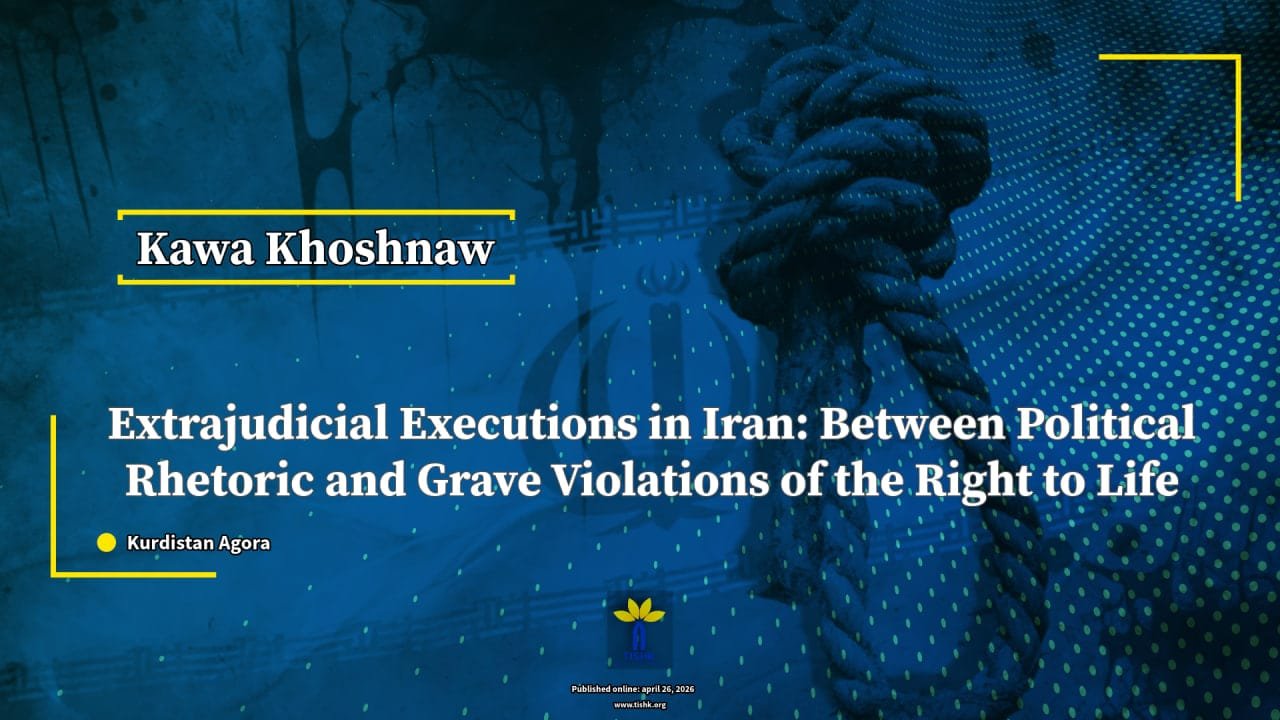
Khoshnaw, Kawa(2026): Extrajudicial Executions in Iran: Between Political Rhetoric and Grave Violations of the Right to Life. Published online by TISHK Center for Kurdistan Studies.
Summary
This article shows how the Iranian government employs a “conspiracy narrative” to mask systemic human rights violations and justify the suppression of dissent. By consistently blaming external actors for domestic crises, the state creates a political smokescreen that diverts public attention from internal economic and political failures while legitimizing restrictive security measures. It argues that this entrenched approach to repression extends beyond national borders, significantly impacting Kurdish populations both within Iran and in the Kurdistan Region of Iraq. Ultimately, the piece highlights a dangerous disconnect between the government’s political rhetoric and its concrete actions, which frequently result in extrajudicial executions and grave violations of the internationally recognized right to life.

Extrajudicial Executions in Iran: Between Political Rhetoric and Grave Violations of the Right to Life
Kawa Khoshnaw[1]
Amid the continuing escalation of regional tensions in the Middle East, the Islamic Republic of Iran has persistently relied on a structured political narrative centered on accusations of external conspiracies. This strategy appears aimed at fostering internal insecurity while justifying increasingly restrictive security policies toward Iranian citizens and suppressing political opposition. However, this rhetoric often coincides with concrete state practices that raise serious legal concerns, particularly regarding alleged extrajudicial executions and grave violations of internationally recognized human rights law.
These developments also reflect broader patterns of policy and governance that suggest an entrenched approach toward repression, not only domestically but also in relation to regional dynamics, including the Kurdistan Region of Iraq and Kurdish populations more broadly, including those within Iran border.
Conspiracy Narratives as a Political Tools
For decades, the Islamic republic of Iran has relied on attributing internal crises to external actors. These accusations are frequently presented as explanations for domestic instability, thereby diverting attention from economic and political challenges within the country. In many cases, such claims lack credible supporting evidence and remain within the realm of political discourse rather than objective fact.
At the same time, the broader international landscape indicates that the Islamic Republic of Iran has engaged in extensive regional and extra-regional activities, including involvement in countries such as Iraq, Syria, Lebanon, and Yemen, with its influence reportedly extending beyond the Middle East into Latin America particularly through strategic ties with Venezuela and into Africa, including reported involvement in conflicts such as Sudan.
This apparent contradiction between rhetoric and practice raises serious questions regarding the credibility of official Iranian claims.
The Kurdistan Region Within the Narrative
Accusations directed toward the Kurdistan Region of Iraq are frequently articulated within this broader political and security framework, often without substantiated evidence. Following the 2003 intervention in Iraq by the United States, the Kurdistan Region has operated within a complex constitutional arrangement under the sovereignty of Iraq, while lacking full sovereign protection within the international system.
This context has contributed to its vulnerability in regional power dynamics. At the same time, such accusations may serve to generate concern among Kurdish communities, particularly given the historical and ongoing political, economic, and security pressures faced by Kurdish populations within Iran border.
These claims stand in contrast to the established political conduct of the Kurdistan Region, which, since its formation in the early 1990s under international protection, has maintained a policy of non-interference in the internal affairs of neighboring states. The Kurdistan region Government has also engaged in regional cooperation initiatives and mediation efforts, while refraining from allowing its territory to be used as a platform for cross-border military operations against Iran. Kurdish opposition groups operating in the region have similarly adhered to restrictions imposed by the KRG authorities.
Extrajudicial Executions as Grave Human Rights Violations
Within this broader context, the issue of extrajudicial executions emerges as one of the most serious concerns. The imposition of the death penalty without fair trial guarantees, or on the basis of confessions allegedly obtained under coercion or torture, constitutes a clear violation of international human rights law.
The International Covenant on Civil and Political Rights guarantees the right to life under Article 6 as a non-derogable right and categorically prohibits torture and cruel, inhuman, or degrading treatment under Article 7. These obligations are binding in all circumstances and admit no justification based on security or political grounds.
Reports by international human rights organizations indicate that executions in Iran often fail to meet minimum international standards of due process and fair trial. In such cases, executions may amount to arbitrary deprivation of life, constituting a serious violation of international human right law.
Notably, reports identify approximately 30 individuals facing execution, including minors, which raises significant concerns regarding compliance with international standards on the rights of the child and the absolute prohibition on imposing the death penalty for offences committed by persons under 18.
Between Rhetoric and Justification
The simultaneity of intensified political rhetoric and the implementation of repressive measures including executions and the suppression of protests raises critical concerns regarding the use of political and media narratives as a precursor to more restrictive state practices.
Rather than addressing internal challenges through reform and engagement, external escalation and security-based narratives appear to function as mechanisms for legitimizing both domestic repression and broader regional policies.
The Right to Life as a Fundamental Norm
The protection of the right to life and the prohibition of torture constitute foundational principles of international human rights law. No state, including Iran, can evade these obligations under the pretext of political, security, or ideological justification.
Even in the context of regional tensions involving the United States and Israel, the continuation of practices such as expedited executions without fair trial guarantees raises serious concerns regarding the use of punitive measures as instruments of intimidation against civilian populations.
Ensuring accountability, transparency, and independent investigations into such cases is essential for upholding the rule of law and protecting human dignity. In light of ongoing violations, the role of the international community remains critical in monitoring, documenting, and addressing these practices, as well as in preventing impunity through appropriate legal and diplomatic measures.
[1] Kawa Khoshnaw holds a Master’s in International Operational Law from the Swedish Defence University and specializes in human rights, armed conflict law, and UN peace processes. He leverages extensive experience across governmental administration and the diplomatic corps to navigate complex global legal frameworks.
Other Research
The Opposition’s Kurdish Blind Spot: How Chauvinism Sabotages the Fight for Iran
Shna Pasbar The Opposition’s Kurdish Blind Spot: How Chauvinism Sabotages the Fight for Iran Published online by TISHK Center for Kurdistan Studies: Bonn, Germany: 2026 Summary This article examines how [...]
The Paper Tiger’s Decapitation and the Path to a New Iran
Sharif Behruz Strategic Policy Analyst and Managing Editor of Kurdistan Agora Published online by TISHK Center for Kurdistan Studies: Bonn, Germany: 01 March 2026 Summary The article argues [...]
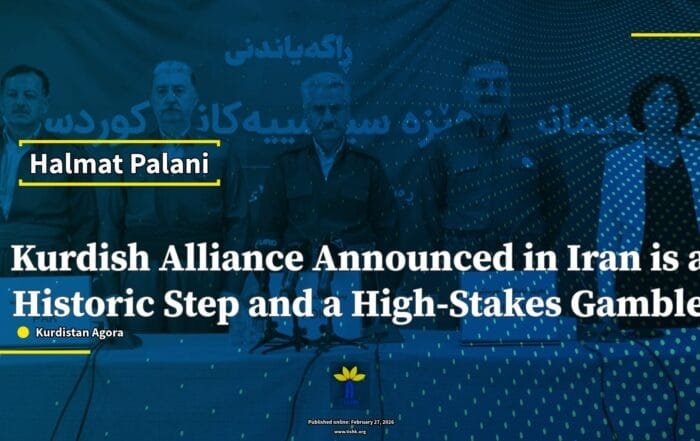
Kurdish Alliance Announced in Iran is a Historic Step and a High-Stakes Gamble
Halmat Palani Halmat Palani is a political analyst and freelance writer who focuses on politics, governance and foreign policy in the Middle East, Iran, and Kurdistan. His articles have appeared in The [...]