Halmat Palani
Halmat Palani is a political analyst and freelance writer who focuses on politics, governance and foreign policy in the Middle East, Iran, and Kurdistan. His articles have appeared in The Washington Times, The Jerusalem Post, Fair Observer, Kurdistan24, Rudaw, and BasNews.
Published online by TISHK Center for Kurdistan Studies: Bonn, Germany: 28 February 2026
Summary
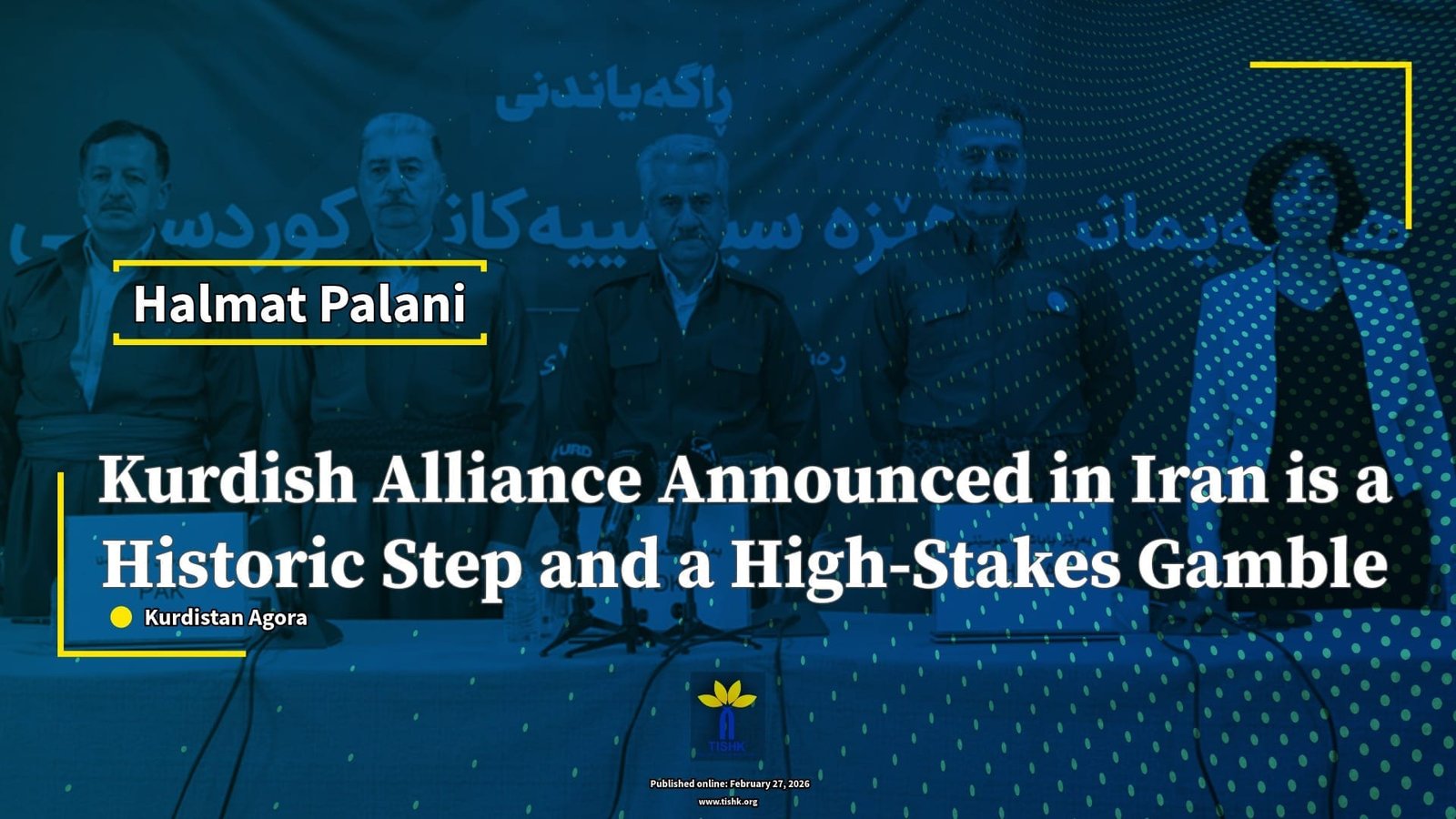
On February 22, 2026, five major Kurdish parties in Eastern Kurdistan: the Kurdistan Freedom Party, Kurdistan Free Life Party, Democratic Party of Iranian Kurdistan, Khabat Organization of Iranian Kurdistan, and Komala of the Toilers of Kurdistan, formed a historic alliance aimed at overcoming longstanding fragmentation and strengthening Kurdish leverage in anticipation of potential upheaval in Iran. The article argues that while the coalition represents a significant step toward political consolidation and preparedness for a post Islamic Republic transition grounded in self determination, democracy, and national rights, it is also a high stakes gamble constrained by internal ideological differences, the non-participation of some factions, regional limitations, and ongoing security threats from the Islamic Revolutionary Guard Corps. Ultimately, it contends that the alliance’s success will depend not just on regime collapse but more so on its ability to institutionalize unity, develop coherent military and governance structures, and withstand geopolitical pressures.

On February 22, 2026, five major Kurdish political forces of Iranian or Eastern Kurdistan announced the formation of an alliance. The signatories to this alliance include the Kurdistan Freedom Party (PAK), the Kurdistan Free Life Party (PJAK), the Democratic Party of Iranian Kurdistan (PDKI), the Khabat Organization of Iranian Kurdistan, and the Komala of the Toilers of Kurdistan.
This development marks one of the most significant attempts in recent decades to consolidate Kurdish political forces in Eastern Kurdistan around a unified national framework after years of fragmentation, rivalry, and ideological divergence.
At its core, the formation of the coalition signifies a realization that the Islamic Republic has lost political legitimacy yet remains in power largely because of the fragmentation of its opposition. For Kurdish people, the announcement carries deep national significance as it demonstrates the potential for a coordinated military, political and organizational Kurdish front capable of advocating and defending the Kurdish people and preventing the marginalization of Kurdish demands in any future transformation inside Iran.
What Have the Parties Agreed Upon?
The coalition’s declaration outlines clear shared objectives. Foremost among them is the struggle for the overthrow of the Islamic Republic and the realization of the Kurdish people’s right to self determination through the establishment of a national and democratic political entity in Eastern Kurdistan based on the political will of its people.
Beyond the central objectives above, the agreement affirms the alliance’s commitment to several core principles. The parties pledge support for democracy, secular governance, social justice, environmental protection, gender equality, and the safeguarding of the rights of all national and religious communities within Kurdistan. They call for free elections and the institutionalization of democratic governance structures in Eastern Kurdistan.
At the national level, they emphasize support for the struggles of other peoples and nations within Iran against dictatorship. However, they make clear that any alliance with broader Iranian opposition forces must rest on three foundations: official recognition of the national rights of the peoples of Iran, acceptance of democracy, and rejection of all forms of dictatorship.
The coalition also stresses the necessity of coordination during a transitional period should the Islamic Republic fall. As explained in remarks to Radio Farda by PDKI leader, Mustafa Hijri, one of the primary motivations behind the eight months of negotiations was to establish a joint plan for administering Iranian Kurdistan during a transitional phase. According to Hejri, once a new central government is formed, governing bodies in Kurdistan would be elected through a free vote by the people.
Can This Unity Hold?
The formation of the coalition is significant, but its durability remains uncertain. Kurdish political history has been shaped by both cooperation and fragmentation. Ideological differences and competing strategies have often undermined attempts at sustained unity. This alliance attempts to move beyond that pattern, yet maintaining cohesion will require more than shared opposition to Tehran. It will require institutional clarity, discipline, and a willingness to subordinate factional interests to collective strategy.
Two of the original seven parties within the Center for Dialogue did not sign the final agreement. These parties include the Komala faction led by Abdullah Mohtadi and the Komala Communist Party of Kurdistan (CPI). Their absence reflects lingering differences within the Kurdish political sphere. Nevertheless, the coalition has explicitly stated that the door remains open for other Kurdish parties and political forces to join, signaling that this is intended as an expanding national front rather than a closed alignment.
The more consequential question lies ahead. Can the five signatories translate political declaration into operational structure? Integrating Peshmerga forces under a unified command, drafting a transitional governance framework, coordinating international diplomacy, and clarifying decision making mechanisms are essential next steps if this alliance is to endure.
How Do Regional Realities Shape the Coalition?
Beyond internal challenges, the coalition faces significant geopolitical constraints. Although these parties maintain Peshmerga forces operating near the borders and in limited clandestine capacities inside Iran, their main bases are located within the Kurdistan Region of Iraq. On the same day as the coalition announcement, the Ministry of Interior of the Kurdistan Regional Government issued a statement emphasizing that the Kurdistan Region has always been a factor of stability and peace and will not allow any party to use its territory against a neighboring country.
This explicit rejection by the KRG significantly limits the coalition’s operational freedom. It means that if the coalition seeks to act decisively during a period of Iranian instability, it must find alternative bases or safe havens outside the KRG’s territory. Given the current regional environment, it is reasonable to assume that such contingency planning is already under consideration within the coalition.
At the same time, the security risk is immediate to the coalition parties. The Islamic Revolutionary Guard Corps (IRGC) has repeatedly carried out cross-border strikes against Kurdish political party bases in KRG in previous years. Should tensions between Washington and Tehran escalate, Kurdish positions could again become targets. Therefore, the coalition must carefully balance legitimacy, visibility, and survival under these constraints, as the margin for error is narrow and the threats from the regime are very real and can prove costly.
Is This a Calculated Gamble?
All of this unfolds against a volatile geopolitical backdrop. The coalition appears to be preparing for the possibility of major upheaval inside Iran, whether triggered by internal collapse, external military confrontation, or a combination of both.
If the Islamic Republic weakens or falls, a unified Kurdish front will be far better positioned to articulate clear demands and prevent Kurdish aspirations from being sidelined in a post regime order. However, if no such rupture occurs, it remains unclear whether the coalition is prepared or capable of sustaining a prolonged armed struggle without substantial regional or international backing. Armed confrontation with the Islamic Republic is not merely a question of resolve but of resources, strategy, and external support.
The coalition’s strength may ultimately depend less on regime collapse and more on its ability to build durable political and institutional foundations irrespective of immediate geopolitical shifts.
Will the Alliance Last?
Nevertheless, the formation of this coalition represents an important and historic first step toward Kurdish unity in Eastern Kurdistan. It reflects political maturation and a recognition that fragmentation weakens leverage at decisive moments. Yet unity on paper is not the same as unity in structure and action. The alliance has not yet consolidated a unified military command, finalized a transitional administrative framework, or established itself as a functioning government in exile capable of operating under sustained pressure. The sooner these goals can be actualized, the more prepared the Kurds can be for responding to new developments in Iran and obtaining recognition of their rights in a new and democratic Iran. As former U.S. ambassador and constitutional expert Peter Galbraith explained on December 13, 2025 during a conference in the French Senate in Paris on Syria, “The key to the success of the Kurds in the constitutional negotiations in Iraq was that they were so well prepared” that they were able to achieve full federalist autonomy. The same applies to the Kurds in Iran as it did with the Kurds in Iraq and Syria.
Ultimately, whether this moment becomes a turning point or a missed opportunity will depend on what follows. The durability of this alliance will be tested by internal discipline, institutional development, regional constraints, and the unpredictable trajectory of events inside Iran. The parties have demonstrated their unity through the formation of this alliance but it is too early to say if they will endure the unfolding threats and opportunities that may emerge as the political and economic circumstances in Iran and the region destabilize.