
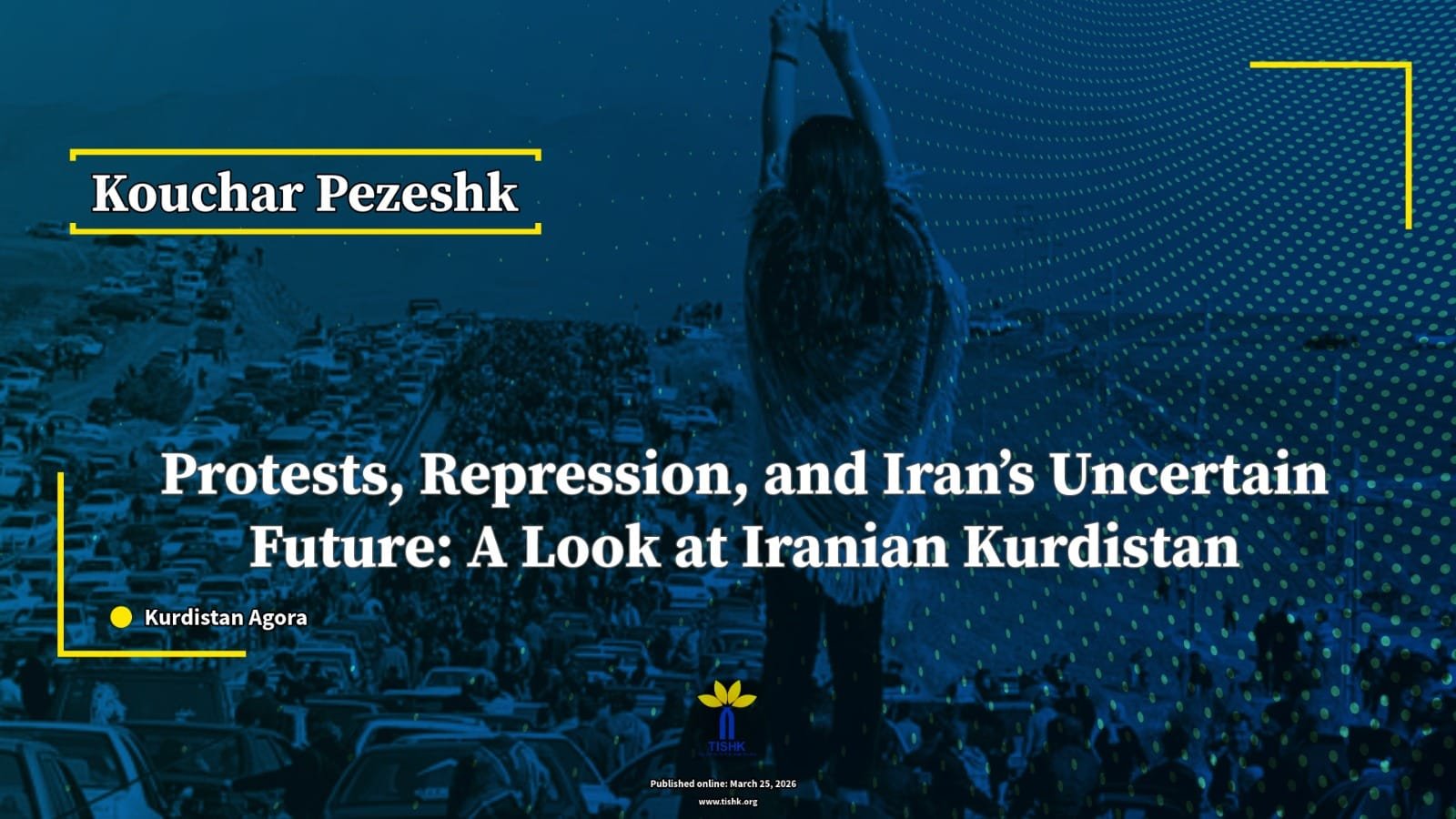
Pezeshk, Kouchar(2026): Protests, Repression, and Iran’s Uncertain Future: A Look at Iranian Kurdistan. Published online by TISHK Center for Kurdistan Studies.
Summary
In recent years, Iran has witnessed successive waves of popular protests—movements rooted in deep economic, political, and social crises. From nationwide uprisings to localized unrest, what stands out most is the persistence of public dissatisfaction and its expansion across diverse segments of society. In this context, Iranian Kurdistan has emerged as one of the primary centers of protest, playing a significant role in shaping this broader trajectory.

Protests, Repression, and Iran’s Uncertain Future: A Look at Iranian Kurdistan
In recent years, Iran has witnessed successive waves of popular protests—movements rooted in deep economic, political, and social crises. From nationwide uprisings to localized unrest, what stands out most is the persistence of public dissatisfaction and its expansion across diverse segments of society. In this context, Iranian Kurdistan has emerged as one of the primary centers of protest, playing a significant role in shaping this broader trajectory.
Kurdistan, due to its historical legacy of struggle for political and cultural rights, has consistently remained at the forefront of protest movements. The region not only faces the general challenges affecting Iran—such as inflation, unemployment, and systemic corruption—but also grapples with compounded forms of discrimination, including ethnic marginalization, securitization, and underdevelopment. These overlapping pressures have given rise to demands that are both deeper and more radical in nature.
During recent protests, cities in Kurdistan were among the first to take to the streets, elevating the movement beyond purely economic grievances. The slogans clearly reflected a shift away from reformist aspirations toward calls for fundamental structural change within the political system. This transformation in discourse represents a serious warning signal for the ruling establishment.
In response, the government’s reaction—while predictable—has been increasingly severe. Widespread repression, deployment of military forces, mass arrests, and intensified security measures—particularly in Kurdistan—demonstrate an approach focused on control and silencing dissent rather than addressing underlying demands. This strategy has not only failed to quell protests but has further deepened the divide between the state and society.
A notable development is the growing connection between protests in Kurdistan and those in other regions of Iran. Unlike in the past, when protests were largely confined to specific areas, a form of nationwide solidarity is now emerging. Although this solidarity has yet to evolve into a fully organized movement, it holds the potential to become a decisive force in shaping Iran’s political future.
Nevertheless, the future remains uncertain. On one hand, continued repression may further restrict political space and increase the cost of dissent. On the other, the accumulation of grievances and the absence of meaningful reform prospects raise the likelihood of more widespread and explosive social upheavals. Under such conditions, Kurdistan will likely continue to serve as a critical and influential focal point in the country’s unfolding developments.
Ultimately, what is currently taking place in Iran—particularly in Kurdistan—is not merely a series of isolated protests, but rather a manifestation of a profound structural crisis. Without fundamental changes in governance, this crisis will not only persist but may escalate to a potentially irreversible stage.
Other Research
Protests, Repression, and Iran’s Uncertain Future: A Look at Iranian Kurdistan
Pezeshk, Kouchar(2026): Protests, Repression, and Iran’s Uncertain Future: A Look at Iranian Kurdistan. Published online by TISHK Center for Kurdistan Studies. Summary In recent years, Iran has witnessed successive waves [...]
A New Balance of Power: Kurdistan’s Strategic Leverage in a Fragmenting Iran
Pasbar, Shna(2026): A New Balance of Power: Kurdistan’s Strategic Leverage in a Fragmenting Iran. Published online by TISHK Center for Kurdistan Studies. Summary As the regional conflict involving Iran intensifies, [...]
The Delusions of National Unity: Why Promoting Autocracy Won’t Bring Democracy
Sharif Behruz Strategic Policy Analyst and Managing Editor of Kurdistan Agora Published online by TISHK Center for Kurdistan Studies: Bonn, Germany: 2026 Summary This critique examines [...]