
Sharif Behruz
Strategic Policy Analyst and Managing Editor of Kurdistan Agora
Published online by TISHK Center for Kurdistan Studies: Bonn, Germany: 2026
Summary
This critique examines the Foundation for Defense of Democracies (FDD) and its recent analytical shift regarding the Iranian opposition. The author argues that the FDD—specifically through the work of analysts like Janatan Sayeh and Saeed Ghasseminejad—has traded pluralistic democratic principles for a Persian-centric, monarchist agenda that promotes centralized autocracy over ethnic inclusion.

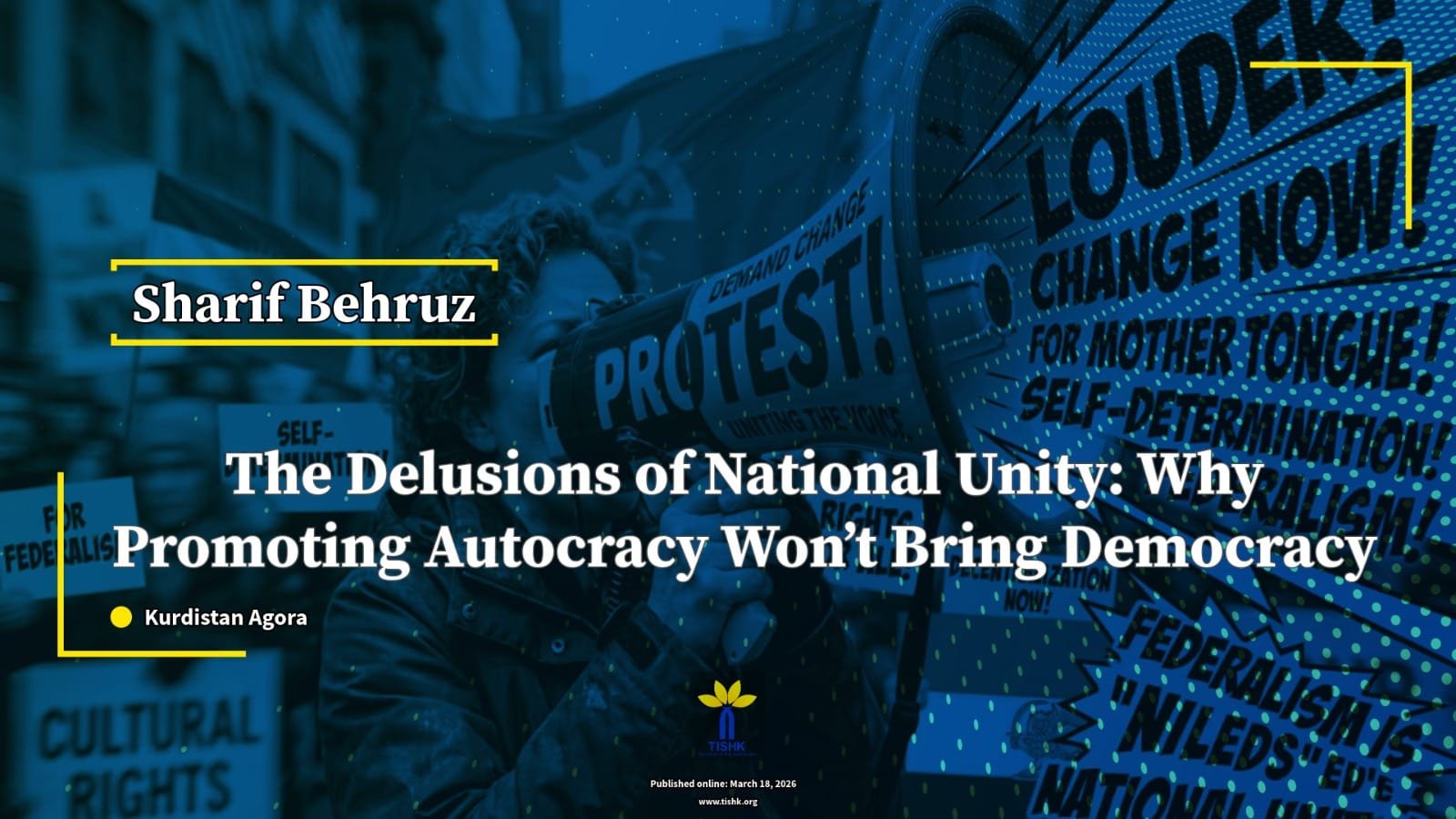
The Delusions of National Unity: Why Promoting Autocracy Won’t Bring Democracy
The Foundation for Defense of Democracies (FDD), through recent analysis by research analyst Janatan Sayeh, has argued that U.S. and Israeli support for Iranian Kurdish groups would hand the Islamic Republic a “lifeline” by fueling “separatism.” While Sayeh’s work claims to prioritize national unity, its reliance on broad labeling and a rigid, Persian-centric view of opposition politics creates significant analytical gaps. This perspective is not an outlier; it reflects an institutional culture that increasingly prioritizes exclusionary nationalist narratives over the pluralistic requirements of a true democracy.
A Culture of Exclusion and the Financial Engine of Influence
The ideological narrowing found in the FDD’s current analysis appears rooted in an internal culture that treats ethnic rights as a threat to the state. A striking example occurred in February 2019, on International Mother Language Day, when FDD senior advisor Saeed Ghasseminejad used his platform to attack movements advocating for non-Persian language education. Ghasseminejad characterized these basic cultural demands as a front for extremism, stating that the goal of the opposition is not to hand Iran over to a bunch of “separatist, fascist, and racist wolves who will tear it apart.”
This hostility prompted immediate concern from those who believe that democracy is not merely a majority rule, but a system that must be fundamentally inclusive. To deny a people the right to be educated in their own mother tongue is not a policy disagreement; it is a hallmark of authoritarianism and an attempt to erase the cultural identity of the peripheries.
At the time, notes were sent to FDD’s President, Clifford May, and associates including Mark Dubowitz and the late Michael Ledeen, suggesting that such rhetoric belonged in a “Federation for Defense of Dictatorships,” not the FDD. Yet, years later, this alignment has only sharpened. Dubowitz, a central figure at the FDD, has emerged as a prominent proponent of Reza Pahlavi, regularly promoting and appearing on the Pahlavi-aligned station, Iran International.
In the world of Washington think tanks, such shifts are rarely purely ideological; they are often lubricated by financial interests. Just as academic circles have been influenced by capital from Doha or Beijing, the FDD’s pivot toward the monarchist camp must be viewed through the lens of “pay-to-play” politics. The Pahlavi camp possesses the endless cash reserves that think tanks depend on for survival. When an institution’s survival is tethered to a specific faction, its “independent analysis” naturally begins to mirror the agenda of its benefactors.
The trajectory of Ghasseminejad himself illustrates this shift. Once a vocal critic of the Pahlavi monarchy’s centralized rule, his transformation into a senior advisor to Reza Pahlavi and the chief architect of the “Emergency Phase” transitional booklet represents a total ideological reversal. Given his position at the FDD, it is difficult to view this roadmap—which critics argue further marginalizes the peripheries to drift Iran back into another cycle of dictatorship—as anything other than a product of the FDD’s own ecosystem. This raises a fundamental question: Is the organization a Foundation for the Defense of Democracies, or a Foundation to Develop Despots?
The “Separatist” Fallacy and the Autocratic “Solution”
To pave the way for such a centralized restoration, the FDD’s output must first delegitimize pluralistic alternatives. This is where Janatan Sayeh’s analysis functions as the rhetorical muscle for the Ghasseminejad roadmap. Sayeh’s core argument relies on a heavy-handed use of the “separatist” label to silence the peripheries. By framing Kurdish aspirations as inherently secessionist, the analysis ignores that major Kurdish organizations have historically advocated for federalism within a democratic Iran. Crucially, the call for self-determination is not a call for secession; it is a demand for the agency to determine a more equitable relationship with the central government. By conflating cultural rights with “Balkanization,” Sayeh adopts the Iranian regime’s own rhetoric to justify domestic repression.
Furthermore, the FDD’s treatment of Kurdish groups as mere “geopolitical leverage” ignores the reality of indigenous movements responding to systemic marginalization. Unlike the monarchist camp, which often seeks external validation for its leadership, Kurdish movements are defined by internal momentum. Perhaps most contentious is the implicit suggestion that a return to a centralized, Pahlavi-era model is the only “stable” alternative to the current theocracy. For many Iranians, particularly those from ethnic minority backgrounds, this is not a democratic vision, but a restoration of exclusionary rule.
Ultimately, the analytical framework presented by Sayeh and supported by the FDD risks creating the very instability it seeks to prevent. By labeling organized ethnic movements as “separatists” and championing nostalgia for an autocratic past, the institution fractures the opposition before it can pose a unified threat to the regime. If the FDD is to live up to its name, it must move away from models that seek to centralize power under a single figurehead and toward a vision that embraces all of Iran’s diverse people.
This critique is based on the author’s independent research and analysis. The findings, interpretations, and conclusions are solely those of the author and should not be attributed to any institution with which the author is affiliated and does not represent the views of Tishk Center for Kurdistan Studies.
Other Research
Democratic Pathways: Assessing the Kurdish Political Experience in the Middle East
Pasbar, Shna(2026): Democratic Pathways: Assessing the Kurdish Political Experience in the Middle East. Published online by TISHK Center for Kurdistan Studies. Summary In this article, Shna Pasbar examines the evolution [...]
The Opposition’s Kurdish Blind Spot: How Chauvinism Sabotages the Fight for Iran
Shna Pasbar The Opposition’s Kurdish Blind Spot: How Chauvinism Sabotages the Fight for Iran Published online by TISHK Center for Kurdistan Studies: Bonn, Germany: 2026 Summary This article examines how [...]
The Paper Tiger’s Decapitation and the Path to a New Iran
Sharif Behruz Strategic Policy Analyst and Managing Editor of Kurdistan Agora Published online by TISHK Center for Kurdistan Studies: Bonn, Germany: 01 March 2026 Summary The article argues [...]