
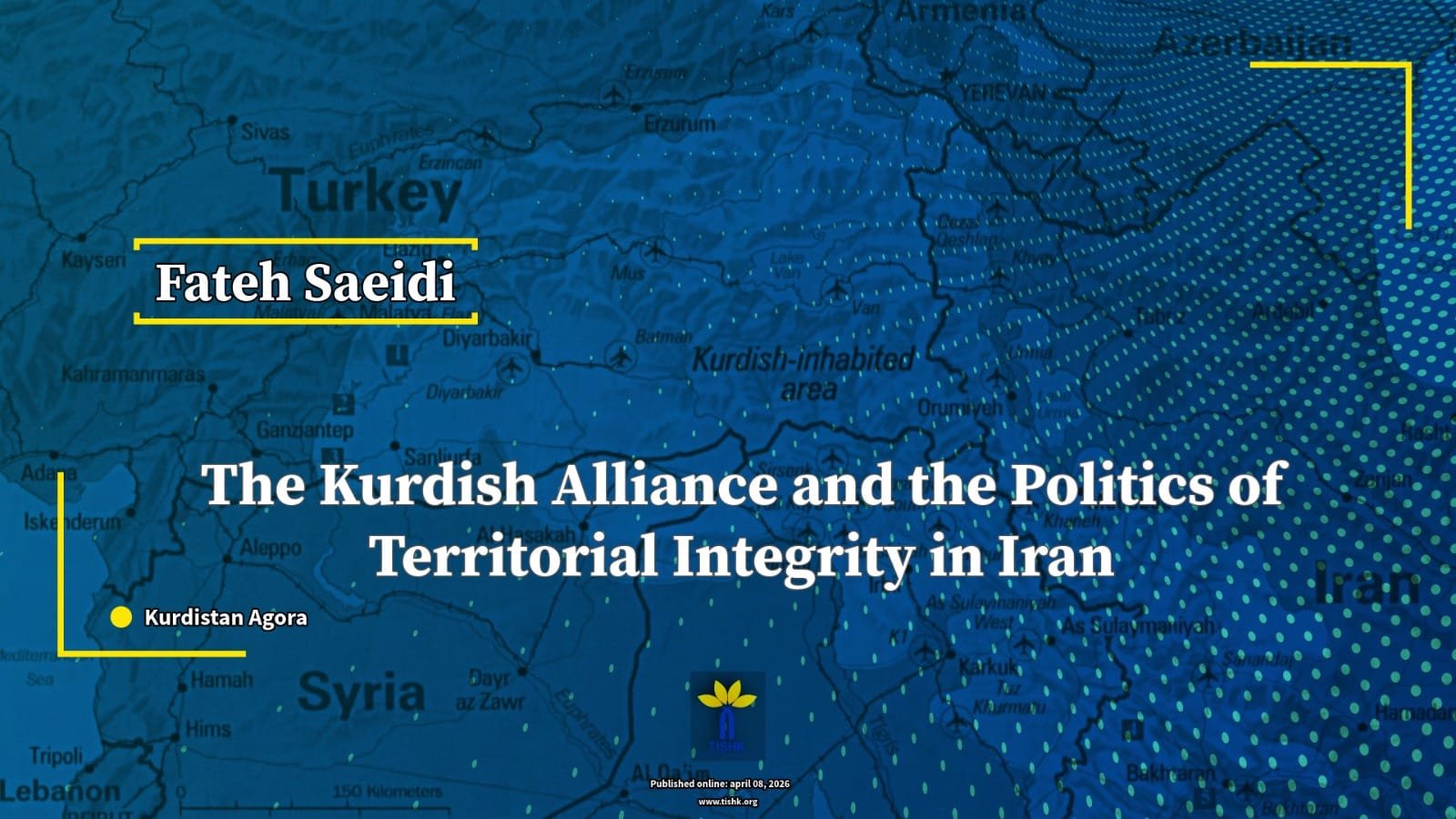
Saeidi, Fateh (2026): The Kurdish Alliance and the Politics of Territorial Integrity in Iran. Published online by TISHK Center for Kurdistan Studies.
Summary
This article examines the formation of a new Kurdish political alliance in Iran and the debates it has triggered over territorial integrity and political sovereignty. It argues that Iranian nationalism remains structured around a Persian-centered core that systematically marginalizes non-Persian peoples. Kurdish demands are consistently reframed as security threats rather than recognized as legitimate political claims. The article shows how this dynamic reflects a deeper structural contradiction within the Iranian state. It concludes that, under these conditions, meaningful equality is unlikely within the existing framework, and that the question of Kurdish independence emerges not as a distant possibility, but as an urgent horizon where the limits of the Iranian political order are finally laid bare.

The Kurdish Alliance and the Politics of Territorial Integrity in Iran
The formation of the Alliance of Iranian Kurdistan Political Parties on February 22, 2026 has reopened a central question in Iranian politics: will the future state remain centralized, or be reimagined as a multinational political order? The alliance unites six Kurdish political organizations that had long operated separately but now coordinate at a moment of crisis. The backlash, especially the swift denunciation by Reza Pahlavi, shows that Kurdish political sovereignty remains unresolved not only under the Islamic Republic but also within the opposition.
Within the framework of Iranian nationalism, full political rights are effectively reserved for the Persian-centered core. This structure elevates Persian language and culture as the official and dominant Iranian national standard, while other ethnic groups are confined to the status of “local” communities. Their languages are excluded from formal education, and their cultural expression is tolerated only within limited, depoliticized spaces. More importantly, any form of political articulation grounded in collective rights or political sovereignty is systematically restricted or delegitimized.
Kurdish demands must be understood in a broader historical context. Since the early twentieth century, the Iranian state has consolidated power through a Persian-centered political core. Peripheral regions such as Kurdistan were integrated through military force, administrative centralization, and cultural assimilation. Within this framework, Kurdish demands have often been reframed as threats to territorial integrity rather than recognized as political claims grounded in collective rights. The new coalition directly challenges this framing.
A Unified Kurdish Political Platform
The alliance brings together six major Kurdish organizations: the Kurdistan Democratic Party of Iran, Komala of Kurdistan Toilers, the Kurdistan Free Life Party, the Kurdistan Freedom Party, the Organization of Khabat, and the Komala Party of Iranian Kurdistan. It emerged after months of negotiations aimed at overcoming fragmentation and presenting a unified front.
Its founding declaration combines Kurdish national demands with broader democratic commitments. It calls for the overthrow of the Islamic Republic, recognition of Kurdish self-determination, and the creation of democratic institutions in Kurdistan based on popular will. At the same time, it situates Kurdish demands within a wider vision for Iran, emphasizing free elections, gender equality, social justice, environmental protection, and secular governance.
In this framework, Kurdish claims are not presented as exceptional but as integral to democracy itself. At the core lies a longstanding principle: the political future of Kurdistan must be determined by its people. Whether through autonomy, federalism, or independence is left open, but the decision must be made democratically.
Territorial Integrity as Political Language
The alliance’s announcement provoked a sharp response from Reza Pahlavi. In a February 25 statement, he accused Kurdish parties of secessionism and declared Iran’s territorial integrity a “red line.” He warned that any group crossing it would face a decisive response and suggested that a future Iranian army should defend the country against secessionists.
Although framed as a defense of national unity, this language casts Kurdish movements as potential enemies. It draws on a long-standing pattern in Iranian political discourse, where Kurdish demands are treated as security threats. The concept of territorial integrity thus functions not only as a legal principle but also as a political tool that delegitimizes claims from peripheral regions.
Kurdish Responses and Democratic Claims
The alliance responded collectively by rejecting accusations of secessionism and emphasizing that such claims have historically been used to silence legitimate political demands. It argued that Kurdish aspirations must be addressed through political dialogue rather than securitized rhetoric or military threats. In its view, labeling Kurdish movements as secessionist obscures the substantive issues at stake and reproduces a long-standing pattern of delegitimization. The alliance insisted that the question of Kurdistan’s future is fundamentally a democratic one, to be decided by its inhabitants through political processes grounded in equality and consent.
Abdulla Mohtadi likewise rejected accusations of secessionism and reaffirmed his commitment to a democratic future in Iran. He emphasized that democracy cannot exist without recognizing the rights of all nationalities, arguing that meaningful political participation requires the acknowledgment of collective rights. Mohtadi also warned that such rhetoric undermines opposition solidarity by reproducing narratives long used by the Islamic Republic to justify repression.
A Wider Political Debate
The exchange quickly expanded into a broader debate. Several organizations rejected the accusation of secessionism and criticized the language used by Pahlavi. Representatives of Arab, Baluch, Kurdish, and other communities argued that such labeling has long been used to suppress legitimate claims. They pointed to decades of discrimination, economic marginalization, cultural repression, and securitization.
Other coalitions, including the Congress of Nationalities for a Federal Iran and the Broad Solidarity for Freedom and Equality in Iran, similarly criticized the use of territorial integrity as a political threat. They argued that lasting unity cannot be achieved through force, but must emerge from equality among the country’s peoples.
These responses show that the controversy extends beyond a single dispute. It reflects a fundamental question about the nature of the Iranian state.
Multinational Reality and Political Sovereignty
Iran contains multiple historical nations whose identities cannot be reduced to cultural diversity within a single national framework. For many Kurdish intellectuals, however, the issue goes beyond recognition. They argue that Kurdistan’s incorporation into the Iranian nation-state has been structured through relations of domination that resemble a form of internal colonialism.
Within this framework, Kurdish political aspirations are not simply marginalized but structurally excluded. The Iranian political system is organized in a way that concentrates sovereignty in a Persian-centered national core. As a result, Kurdish claims to political autonomy are consistently reframed as threats to territorial integrity and denied legitimacy. From this perspective, self-determination is not merely a democratic principle awaiting recognition within Iran, but a question that exposes the limits of the existing political structure itself.
This has led a number of Kurdish intellectuals to question whether meaningful political sovereignty is achievable within the current model of the Iranian nation-state. They argue that as long as this structure remains intact, Kurdish political agency will continue to be constrained. For some, this raises the possibility that political sovereignty ultimately requires delinking from Iran and pursuing an independent Kurdistan. In this view, the problem lies not only in the policies of particular governments, but in the deeper logic of Iranian nationalism, which has historically shown little openness to recognizing Kurdish political sovereignty.
The accusation of “secessionism,” therefore, obscures rather than clarifies the debate. The central issue is not simply whether Kurdistan should remain within Iran, but whether a political relationship shaped by domination can be transformed into one based on equality and consent. For many Kurdish intellectuals, the answer remains uncertain.
The formation of the Kurdish alliance has forced back into view a question that Iranian politics has long sought to contain: whether a centralized national framework can sustain itself while denying meaningful political plurality. What is now exposed is not simply a policy disagreement, but a structural contradiction at the core of the Iranian state. As recent tensions between Kurdish actors and opposition figures demonstrate, even within anti-regime politics, the limits of recognizing Kurdish political sovereignty remain firmly in place.
In this context, the persistent refusal to recognize Kurdish political sovereignty is not an incidental failure but a constitutive feature of Iranian nationalism itself. If Kurdish political claims continue to be structurally reframed as threats to territorial integrity, then the possibility of achieving genuine equality within the existing framework becomes increasingly untenable.
From this perspective, the question of Kurdistan’s future can no longer be confined to debates over autonomy or federalism within Iran. Rather, it raises the more fundamental possibility that only through full political independence can the enduring structures of domination, often articulated in terms of internal colonialism, be brought to an end.
Whether one accepts this conclusion or not, the debate itself reveals the limits of a centralized model that has yet to reconcile sovereignty with plurality. The future of Iran, therefore, will depend not only on political transition but also on whether it can confront this foundational contradiction or continue to reproduce it.
Other Research
The Kurdish Alliance and the Politics of Territorial Integrity in Iran
Saeidi, Fateh (2026): The Kurdish Alliance and the Politics of Territorial Integrity in Iran. Published online by TISHK Center for Kurdistan Studies. Summary This article examines the formation of a [...]
Unequal Lands: War, Infrastructure, and Survival in Iran’s Kurdish Regions
Pasbar, Shna(2026): Unequal Lands: War, Infrastructure, and Survival in Iran’s Kurdish Regions. Published online by TISHK Center for Kurdistan Studies. Summary This article argues that the impact of conflict is [...]
Protests, Repression, and Iran’s Uncertain Future: A Look at Iranian Kurdistan
Pezeshk, Kouchar(2026): Protests, Repression, and Iran’s Uncertain Future: A Look at Iranian Kurdistan. Published online by TISHK Center for Kurdistan Studies. Summary In recent years, Iran has witnessed successive waves [...]