
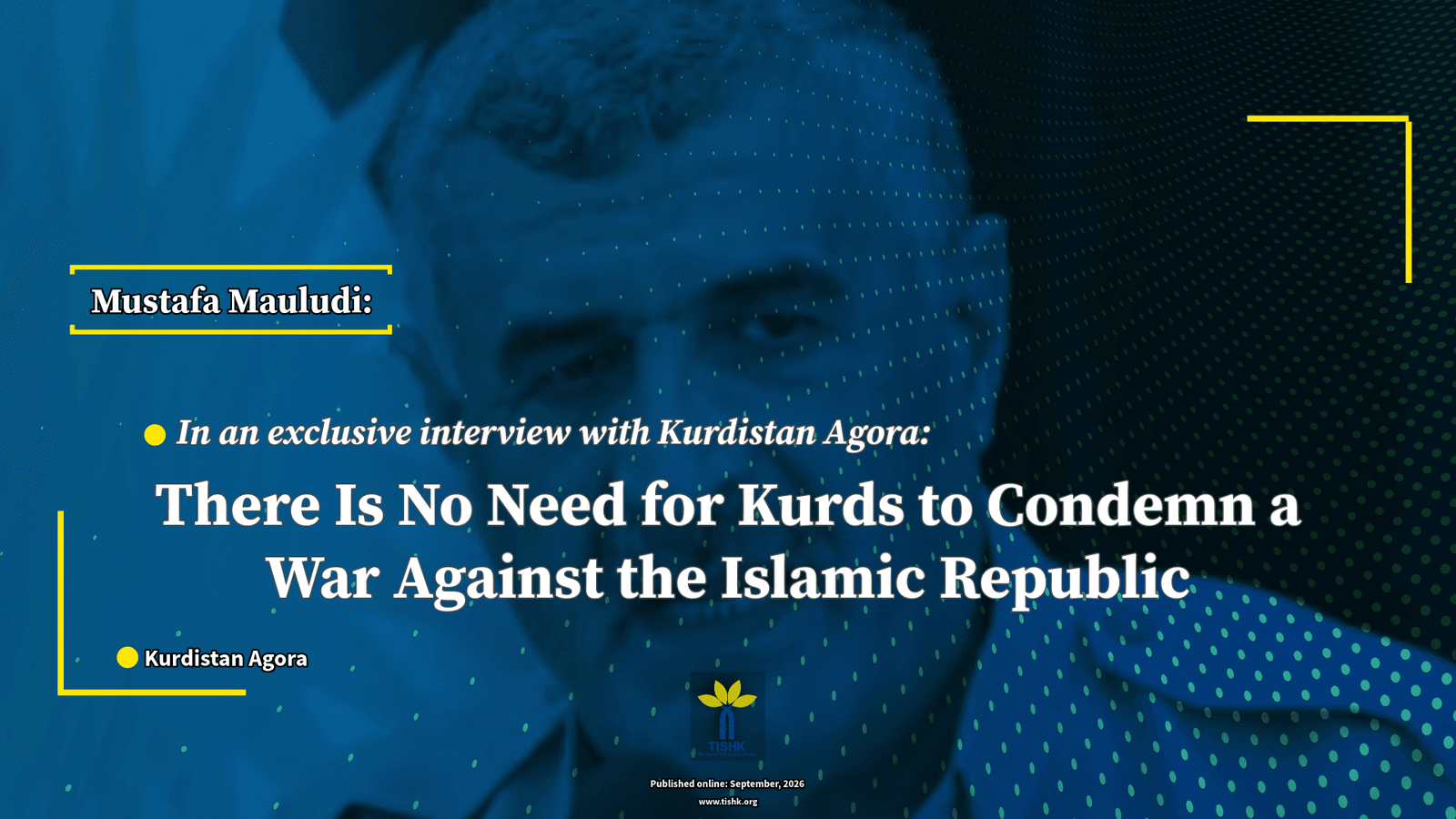
Exclusive interview with Mustafa Mauludi
Interviewer: Shna Pasbar
Published online by TISHK Center for Kurdistan Studies, Kurdistan Agora: Bonn, Germany: 2026
Interview
In an exclusive interview with Kurdistan Agora, the English-language platform of the TISHK Centre for Kurdistan Studies, Mustafa Mauludi, Deputy Secretary-General of the Democratic Party of Iranian Kurdistan (PDKI), shares key insights on the party, Kurdistan, Iran, and broader regional affairs with Shna Pasbar, a member of the Editorial Board of Kurdistan Agora..
In an era of intense geopolitical realignment across the Middle East, the political trajectory of Eastern Kurdistan (Rojhelat) remains central to Iran’s political future. Facing external military friction and severe domestic instability, he provides a comprehensive look into the Party’s strategic calculus. In this interview, Mauludi addresses critical questions regarding military conflicts, coalition building, transitional management, and opposition realignments, asserting a distinct vision for self-determination within a free, democratic, and federal Iran.

The following is an exclusive interview with Mustafa Mauludi, Deputy Secretary-General of the Democratic Party of Iranian Kurdistan (PDKI), conducted by Shna Pasbar, a member of the Editorial Board of Kurdistan Agora..
Shna Pasbar:
For more than a year, the Islamic Republic of Iran has been attacked on three separate occasions. In none of these cases has your party opposed the attacks or issued a statement condemning them; at the same time, you have not explicitly supported them in any of your statements either.
What is the reason for this position? Given that your party seeks the overthrow of this regime, and that this is reflected in your congress slogans and political program, why do you not openly support efforts that weaken the regime or could contribute to its overthrow?
Mustafa Mauludi:
Those attacks, carried out by the United States against the Islamic Republic of Iran in three separate rounds, were not aimed at occupying Iran. Nor were they attacks on the interests of the Iranian people; rather, they were directed against the regime of the Islamic Republic of Iran. A regime that, for more than forty-seven years, has held Iran and its peoples hostage to its policies and devoted much of the country’s resources to imposing its rule on the Iranian people and creating crises across the Middle East. Therefore, from this perspective, attacks on the Islamic Republic regime are not attacks on its peoples or the country of Iran; rather, it’s a war against the Islamic Republic regime—a regime that poses a grave threat to its people and has become a cancerous tumor in the Middle East. Accordingly, there is no need for the Kurds to condemn such a war.
Furthermore, it is true that this war—which U.S. officials say is intended to change the behavior of the regime in Tehran and protect U.S. interests in the region—has inflicted very significant damage on the regime. It has killed Khamenei and many senior officials of the regime and inflicted damage on the regime’s political, military, security, and economic centers. And in turn, this could create an opportunity for the people to intensify their resistance against the regime. However, it has become clear that the United States’ objective in this war is not to serve the broader interests of the Iranian people. Looking at some of the points the United States has set out as conditions in the proposed Memorandum of Understanding for ending this war, there is clearly nothing in them for the Iranian people; they do not mention the people or the protection of their interests. They do not even call, if only symbolically, for the release of the tens of thousands of political prisoners. The peoples of Iran understand this very clearly, especially the people of Kurdistan and the Democratic Party, which pursue a realistic political approach. Naturally, they will not become part of a war that offers no guarantee whatsoever that their rights will be secured or protected.
Shna Pasbar:
According to media reports and some security sources, during those attacks there was a plan for an offensive against the regime to begin from Kurdistan, but the plan was later cancelled. First, I would like to know what level of contact or coordination there was with the Kurdish side, particularly with your party. And secondly, what was the reason for cancelling that plan?
Mustafa Mauludi:
First, the United States had no specific plan or program for a ground invasion or for entering Iranian territory, and U.S. officials have repeatedly stated clearly that they would not send their troops into Iran. Second, there was no such plan or arrangement of that kind between us and the United States either. Iran’s geography has its own particular characteristics in terms of terrain and location; therefore, a ground invasion of the country may not be easy, although it is certainly not impossible. However, there was no such plan in the first place, so there was no basis for determining whether such an attack would be launched from Kurdistan or from somewhere else against Iran. If an attack on Iran is going to happen, I don’t think it would be appropriate for the attack to be launched from Kurdistan:
First, if there is a plan to launch an attack, it would have to target important centres in Iran, particularly the capital. Tehran is also very far from Kurdistan, and reaching it would come at a high cost in both lives and resources.
Second, from a logistical perspective, a ground war requires specific infrastructure and support systems. Kurdistan does not have the necessary capabilities, transportation routes, and logistical resources to launch such an attack against the Iranian regime from there.
Third, even if such a plan were under consideration, the attack would presumably target the regime’s sensitive and important political, military, security, and administrative centres, as well as the country’s key economic infrastructure. However, apart from the numerous and extensive bases and headquarters of military and security forces in Kurdistan—such as the Islamic Revolutionary Guard Corps (IRGC), the regular army, intelligence services, the Basij, and others, whose primary role is to suppress Kurdish political and social movements—there are no comparable strategic political, economic, or administrative centres located there.
Fourth, if the objective of such a war were to seize territory from the Iranian regime in order to gain a strategic advantage, there are locations far more significant than Kurdistan. Military experts have often pointed to Iran’s southern islands—such as Kharg, Kish, Lavan, and others—because of their highly strategic locations.
Therefore, as far as I am aware, there has never been any plan to launch an attack on Iran from Kurdistan. It was merely propaganda circulated by certain media outlets, which unfortunately ended up harming the Kurds.
Shna Pasbar:
One of the preparations that should be made before the fall of this regime is to establish an alternative, as was done in Iraq. What steps have you taken toward that objective?
Mustafa Mauludi:
Iran’s social and political composition has its own particular characteristics. Therefore, for the reasons I will explain, creating a viable alternative is not an easy task:
First, bringing together all or most political forces under a common coalition, with the goal of federalizing Iran and establishing a democratic federal political system, is highly necessary and appropriate, but it is by no means an easy task.
Second, Iran is a multi-nation country, and its different national groups have distinct—and sometimes widely differing—aspirations and objectives. This makes bringing them together particularly difficult. For example, many Persians in Iran seek freedom and democracy, while Kurds, in addition to wanting a free and democratic Iran, also seek recognition and protection of their national and political rights within that framework. Therefore, incorporating these different demands into a common political platform is a difficult task.
Third, the political forces in Iran have very different visions of the type of political system the country should have. They range from democrats and leftists to republicans and monarchists, and bringing all of these groups together within a single framework or coalition is extremely difficult. Therefore, although forming a broad political coalition in Iran is not impossible, it is a very challenging task.
You referred to Iraq under Ba’ath Party rule and the fall of that political system as an example. When the anti-Saddam coalition was formed in Iraq, the United States brought together, under its leadership, most of the political forces from Iraqi Kurdistan, as well as Iraqi Shiie and Sunni political groups, within that coalition. The United States was determined to overthrow the Ba’ath government and devoted substantial resources and capabilities to that objective. At the time, the United States was firmly committed to the view that Saddam Hussein’s regime had to be removed and replaced by a new political authority. However, up to now, the United States has not shown the same kind of intention toward Iran under the Islamic Republic, even though the peoples of Iran seek the overthrow of the Islamic Republic regime. It is clear that some countries in the region, as well as some Western countries, would prefer to see this regime removed. However, neither individually nor collectively do they have a clear and defined political plan or strategy for that purpose. As a result, they are not seriously working toward creating an alternative to the regime, and therefore no viable alternative has emerged. There is another point that should be mentioned. Many people argue that the Iranian regime has remained in power because there is no strong alternative to it. I do not agree with that assessment, and I believe such a view can discourage people from continuing their struggle against the regime. On the contrary, I believe that, given the right circumstances, the people are capable of bringing about a revolution and overthrowing the regime even without a fully formed alternative, and then taking responsibility for governing the country.
Shna Pasbar:
Still on the issue of an alternative, I would like to know whether the Iran Freedom Congress was an effort toward that objective. The Congress itself denies that it is intended to serve as an alternative. At the same time, there appear to be disagreements among the Kurdish parties within the Congress, particularly during the election process, when your representative did not receive the required number of votes. Many people criticize the fact that the level of recognition and protection of Kurdish rights within this Congress is essentially no greater than what was provided for in the Georgetown Agreement, which your party opposed. If you believe this Congress is different from the Georgetown Agreement, what exactly is the difference? You are a member of this Congress, To what extent are the Congress’s decisions and declarations binding on its members, particularly on your party? My final question on this issue is: why did your organization choose to join with a number of individual political figures, when you could instead have formed this front with established organizations of comparable political weight to your own, such as the People’s Mojahedin Organization of Iran (MEK)?
Mustafa Mauludi:
First, you have raised several questions within the framework of a single question, and I will try to answer them briefly. The main objective of the Democratic Party of Iranian Kurdistan is to strive for the establishment of a federal system within the framework of a free and democratic Iran. The party believes that, within the framework of the free, democratic, and federal Iran we envision, the Kurds of Eastern Kurdistan would be able to realize a significant part of their rights. Naturally, achieving this objective requires a difficult and sustained struggle, and one of the ways to pursue it is through dialogue and engagement with other Iranians; In general, this includes dialogue with individuals, organizations, forums, associations, and political parties, and even, under appropriate circumstances, with government officials of other countries. In line with this policy, members and cadres of the Democratic Party have participated in the forums and meetings of the Iran Freedom Congress.
Second, the Iran Freedom Congress has only recently begun its activities. It brings together political figures, academics, political activists, and members of various nationwide and national political parties and organizations, who work together within the Congress. The aim is to find a more suitable framework and approach for cooperation against the Islamic Republic of Iran and for the establishment of a democratic political system. The fact that our candidate withdrew from the election for the Congress’s executive body, which was elected for a short three-month term, does not in any way diminish the role or influence of the Democratic Party of Iranian Kurdistan within the Congress. It should also be noted that the party is not an official member of the Iran Freedom Congress. Nevertheless, participants in the Congress recognize the party’s standing and influence. Therefore, the participation of party members in the Congress and the use of this platform serve the interests of bringing the voice of the Kurdish movement and the party’s political positions to a broader Iranian audience. It is true that the representatives of the Kurdish parties within the Congress were not sufficiently coordinated and did not exchange views on how they could work together as a unified Kurdish team. This is one of the shortcomings of Kurdish political engagement. In other words, the problem is not participation in such forums and meetings itself, but rather how that participation is organized and coordinated. We hope that the Coalition of Political Forces of Iranian Kurdistan will be able to address these shortcomings.
Third, regarding the comparison between the Iran Freedom Congress and the Georgetown initiative, the two are very different in virtually every respect. The Georgetown initiative had designated a future shah for Iran, whereas no such issue exists within the Iran Freedom Congress. Georgetown presented itself as an alternative to Iran’s current regime, while the Iran Freedom Congress does not consider itself an alternative government or replacement for the regime.
Finally, on this point, the Democratic Party maintains relations with most Iranian political forces. Fortunately, it does not consider itself an adversary of any Iranian political party and remains open to dialogue with all democratic groups. However, we cooperate and form alliances with those parties and organizations that support changing the Islamic Republic regime, recognize the rights of the national groups within Iran, and actively work toward achieving those objectives. From that perspective, the relationship between the Democratic Party of Iranian Kurdistan and the Mojahedin Organization of Iran (MEK) is likewise based on the same approach and policy.
Shna Pasbar:
It is clear to everyone that the Kurdistan Free Life Party, known as PJAK, is the eastern branch of the Kurdistan Workers’ Party (PKK). The source of this organization’s decisions is the Kurdistan Communities Union (KCK), or the PKK, of which PJAK is a member. It is also clear to all sides that the level of the KCK’s demands has been reduced to a more moderate level, and this approach can be clearly seen in the KCK’s policies in Turkey and Syria. In Iran as well, PJAK’s demands remain within the framework of the KCK’s objectives and demands, focusing mainly on seeking greater citizenship rights in Iran. Don’t you think that PJAK’s relatively limited demands have weakened the Kurdish bargaining position among Iranian political groups, and that the support PJAK receives from Persians stems from this very fact?
Mustafa Mauludi:
The Democratic Party does not consider dialogue, relations, and cooperation among Kurdish parties from all parts of Kurdistan to be wrong or prohibited, provided that they do not interfere in one another’s affairs or intervene in the affairs of other parts of Kurdistan. In fact, the party itself follows this policy, because each part of Kurdistan has its own distinct political and legal characteristics. We also know that PJAK has close ties with the PKK and, to some extent, draws inspiration from it. It even regards the leader of the PKK as its own leader. We also know that PJAK’s main area of activity is in Eastern Kurdistan, and that most of its members are young men and women from that region. The Democratic Party, as an experienced and responsible party in Eastern Kurdistan, feels a sense of responsibility in all areas and is one of the influential parties involved in guiding the Kurdish political movement in the region. Therefore, it has always considered coordination, cooperation, and even the formation of alliances among the political forces of Eastern Kurdistan to be necessary and important. In practice, it has worked toward this goal and has even made sacrifices of its own to achieve it.
Previously, both when the Cooperation Center was established and when the Dialogue Center was formed—which later led to the Alliance of Political Forces of Iranian Kurdistan—the Democratic Party played a central role in all of these efforts and platforms.
We should also keep in mind that every party has its own specific program and objectives and formulates its policies according to what it considers its own interests. Therefore, the parties must accept these differences. They can then work and cooperate together based on clearly defined mechanisms, bylaws, and agreements approved by all participating parties in the joint body.
Shna pasbar:
Many people say that PJAK was the reason why, not only during the announcement of the alliance but also on other occasions, there were no signs of the Kurdistan flag or other Kurdish national symbols. To what extent is this view accurate? And, as a party, were you not concerned from the outset of forming this alliance about PJAK’s participation and the possibility of Turkish intervention on account of PJAK’s ties with the PKK? Regarding PJAK, in the past you were unwilling to cooperate with them, and your position was that PJAK was not an independent party but was affiliated with the PKK. What has changed now that you accept PJAK as a Kurdish political party? Does this acceptance not amount to accepting the involvement of an external force in the affairs of Eastern Kurdistan? And could what happened in Rojava as a result of internal political rivalries eventually be repeated in Eastern Kurdistan as well?
Mustafa Mauludi:
Again, several questions have been linked together here, and I will answer them very briefly. It is clear that the Democratic Party and PJAK are two distinct parties in Eastern Kurdistan. Each carries out its own activities and struggle without interfering in the other’s affairs, and this principle must also be fully respected within the coalition. Eastern Kurdistan and its people have their own distinct characteristics and differences compared with Northern and Western Kurdistan. At the same time, circumstances have changed. Therefore, the political parties of Eastern Kurdistan need to formulate their policies with updated knowledge and awareness of the situation there, while taking into account the particular characteristics of that part of Kurdistan. I hope that the participation of six parties from Eastern Kurdistan in the Political Alliance Center will mark a new chapter of unity and cooperation among the political forces of Eastern Kurdistan, based on clear bylaws that address these concerns and commit all parties to cooperation and joint action.
Shna Pasbar:
Why do you not have a clear plan for governing Kurdistan during a transitional period—one that could give people greater confidence and prevent Kurdistan from falling into confusion or instability? Or, if such a plan exists, why has it not been announced yet, especially when groups such as the National Council of Resistance and the monarchists have already presented and publicized their own plans?
Mustafa Mauludi:
It would not be accurate to say that the parties—particularly a party such as the Democratic Party of Iranian Kurdistan, given its long history—do not have plans and programs for the future of Kurdistan. Our party has experience in this regard. On several occasions when a power vacuum emerged in Kurdistan, it stepped in to fill that vacuum and established popular forms of governance, such as the establishment of the Republic of Kurdistan in 1324 of the Iranian calendar (1946), and the formation of city and village councils in the liberated areas of Kurdistan during the early years following the 1979 Revolution. The Democratic Party did not begin addressing this issue only now, when developments have reached a critical stage. More than 20 years ago, it held several meetings with Komala and other parties to discuss the matter and exchange views. In fact, in the Iranian year 1381 (2002–2003), a memorandum of understanding on this issue was formulated between the Democratic Party and Komala. At present, with discussions underway about a possible change in Iran’s political regime, this has become one of the important issues both within the party organization and across Kurdistan’s broader political community.
Therefore, this issue has been discussed within the Coalition of Political Forces of Kurdistan, including how we can work together at the appropriate time to safeguard security and the normal daily lives of citizens, how to make effective use of the available resources and capacities, and, for example, how to deal with remnants of the regime. There are also many other related issues that clearly require further discussion and planning, both within the alliance and in coordination with other political forces in Iran.
Shna Pasbar:
Undoubtedly, over the past one or two years, support for the monarchy has grown among Persians, and it appears that this trend may continue to expand. This political current makes no secret of its strong opposition to the decentralization of power in a future Iran, particularly to the rights of different national groups. As a Kurdish political party, what would your position be if, for example, the monarchists came to power?
Mustafa Mauludi:
Kurds in Iran have experience with the monarchical political system. In particular, during the reign of Reza Shah Pahlavi, the prominent Kurdish leader Ismail Agha Simko Shikak was assassinated through a planned and deceptive plot. Later, during the reign of Mohammad Reza Pahlavi, the Republic of Kurdistan was attacked and overthrown, and the first Kurdish president, Peshawa Qazi Muhammad, along with his comrades, was executed by hanging. It was the very system of governing the country under the monarchy that ultimately led to the people’s uprising and its overthrow. In the report of the party’s 9th Congress, the party clearly rejected the monarchical system for a number of reasons and explicitly stated that it strives for the establishment of a democratic republican system in Iran. This position remains unchanged today.
We see that Reza Pahlavi currently holds no political power and does not even have an organized political party or structure, yet he has published a booklet outlining a plan for an emergency transitional period. In that plan, he continues along the path of his father and grandfather and, rather unskillfully, presents a highly centralized model of governance as his own program and political plan. This gives the Kurds a clear understanding of what such a situation could mean.
If we are to draw a conclusion from this discussion, I would say:
First, Iranians as a whole brought that form of political system to an end through the 1979 Revolution. Second, the Kurds have waged a serious, sustained, and multifaceted struggle against that system. From our perspective, such a system has no real chance of succeeding again. Therefore, we do not consider it appropriate to help restore a system that has already been tried and that was also opposed to our rights.
Shna Pasbar:
At the level of international relations, the Democratic Party has always been recognized as one of the main political parties in Eastern Kurdistan and has been viewed similarly at the international level. To what extent have you been able to build lobbying networks in different countries so that your voice can be heard more effectively? Why does it seem that you have been relatively weak in this area?
Mustafa Mauludi:
Both the Kurdish political movement and the Kurdish cause have a long history, and many countries are already quite familiar with Kurdistan and Kurdish demands. Therefore, the Kurdish question is neither unknown nor unfamiliar; rather, it is one of the sensitive and complex issues of the Middle East. We have always said that as long as the Kurdish question in the region remains unresolved and the Kurds do not attain their political and national rights, the Middle East will not achieve lasting security and stability. Therefore, even if the Kurdish issue is not always openly discussed at the negotiating tables of those in power, this does not mean that the issue is unknown or that the Kurds themselves have not worked to advance their cause. However, unfortunately, the issue is sometimes overlooked because of its sensitivity, importance, and complexity. The Kurds have introduced their cause to the world and have also built lobbying efforts around it. For example, the prominent Kurdish leader Dr. Qasemlu worked extensively on this issue, and his influence remains evident.
Today, the Democratic Party of Iranian Kurdistan continues along the same path, striving through diplomacy to bring the Kurdish question to the attention of decision-makers and to strengthen lobbying efforts so that the Kurdish issue remains on the political agenda.
Shna Pasbar:
At the domestic level in Eastern Kurdistan, as the leading political party, what have you done to prepare the people for the possibility of future changes? Should people themselves find the way forward, or do you consider your party responsible for providing guidance and preparation in this regard?
Mustafa Mauludi:
The people of Kurdistan are revolutionary and courageous. For more than 47 years, they have bravely stood against the Islamic Republic regime, continuing their struggle and resistance. Therefore, compared with other regions of Iran, Kurdish society is a highly politicized society. We can also see that people are already filling existing gaps through various forms of civil activity and engagement, with many valuable and impressive examples and achievements. The Democratic Party, as the leading party in Eastern Kurdistan, has extensive and valuable experience and a strong historical record in this regard. Its formation of the Political Alliance Center together with five other parties from Eastern Kurdistan stems from this very need and objective: both to establish a framework for governing Eastern Kurdistan and to encourage collective action among the people and prepare them for when such action may be necessary. Beyond that, this decision is also about preparing for every possible scenario and any change in circumstances, so that the country can be administered and managed through the people themselves. I am not saying that all of these measures have already been fully planned and completed, but they constitute an important part of the responsibilities of the Political Alliance Center. The Democratic Party, in accordance with its influence and position, continues to play an active role in all of these efforts.
This interview was translated and edited by Sharif Behruz
Other Research
I came to know myself outside textbooks, for my nation was never narrated in them
Kamal Soleimani Professor of Islamic and Middle Eastern Studies | El Colegio de México, Centro de Estudios de Asia y África Published online by TISHK Center for Kurdistan Studies: Bonn, Germany: 19 January 2026 [...]
Narrative Hijack: How Exile Media Captures Iran’s Uprising Amid Blackouts
Behrooz Chamanara Director of IISKS| Germany Published online by TISHK Center for Kurdistan Studies: Bonn, Germany: 18 January 2026 Summary Iran has entered a revolutionary moment marked by mass protests, [...]
Reza Pahlavi’s Transition Plan: How a Non-Democratic Roadmap Reproduces Authoritarian Power in Iran
Fateh Saeidi Postdoctoral Researcher | University of Texas at Austin Published online by TISHK Center for Kurdistan Studies: Bonn, Germany: 16 January 2026 Summary Reza Pahlavi’s Emergency Phase transition plan presents itself [...]