
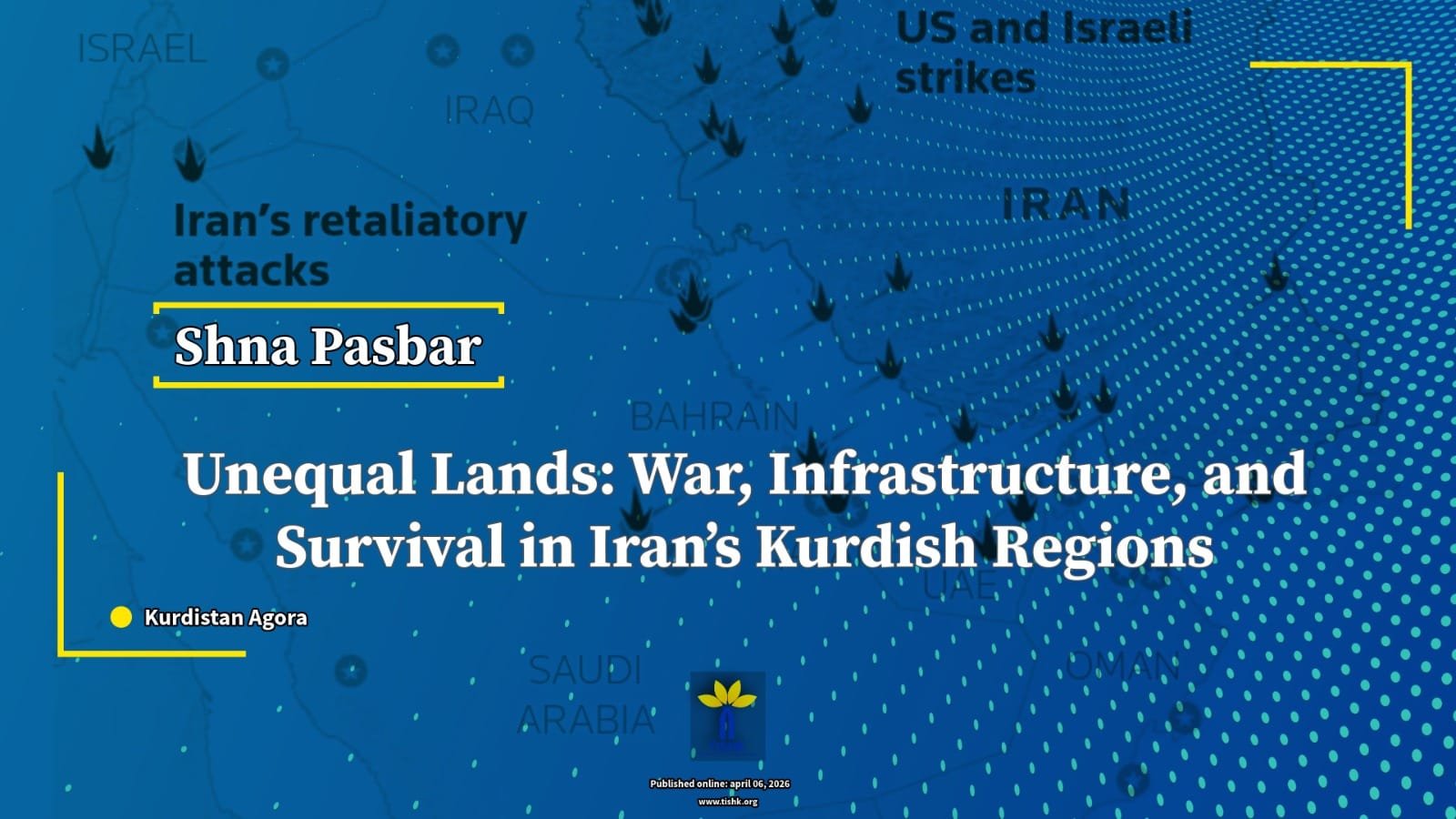
Pasbar, Shna(2026): Unequal Lands: War, Infrastructure, and Survival in Iran’s Kurdish Regions. Published online by TISHK Center for Kurdistan Studies.
Summary
This article argues that the impact of conflict is dictated by a pre-existing “geography of inequality” that marginalizes East Kurdistan. While Iran’s central and southern provinces are defined by high-value economic assets, a century of occupation and systemic underinvestment under both the Pahlavi and Islamic Republic regimes has left Kurdish regions with little more than crumbling, lethal basic infrastructure. Instead of industrial development, the state has prioritized a dense security architecture designed to control a restive population, shifting the nature of wartime strikes from economic disruption to intensified militarization. Ultimately, the article demonstrates that war does not create this inequality but rather reveals it, exposing how decades of political marginalization and militarized state priorities have structured the landscape long before the first strike occurred.

Unequal Lands: War, Infrastructure, and Survival in Iran’s Kurdish Regions
As the April 6 deadline approaches, the confrontation between the regime of the Islamic Republic of Iran and its primary adversaries—the United States and Israel—has shifted into a state of open, head-on warfare, marked by an explicit threat of total structural collapse. This escalation reached a fever pitch following President Donald J. Trump’s recent ultimatum: a final warning to “make a deal” and reopen the Strait of Hormuz or face a reality where “all hell will reign down.”
This is no longer a matter of mere rhetoric. The U.S. administration has moved toward a policy of “economic paralysis,” explicitly designating upcoming military operations as “Power Plant Day and Bridge Day.” By naming these specific nodes of national survival, the ultimatum signals a calculated shift toward the systematic dismantling of the regime’s functional infrastructure.
In this high-stakes environment, public and military attention has centered on economic infrastructure—a term that typically encompasses the massive industrial complexes, oil and gas facilities, and transportation networks concentrated in Iran’s central and southern provinces. These assets are the literal backbone of the country’s economic output and wartime resilience. However, this focus on the central heartland obscures a different, more neglected reality on the periphery.
In Iran’s Kurdish-majority provinces—Kurdistan, Kermanshah, Ilam, and West Azerbaijan—the scale and concentration of such infrastructure are significantly lower. Together, these provinces account for a disproportionately small share of the national economy; for instance, economic output in Kurdistan province accounts for less than one percent of the national GDP, placing it near the bottom among all Iran’s provinces in overall economic performance. Moreover, the combined GDP of six underdeveloped provinces, including Kurdistan and Ilam, amounts to barely one-fifth of Tehran’s GDP alone. This imbalance reflects a long-standing pattern of uneven investment and state planning. While central hubs like Tehran and Isfahan have benefited from concentrated industrial development, the western Kurdish regions have seen far lower capital attraction, with some areas like Ilam and Kurdistan consistently ranking at the bottom of national development and value-added indices.
Over decades, the country’s core energy and industrial systems have been anchored in the south and center, leaving the Kurdish provinces marginalized within a development model that prioritizes strategic growth poles over regional equity.
This disparity matters because it shapes how war is experienced.
In more industrialized parts of Iran, military strikes are more likely to target facilities central to the regime’s production of missiles, drones, and other military means, as well as assets vital to national strategic and economic function: refineries, steel plants, energy grids, and major transportation infrastructure.
In contrast, in the Kurdish regions, where such industrial concentrations are limited, the pattern of exposure is different. These areas are more often associated with military installations, security compounds, drone and missile storage facilities, and border-control infrastructure rather than with nationally decisive economic assets. Consequently, the geography of conflict shifts. War in these provinces does not primarily disrupt major industrial production; instead, it intensifies militarization and insecurity, placing further pressure on already-fragile local economies. This is not accidental, but rather the logical outcome of over a century of occupation of East Kurdistan and a sustained history of uneven development under both the Pahlavi monarchy and the Islamic Republic.
This is not to suggest that the Kurdish regions are entirely devoid of infrastructure, but rather what exists is fundamentally basic and critically neglected. These provinces possess only a skeleton of essential infrastructure—such as roads and bridges—that is notoriously poorly designed and under-maintained. In the absence of modern highways or safe transit corridors, these “death roads” claim thousands of lives annually due to preventable accidents, serving as a lethal reminder of state indifference. Rather than receiving the sustained investment in industry, employment, and public services seen in the center, Kurdish-majority provinces have been treated strictly as sensitive frontier zones.
Consequently, state planning has prioritized the expansion of military checkpoints, surveillance systems, and security installations over the safety and well-being of the local population. This strategy is reflected in the current air campaign, where the majority of strikes in the western Kurdish regions have specifically targeted IRGC bases, intelligence facilities, and security compounds. These sites serve as the primary mechanisms for keeping a large, restive Kurdish population in check rather than contributing to the region’s economic health. By focusing on these assets, the conflict further entrenches the region’s status as a fortified, rather than developed, territory—a direct consequence of decades of occupation and institutionalized neglect.
This prioritization of military presence over economic development has had lasting consequences. Western provinces such as Kermanshah and West Azerbaijan have also been integrated into Iran’s broader military strategy, including the placement of missile and drone storage facilities and underground facilities in strategically important border areas. In effect, these provinces have been incorporated into the national system in unequal ways: underdeveloped economically, yet heavily embedded in the state’s security architecture. The result is a double burden.
Because these provinces contain fewer large-scale industrial assets, they are less likely to be discussed as centers of “economic infrastructure” in wartime analysis. But this does not mean they are insulated from violence. On the contrary, the concentration of military and security facilities makes them especially vulnerable during conflict. Where industrial centers may face attacks that interrupt production, Kurdish regions face bombardment, tighter militarization, heightened border controls, and persistent instability. Their exposure is not lower; it is structured differently. The social consequences can be just as severe.
In regions where formal economic opportunities are already limited, many people depend on fragile livelihoods, including informal and semi-formal cross-border trade. When conflict escalates, borders tighten, mobility becomes more dangerous, and local survival strategies are disrupted. What is damaged in these cases may not be a refinery or a factory, but the everyday systems through which people sustain themselves. For communities already facing underinvestment and limited state support, the effects of war can therefore be immediate and profound. Seen from this perspective, the issue is not only external conflict. It is also the internal geography of inequality that predates the war itself.
The Kurdish regions experience war differently not because they stand outside the national system, but because they have been integrated into it unequally. They have received a smaller share of industrial development and economic investment, while bearing a disproportionate degree of militarization and security control. In times of conflict, that history becomes visible. There is less nationally significant infrastructure to destroy, but also fewer protections against the economic and social shocks of war.
In this sense, war does not create inequality. It reveals it. It exposes how uneven development, political marginalization, and militarized state priorities have shaped the landscape long before the first strike occurred. In Iran’s Kurdish regions, the violence of war is not only a matter of what is targeted from outside, but also a reflection of how these provinces have been structured from within.

Other Research
Unequal Lands: War, Infrastructure, and Survival in Iran’s Kurdish Regions
Pasbar, Shna(2026): Unequal Lands: War, Infrastructure, and Survival in Iran’s Kurdish Regions. Published online by TISHK Center for Kurdistan Studies. Summary This article argues that the impact of conflict is [...]
Protests, Repression, and Iran’s Uncertain Future: A Look at Iranian Kurdistan
Pezeshk, Kouchar(2026): Protests, Repression, and Iran’s Uncertain Future: A Look at Iranian Kurdistan. Published online by TISHK Center for Kurdistan Studies. Summary In recent years, Iran has witnessed successive waves [...]
A New Balance of Power: Kurdistan’s Strategic Leverage in a Fragmenting Iran
Pasbar, Shna(2026): A New Balance of Power: Kurdistan’s Strategic Leverage in a Fragmenting Iran. Published online by TISHK Center for Kurdistan Studies. Summary As the regional conflict involving Iran intensifies, [...]