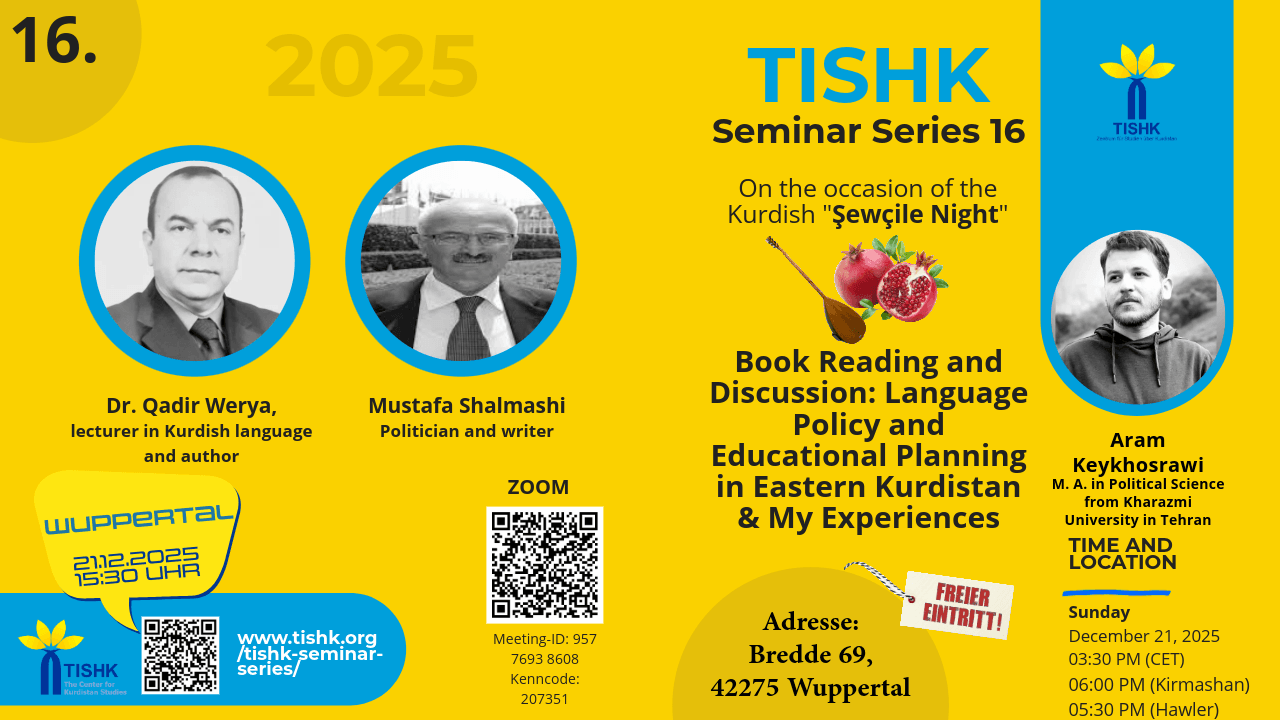
Book Reading and Discussion: Language Policy and Educational Planning in Eastern Kurdistan & My Experiences
TISHK Seminar Series
TISHK Seminar SeriesA seminar on ‘Book Reading and Discussion: Language Policy and Educational Planning in Eastern Kurdistan & My Experiences’
The TISHK Center for Kurdistan Studies is pleased to announce its sixteenth seminar in the 2025 series, entitled
“Book Reading and Discussion: Language Policy and Educational Planning in Eastern Kurdistan & My Experiences.”
The seminar consists of two panels.
Language Policy and Educational Planning in Eastern Kurdistan
The first panel of the seminar, entitled “Language Policy and Educational Planning in Eastern Kurdistan,” will be presented by Dr. Qadir Werya, lecturer in Kurdish language and author of twenty published books.
Qadir Werya is from the city of Şino in Eastern Kurdistan and has been active as a political activist and academic since 1980. He holds a PhD in Kurdish linguistics and served for nearly fourteen years as a lecturer in Kurdish language and literature at the Universities of Raparin and Koya in the Kurdistan Region of Iraq.
The seminar “Language Policy and Educational Planning in Eastern Kurdistan” is devoted to the analysis and critical discussion of the author’s most recent work. The book, which represents Dr. Qadir Werya’s latest publication and was released by the TISHK Center for Kurdistan Studies in Bonn, is based on his doctoral dissertation.
This study examines Iran’s language policy in the education system and its impact on non-Persian languages, with particular emphasis on Kurdish in Eastern Kurdistan. Since the early twentieth century, Iran’s monolingual education policy has contributed to the marginalization and endangerment of many minority languages. The research explores the perspectives of Kurdish experts—including writers, teachers, and activists—regarding the importance of mother-tongue education and the obstacles hindering its implementation.
Based on written interviews with specialists from various cities in Eastern Kurdistan, the study analyzes these perspectives through theoretical approaches to language policy, linguistic pluralism, and language rights. The findings reveal a broad consensus that education in the mother tongue is essential for the preservation of identity, cultural continuity, and equality. Kurdish-language education is viewed as a foundation for social and economic development, creativity, and linguistic justice.
The study concludes that, in the absence of state support, the protection of the Kurdish language largely depends on its speakers themselves. Community-based initiatives such as voluntary Kurdish language courses, dictionary projects, and linguistic research play a central role in preserving and revitalizing Kurdish in Eastern Kurdistan.
Second Panel: My Experiences
The second panel of the seminar, entitled “My Experiences,” will be presented by Mustafa Shalmashi, one of the well-known political figures of Eastern Kurdistan.
Mustafa Shalmashi was born in 1952 in a village named Shalmash near the city of Sardasht. At the age of fifteen, following the repression of the monarchical regime and the execution of his elder brother Ahmad Shalmashi—known as Mulla Awara—he left Eastern Kurdistan and moved to Southern Kurdistan. At the age of eighteen (1970), he began his political activities.
The seminar “My Experiences” engages with the author’s most recent work, in which he states:
“From the beginning of the liberation struggle until today, the Kurdish people have not possessed a stable national strategy. Their struggle and demands have largely been shaped by global, regional, and Kurdish circumstances. Even these limited demands have often been reduced and minimized according to conditions and the interests of opposing forces. This occurs at a time when a people’s national will for liberation should not fall below the level of establishing a nation-state, or at least securing an autonomous administrative entity.”
In addition to writing his memoirs, Shalmashi seeks to draw a number of general conclusions regarding the Kurdish struggle, its sacrifices, and its achievements to date, summarized in six key points:
The Kurdish people must change their strategy; the goal must be the right to self-determination.
No one should believe they possess the absolute truth; political cooperation and mutual acceptance are the keys to unity.
The Kurds require internal tolerance.
The Kurds must better understand their adversaries.
Through policies of appeasement, leniency, and compromise, the Kurds cannot change their opponents’ positions regarding Kurdish rights and freedoms. Tehran, Baghdad, Ankara, and Damascus make their decisions based on Kurdish strength and unity; when the Kurds are strong, they are taken into account, but when they are weak and divided, even what has already been achieved is taken away from them.
Kurdish intellectuals and politicians have accepted the division of Kurdistan and work toward legitimizing this division rather than overcoming it—at a time when the enemies of the Kurds make no distinction in their opposition to the Kurdish question and the Kurdish people.
The seminar will be moderated and chaired by Aram Keykhosrawi, Master’s graduate in Political Science from Kharazmi University in Tehran.
The seminar will take place on Sunday, December 21, 2025, at 15:30 (Berlin time) at Bredde 69, 42275 Wuppertal, and will be held in Kurdish. The session will include a 10-minute introduction, a 30-minute presentation, a 25-minute Q&A session, and a 10-minute panel discussion and concluding remarks.
Admission is free. The event will be held in person and will also be live-streamed via Zoom .
Seminars on our Youtube page
TISHK Seminar SeriesThe videos of the Seminars on our Youtube page
Date: December 21, 2025
Lecturer: Dr. Qadir Werya, lecturer in Kurdish language and author & Mustafa Shalmashi, one of the well-known political figures of Eastern Kurdistan
Moderator/Presenter: Aram Keykhosrawi, Master’s graduate in Political Science from Kharazmi University in Tehran
Start: at 15:30 pm
Language: Kurdish
Address:Bredde 69, 42275 Wuppertal & live-streamed via Zoom
Contact: info@tishk.org
Universität Bonn