
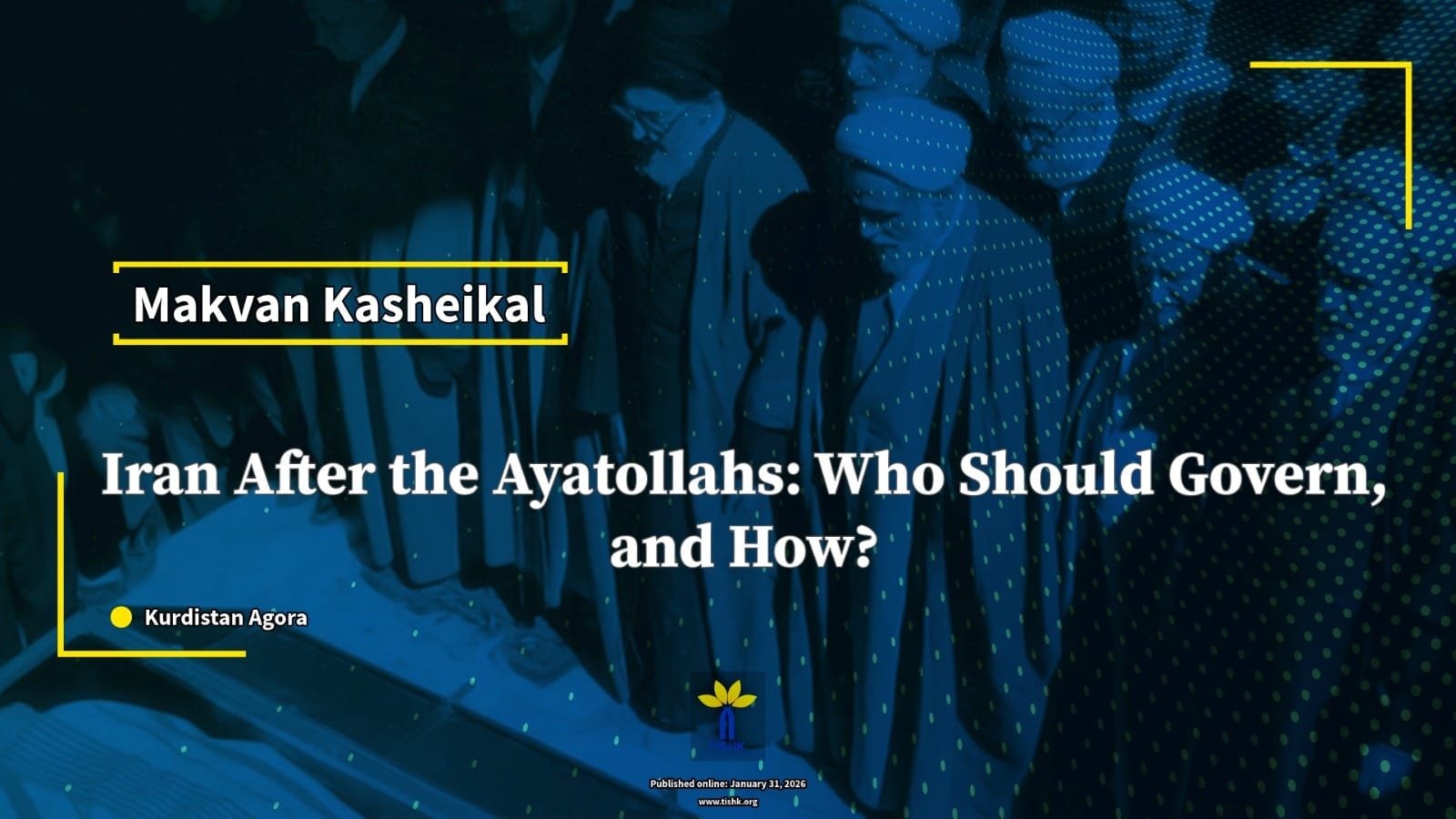
Makvan Kasheikal
Political analyst focusing on Kurdish political and social issues.
Published online by TISHK Center for Kurdistan Studies: Bonn, Germany: 31 January 2026
The Point
Accordingly, any future model of governance in Iran must acknowledge that the country cannot continue to exist as a highly centralized state. Iran must, at a minimum, be reorganized as a federal system or as a state with genuine regional autonomy that guarantees the rights of Kurds, Persians, Arabs, Turkic peoples, and other ethnic groups.

Iran After the Ayatollahs: Who Should Govern, and How?
All available evidence indicates that the ayatollah regime, after nearly 47 years of rule characterized by repression, torture, and the isolation of Iranian society, has lost its legitimacy. The complete economic collapse of recent years has further exacerbated this situation, and today the people of Iran are engaged in a difficult struggle to reclaim control over their own country and destiny.
Therefore, the central question is no longer whether the regime will fall, but when. The decisive issue concerns the aftermath: who should govern Iran after the ayatollahs, and how can the country be rebuilt as a democratic state founded on human rights and peaceful coexistence in a region marked by deep religious and ethnic tensions?
In recent months, the son of the former Shah, Reza Pahlavi, has been promoted by some as a potential successor. This proposition is deeply problematic. The Iranian people overthrew the Pahlavi regime 47 years ago precisely because the country was governed through systematic repression, the absence of political freedoms, and the large-scale plundering of national resources. Billions of dollars in oil and gas revenues were diverted to the royal family and a narrow circle of its affiliates.
Neither the Pahlavi regime nor its present-day heir enjoys genuine social legitimacy or historical grounding among Iran’s diverse ethnic and national groups. A clear example is the Kurdish population, which for more than 80 years has waged a difficult and costly struggle against both the Pahlavi dictatorship and the ayatollah regime in Tehran. The Kurds do not seek the establishment of a new centralized authoritarian system; rather, they demand self-governance within a democratic framework, represented by political parties with deep historical and social roots among the population.
Accordingly, any future model of governance in Iran must acknowledge that the country cannot continue to exist as a highly centralized state. Iran must, at a minimum, be reorganized as a federal system or as a state with genuine regional autonomy that guarantees the rights of Kurds, Persians, Arabs, Turkic peoples, and other ethnic groups.
In the Kurdish regions, political parties such as the Kurdistan Democratic Party of Iran (PDKI) and Komala possess substantial social legitimacy. Through repeated mass mobilizations and political initiatives, they have demonstrated that they command public trust and recognition. Ignoring this reality would lay the groundwork for renewed conflict in a post-ayatollah Iran.
At a time when the heir of the former dictatorship seeks to present himself as a unifying alternative, this effort appears less as a response to popular demands and more as an attempt to appropriate a legitimate popular revolution. This process is further facilitated by access to vast financial resources that were historically extracted from Iran’s oil and gas wealth for the benefit of the royal family.
A new Iran cannot be built upon old authoritarian structures—whether religious or monarchical. The path forward must be democratic, inclusive, and rooted in the country’s national and social diversity. Without genuine power-sharing, respect for the rights of nations and ethnic groups, and the establishment of a federal or at least a genuinely decentralized system of governance, Iran risks repeating its own history of authoritarianism and crisis.
Other Research
A New Balance of Power: Kurdistan’s Strategic Leverage in a Fragmenting Iran
Pasbar, Shna(2026): A New Balance of Power: Kurdistan’s Strategic Leverage in a Fragmenting Iran. Published online by TISHK Center for Kurdistan Studies. Summary As the regional conflict involving Iran intensifies, [...]
The Delusions of National Unity: Why Promoting Autocracy Won’t Bring Democracy
Sharif Behruz Strategic Policy Analyst and Managing Editor of Kurdistan Agora Published online by TISHK Center for Kurdistan Studies: Bonn, Germany: 2026 Summary This critique examines [...]
A Brief Derridean Reading of “A Cautionary Manifesto by Iranian Cultural Figures” That Opposes Kurdish Newroz
A Brief Derridean Reading of “A Cautionary Manifesto by Iranian Cultural Figures” That Opposes Kurdish Newroz. Published online by TISHK Center for Kurdistan Studies. The Point Since April 9, 2025, [...]