Kurdish Constitutional Struggles, Regional Upheaval, and the Future of Kurdish Self-Determination
Abstract
This interview with Prof. Brendan O'Leary—Lauder Professor of Political Science at the University of Pennsylvania and former constitutional adviser to the Kurdistan Regional Gov-ernment (KRG) from 2003 to 2017—examines the Kurdish constitutional experience in, Iraq, the aftermath of the 2017 independence referendum in Southern Kurdistan[1], and the implications of the current regional upheaval for Kurdish political prospects across Iraq, Syr-ia, Turkey, and Iran. Drawing on O'Leary's extensive work in constitutional design and his direct involvement in Kurdish governance, the interview situates Kurdish political struggles within the comparative frameworks of federalism, consociation, and O'Leary's views on the "right-sizing" of states. O'Leary offers an assessment of the systematic violations of Iraq's 2005 constitution, particularly the failure to implement Article 140 on the disputed territories, and the internal Kurdish divisions that led to the catastrophic loss of Kirkuk by the Kurds following the 2017 referendum. The interview further addresses the collapse of the Rojava project in northeastern Syria, the PKK's disarmament without reciprocal guarantees from Turkey, and the strategic calculus facing Kurds in Iran amid an ongoing regional war. Throughout, O'Leary argues that Kurdish political movements have repeatedly been under-mined by a combination of great-power indifference, neighboring-state hostility, and internal fragmentation, a pattern stretching back over a century to the broken promises of the post-World War I order. At a moment when the Middle East is undergoing another profound structural rupture, this interview insists that Kurdish voices and Kurdish historical experienc-es must be understood not as peripheral footnotes to regional geopolitics, but as central to any durable political settlement.
Publication record
- Author
- Brendan O'Leary and Mahsun Oti
- Type
- TISHK Interviews
- Published in
- TISHK Interviews
- Publisher
- TISHK Center for Kurdistan Studies
- Editor
- TISHK Center for Kurdistan Studies
- Date
- 29/06/2026
- DOI
- https://doi.org/10.69939/2026iv01
- Language
- En
- Pages
- 1 – 11
Oti, Brendan O'Leary and Mahsun (2026). Kurdish Constitutional Struggles, Regional Upheaval, and the Future of Kurdish Self-Determination. TISHK Interviews, 1–11, TISHK Center for Kurdistan Studies. https://doi.org/10.69939/2026iv01
INTERVIEW
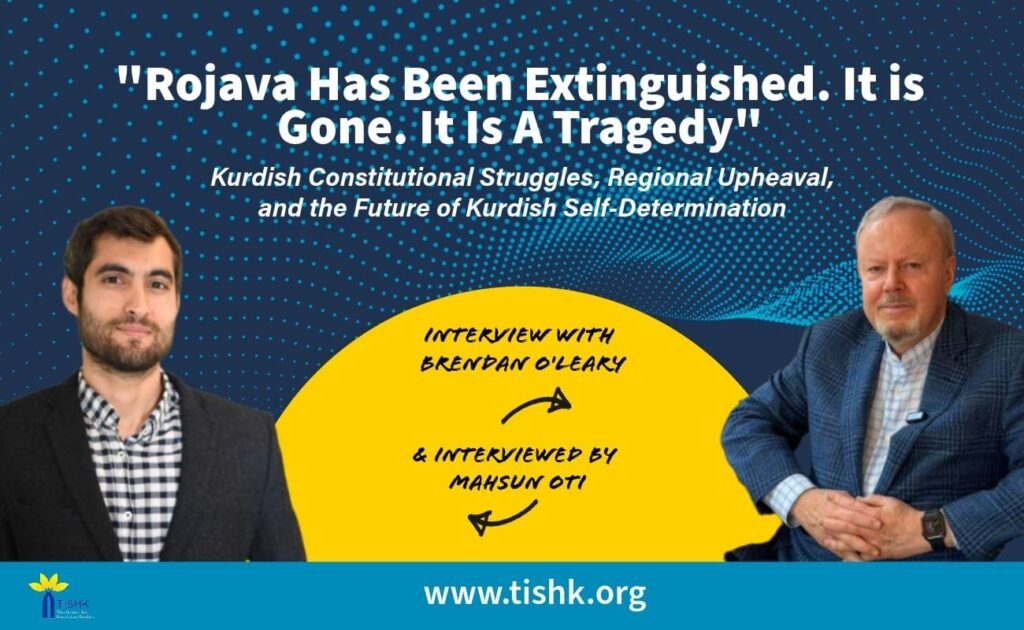
“Rojava Has Been Extinguished. It is Gone. It Is A Tragedy”: Kurdish Constitutional Struggles, Regional Upheaval, and the Future of Kurdish Self-Determinationm
Published online by TISHK Center for Kurdistan Studies: 29.06.2026
DOI: https://doi.org/10.69939/2026iv01
O’Leary, Brendan and Mahsun Oti 2026. “Kurdish Constitutional Struggles, Regional Upheaval, and the Future of Kurdish Self-Determination” TISHK Center for Kurdistan Studies. TISHK Interviews.
Abstract
This interview with Prof. Brendan O’Leary—Lauder Professor of Political Science at the University of Pennsylvania and former constitutional adviser to the Kurdistan Regional Government (KRG) from 2003 to 2017—examines the Kurdish constitutional experience in, Iraq, the aftermath of the 2017 independence referendum in Southern Kurdistan[1], and the implications of the current regional upheaval for Kurdish political prospects across Iraq, Syria, Turkey, and Iran. Drawing on O’Leary’s extensive work in constitutional design and his direct involvement in Kurdish governance, the interview situates Kurdish political struggles within the comparative frameworks of federalism, consociation, and O’Leary’s views on the “right-sizing” of states. O’Leary offers an assessment of the systematic violations of Iraq’s 2005 constitution, particularly the failure to implement Article 140 on the disputed territories, and the internal Kurdish divisions that led to the catastrophic loss of Kirkuk by the Kurds following the 2017 referendum. The interview further addresses the collapse of the Rojava project in northeastern Syria, the PKK’s disarmament without reciprocal guarantees from Turkey, and the strategic calculus facing Kurds in Iran amid an ongoing regional war. Throughout, O’Leary argues that Kurdish political movements have repeatedly been undermined by a combination of great-power indifference, neighboring-state hostility, and internal fragmentation, a pattern stretching back over a century to the broken promises of the post-World War I order. At a moment when the Middle East is undergoing another profound structural rupture, this interview insists that Kurdish voices and Kurdish historical experiences must be understood not as peripheral footnotes to regional geopolitics, but as central to any durable political settlement.
-
Interviewed by: Mahsun Oti
-
An Interview with: Brendan O’Leary
- Published (online): 29.06.2026
- Language: English
- Published Version: PDF
- Place of publication: Bonn, Germany
- DOI:https://doi.org/10.69939/2026iv01
- Institution: TISHK Center for Kurdistan Studies
-
Copyright: This article is licensed under CC BY-NC 4.0


Keywords: Kurdistan, federalism and constitutional law, Kurdish self-determination, stateless nations.
Editorial Introduction
The Kurds are the world’s largest stateless nation, numbering between thirty-five and forty million people.[1] Their homeland, Kurdistan, is partitioned by and colonized by four states: Turkey, Iraq, Iran, and Syria. Kurds inhabit a contiguous geographic region that has never been recognized as a sovereign state: a fact that is a product of deliberate geo-political design. The post-World War I settlement, codified in the Treaty of Sèvres in 1920[2] and then quickly reversed by the Treaty of Lausanne in 1923[3], buried the Kurdish question under the competing imperatives of Turkish nationalism, British and French imperial interests, and an emerging international order that privileged territorial integrity over the self-determination of peoples. One hundred years later, the promise of Kurdish statehood remains conspicuously unfulfilled, and if anything, the structural conditions that have long frustrated it appear more entrenched than ever.
The interview published here takes place at a moment of acute regional crisis. The ongoing war involving Iran, encompassing American and Israeli strikes on Iranian targets, increasing pressure on Iranian proxies across Iraq, Syria, Lebanon, and Yemen, has once again thrown the Kurdish question into sharp relief. As regional borders tremble and power vacuums open and close with alarming speed, Kurds in their homeland, Kurdistan, under the occupation of Turkey, Iraq, Iran, and Syria, find themselves navigating between forces larger than themselves, simultaneously courted as potential allies and dismissed as inconvenient complications. The Rojava experiment in northeastern Syria, once celebrated in international media as a radical democratic and feminist alternative to both authoritarian state power and Islamist militancy, has been effectively dismantled, its territories subjected to Turkish military occupation and demographic engineering. The PKK’s disarmament, announced without securing any formal commitments from Ankara on cultural rights, political prisoners, or territorial autonomy, has struck many observers. Southern Kurdistan (The Kurdistan Region of Iraq-KRG), on the other hand, continues to navigate a treacherous terrain of Baghdad’s constitutional violations, Iranian militia pressure, and the unresolved status of Kirkuk and other disputed territories. Kurds in Iran are organized across six parties in anticipation of potential regime change.
In this context, understanding what has happened to Kurds, not as a subplot of great-power competition but as a century-long struggle for political recognition, territorial sovereignty with its own internal logic, its own internal divisions, and its own accumulated wisdom, is essential for any serious analysis of the Middle East. The interview with Prof. Brendan O’Leary that follows offers a rare opportunity to do precisely this. O’Leary brings to this conversation not only the analytic framework of comparative constitutionalism, developed across decades of scholarship on federalism, consociation, and ethnic conflict, but also direct, sustained engagement with Kurdistan’s political institutions as a constitutional adviser. His perspective bridges the scholarly and the practical in ways that are uncommon and, at this moment, indispensable.
O’Leary’s analysis engages, explicitly and implicitly, with several of the central debates in political and legal anthropology. His discussion of Iraq’s constitutional failures speaks to longstanding anthropological concerns about the limits of liberal constitutionalism as a technology of conflict resolution—a question explored, with different emphases, in work on post-conflict state-building from the Balkans to sub-Saharan Africa. His framing of the Kurdish experience as a history of systematically broken agreements—what he calls, with striking metaphoric force, the condition of “a battered bride”—resonates with anthropological literature on the phenomenology of political betrayal, on the way that repeated violation of agreements produces not simply frustration, but a specific kind of political consciousness shaped by the expectation of betrayal. His critique of Rojava’s ideological self-dissolution—the abandonment of Kurdish national identity in favor of a universalist democratic confederalism that, he argues, provided no protection against Turkish military power or Kemalist ideology —raises important questions about the relationship between political ideology and political effectiveness in nationalist movements. And his concept of “right-sizing” the state-adjusting political borders to better align with the distribution of peoples engages, in the idiom of political science, with questions about the relationship between territory, sovereignty, and ethnic identity that have occupied political anthropologists since the field’s engagement with decolonization.
“Rojava Has Been Extinguished. It is Gone. It Is A Tragedy”: Kurdish Constitutional Struggles, Regional Upheaval, and the Future of Kurdish Self-Determination
Interview
Mahsun Oti: You have worked at the intersection of scholarship and political advising, from Northern Ireland’s peace process to Kurdish constitutional projects in Iraq. Both cases involve nations managing their futures within larger polities that have historically oppressed them. What do these two cases teach you about the limits of constitutional governance as a tool of conflict resolution?
Brendan O’Leary: Constitutions can only be one part of successful political settlements. They will not work if the parties do not keep to the commitments they make or if they rapidly undermine those core commitments. In the case of Ireland and Northern Ireland, there is a fundamental constitutional problem: the UK does not have a constitution in the conventional sense. It operates according to the principle of parliamentary sovereignty, which creates no special protections for agreements reached by that Parliament, including devolution arrangements and international treaties. The UK Parliament reserves the right to reverse the decisions of its predecessors. This made it extremely difficult for the UK to make credible constitutional settlements with the Irish in the 19th century, again at the beginning of the 20th century, and even after the Good Friday Agreement. A clear example: the Northern Ireland Assembly was designed so that nobody could suspend it, yet the Secretary of State for Northern Ireland, Peter Mandelson, simply took a bill to Parliament in 2000, creating a power of suspension that was not in the agreement, thereby breaking the treaty with the Irish government.
In the case of Iraq, a constitution made under foreign occupation faced immediate legitimacy problems, particularly among Sunni Arabs. What the Kurds did achieve, during the Transitional Administrative Law, was a ratification rule that required not only an Iraq-wide majority but also stipulated that the constitution could not pass if three or more governorates voted against it by two-thirds or more. That gave the Kurdish population in four governorates-Duhok, Sulaymaniyah, Erbil, and Nineveh-an effective veto. It was a great achievement. But the Arab parties that made that agreement, particularly Dawa, subsequently resiled from it, resuming a historic pattern familiar to Kurds since the 1950s: agreements are made, then broken.
Mahsun Oti: A pattern that seems almost structurally reproduced across every constitutional moment.
Brendan O’Leary: Kurds had hoped 2005 would break that cycle. Unfortunately, it has not.
Mahsun Oti: In certain periods, you served as a constitutional adviser to the Kurdistan Regional Government from 2003 to 2017. Looking back, how do you assess the sustained failure to implement Article 140, the 2017 independence referendum, and the loss of Kirkuk?
Brendan O’Leary: The category of ‘disputed territories’ was itself an American invention. Under Saddam, there had been a deliberate strategy to restructure Kirkuk’s boundaries and those of other districts in Salahadin, Khanaqin, and Nineveh, minimizing the Kurdish share of the population and bringing in Shia settlers from the south to alter Kirkuk’s demographic character. The Kurds correctly believed this was all done to destroy the autonomy agreement made with Mullah Mustafa Barzani in 1970. In 2003, KDP and PUK Peshmerga were allied with the Americans in the liberation of Kurdish areas. The KDP took Mosul; the PUK took Kirkuk. The Americans, not wanting to antagonize Turkey or be seen as creating conditions for an independent Kurdistan, asked the Kurds to withdraw from the cities, which they did. Article 58 of the Transitional Administrative Law set out a process for rectifying the crimes of ‘nationality correction,’ property theft, and forced expulsion. Article 140 of the 2005 Constitution built on this provision, with a clear deadline of December 2007 for completion. The Arab parties in the new coalition government simply delayed implementation and have continued to do so ever since.
Mahsun Oti: And then ISIS complicated everything further.
Brendan O’Leary: When ISIS invaded Mosul and the disputed territories in 2014, Iraqi forces withdrew completely, handing the keys of Kirkuk’s refineries to the Kurds. These territories remained under Kurdish control until the 2017 referendum. The original plan was to vote sequentially by governorate, Duhok, Erbil, Sulaymaniyah, and then Kirkuk separately, given its unresolved status. In my personal view, the PUK resisted this sequential approach because they feared Kirkuk would not vote to join an independent Kurdistan, and they expected to be the largest Kurdish party in Kirkuk. They argued for a single simultaneous vote across all of Kurdistan, believing the KDP would not go ahead. The KDP called their bluff, agreed to include Kirkuk, but the results were counted as a single block rather than released governorate by governorate. This was all unfortunate for two reasons. Rolling referendums by governorate could have slowly built momentum for making independence seem inevitable, on the model of Scandinavian entry into the EU, and could have allowed for a pause before a vote in Kirkuk. And explicit counting by governorate, district, and sub-district would have given greater international legitimacy to the outcome, and would have enabled negotiations.
Mahsun Oti: And what happened in October 2017 is then the consequence of that internal miscalculation?
Brendan O’Leary: The underlying tensions between Kurdish became catastrophic a month after the referendum. Bafel Talabani made a deal with General Soleimani of Iran, allowing Iranian-trained militia and Iraqi forces to retake Kirkuk. PUK Kurds loyal to independence and the KDP were both completely outflanked. The Americans, who had tried to postpone the referendum, were very late and proposed a UN mission without credible commitments, and they chose not to intervene when the Iranian-led forces moved in—though they did stop them from overrunning Duhok, Erbil, and Sulaimania. A combination of American non-decision-making and internal Kurdish divisions produced this disaster.
Mahsun Oti: Was the PUK’s behavior driven primarily by the fear of losing power to the KDP after independence?
Brendan O’Leary: The PUK was not of one view. There were people within it who wanted independence just as much as anyone in the KDP: I met them. But the faction around the Talabani family was deeply worried about the potential loss of power and patronage after independence to the KDP, which had proven itself the more popular and more unified party. The PUK was, at its foundation, a coalition of all the parties that opposed the Barzanis; that was all they had in common. The lack of PUK internal cohesion and the fear of becoming second fiddles in an independent Kurdistan played an important role in how they behaved.
Mahsun Oti: The Iraqi Federal Supreme Court has issued rulings against KRG oil contracts and Peshmerga funding that the KRG contests as unconstitutional, arguing the court itself was never legitimately constituted under Article 92. At what point does a sustained pattern of constitutional violation destroy the entire federal compact? Have we already passed that threshold in Iraq?
Brendan O’Leary: It was precisely the KRG’s argument that the constitution had been systematically violated. I was part of the team compilation that documented those violations. The major ones were: first, the failure to legislate a second chamber, a chamber of the regions, as most federations have, that would have required a two-thirds resolution of the Iraqi parliament. Second, the failure to establish a proper Supreme Court by the same two-thirds mechanism under Article 92: 2.
Mahsun Oti: So the federation’s own foundational institutions were never actually built.
Brendan O’Leary: Yes, without these two institutions, the federation had not genuinely been brought into being. You had, de facto, parliamentary sovereignty-a single dominant chamber passing legislation irrespective of the constitution. Third, Article 140 remained unimplemented. Fourth, the provisions on oil and gas had not been properly honored-the federal government behaved as if Saddam’s laws were still valid.
Mahsun Oti: And the Supreme Court rulings on oil contracts, are they legitimate?
Brendan O’Leary: The so-called Supreme Court is a court left over from the transitional period that should never have been allowed to continue. Kurdistan is perfectly within its rights to declare its decisions invalid. And even if the court was valid, which it is not, the decision was absurd. The constitution’s text on oil and gas has already been interpreted by judges in London. Oil companies often agree to resolve disputes between themselves and with governments under international courts under English law. In Dana Gas v. KRG, Judge Butcher had no difficulty concluding that the federal government has no ownership over oil and gas developed after the Constitution came into force, and he recognized Kurdistan’s minister of natural resources as having the authority of the sovereign state of Iraq to sign agreements with international oil companies. The Iraqi federal government has manifestly failed to honor these provisions.
Mahsun Oti: What do all these unresolved constitutional problems tell us about Kurdistan’s situation more broadly? Is there a path forward?
Brendan O’Leary: Kurdistan has a history, to use a metaphor, of a bartered bride: promises made to it have been systematically broken, not just once but many times. I see three paths forward. First, the Kurds could help form yet another Iraqi government and extract pledges on implementing the constitution, a new court, a second chamber, and respect for oil and gas rights. Second, they could move toward independence. If so, I would strongly advise against including Kirkuk: it is divisive, more likely to trigger Turkish intervention, and a special arrangement for Kirkuk could be negotiated separately. Third—and this is my preferred view—they could negotiate a confederal relationship. In a confederation, both entities would be sovereign, bound together by treaty, with a common foreign policy of neutrality, shared defense, and a common OPEC export policy, but otherwise separate. That would give Kurdistan the reality of independence without requiring immediate UN membership. Of these three options, I believe confederation is the best, but it is for Kurds to negotiate and decide their own future.
Mahsun Oti: A kind of sovereign reality without the full diplomatic apparatus of statehood. Moving to other parts of Kurdistan, the PKK has announced disarmament without securing any commitments from Turkey on cultural rights, political prisoners, or territorial autonomy. Rojava appears to be in terminal decline. How do you assess the state of Kurdish movements across the region?
Brendan O’Leary: The Kurds of Syria have made major strategic errors, some forced upon them by the withdrawal of American support. But they did not persist in their demand for territorial autonomy, and as far as I can tell, they did not even insist on language rights for Kurds in Syria. As far as I am concerned, Rojava has been extinguished. It is gone. It is a tragedy.
Mahsun Oti: Do you think the ideological framework of democratic confederalism contributed to that failure? There is a growing dispute among the Kurds on how the abandonment of explicit nationalist frameworks affected Kurdish political failure in Rojava.
Brendan O’Leary: What disabled the Syrian Kurds was that they believed their own ideology too much. They forgot that they had mobilized Kurds as Kurds and that was their first duty: to the Kurdish national identity. It is utopian nonsense to abandon Kurdish national identity in the hope of receiving equal treatment from regimes that have shown no record of providing it.
Mahsun Oti: And in Turkey, the situation looks even more interesting.
Brendan O’Leary: Interesting would not be my chosen word. The PKK has surrendered without any commitments from the Turkish government, no commitment to cultural rights, no commitment to territorial autonomy, and no commitment to examine the cases of political prisoners. Enormous one-sided concessions. What was all the fighting for since 1984—let alone the internal fighting in order to establish the PKK as the sole spokesman of the Kurds?
Mahsun Oti: Currently, Northern Kurdistan and Rojava are operating on the basis of the language of integration proposed by Öcalan. What do you think of the term ‘integration’ in the Kurdish context?
Brendan O’Leary: It means that Öcalan is not a real nationalist Kurd; indeed, not a representative Kurd. You can quote me on that.
Mahsun Oti: I will.
Brendan O’Leary: Öcalan and his advisers have taken an enormous gamble with nothing pledged from the other side. They are speaking a strange language of integration as citizens of Turkey, as if they have completely forgotten that they are Kurds. The original project of Atatürk was to make everyone into a Turk. I think he may be laughing in his grave. Öcalan, in what he is apparently directing his movement to do, is a traitor to Kurdish interests. That does not mean that I support armed struggle: it has demonstrably not been successful. What I do say is that Kurds in Turkey have sought territorial autonomy, cultural autonomy, and democratic rights in that order—and that order should remain at the forefront of their demands.
Mahsun Oti: That is a remarkable and sharp judgment. So even before the current war with Iran, two major sites of Kurdish struggle had suffered historic defeats.
Brendan O’Leary: Yes. The Kurds of Iraq are not yet in that position, but they could be. I hope not.
Mahsun Oti: But let me push on that. Öcalan’s language is also the language of coexistence-he and others within the movement have argued that the Kurdish future lies not in a separate state but in the transformation of existing political structures toward democratic pluralism. Is there a version of a coexistence framework that could be genuinely productive for Kurdish politics? Can coexistence function as a durable political arrangement in the absence of sovereign recognition?
Brendan O’Leary: Coexistence can take place in a multi-national or multi-ethnic federation. It can take place through power-sharing mechanisms in which Kurds would be proportionally represented. It can take place through a regime of two languages. But it is not co-existence when one side offers to cease to be itself: when Kurds seek merely to be Turkish citizens. The offer, if I can call it that, of integration and/or assimilation has been there since the late 1920s. Coexistence is of course required—and should be a normative guide to all in the region, but Kurds need recognition as Kurds, and Kurdistan needs recognition, minimally as an autonomous region inside each of the four encompassing states.
Mahsun Oti: While Rojava and Northern Kurdistan face political decline, a coalition of six Kurdish parties from Eastern Kurdistan has formed in anticipation of a potential change in Iran. Could Kurds in Eastern Kurdistan, Southern Kurdistan, and Rojava regain strategic ground if the Iranian state is sufficiently weakened?
Brendan O’Leary: Once wars start, it is difficult to predict secondary effects. In Syria, it looks to me as if a Sunni Arab majority dictatorship has been established with Turkish supervision in the north and Israeli control in the south. The Turks will likely try to alter the demographic composition of the three cantons that the Kurds formerly controlled. I am not optimistic about Rojava’s prospects.
Mahsun Oti: And Iran?
Brendan O’Leary: The regime is in trouble but appears to have played its wild card successfully, exercising control over the Strait of Hormuz. Unless the Trump administration and the Gulf states take far more dramatic action, the regime looks likely to survive. There are four provinces in Iran where Kurds are probably a majority: two Sunni, two mostly Shia. The two Sunni ones could potentially be held by Kurdish forces with air support, but they would be holding mountainous rural territory with no ability to project power south toward Tehran or Isfahan, and would be highly vulnerable to repression if the regime stabilizes. My advice would be to keep their powder dry: wait and see. Build alliances.
Mahsun Oti: What about building broader alliances inside Iran itself?
Brendan O’Leary: Persia will always exist, even if Iran as a political entity does not. Kurds need to maintain diplomatic relations with Persians as much as possible; without that, they cannot achieve a genuine autonomy, let alone a federal Iran. Building alliances with Balochis, Azeris, and liberal Persians must be a political priority. What the Kurds of Iraq can legitimately argue is that they are being attacked by Iran directly and by Shia militia inside Iraq, while being expected to remain part of an Iraqi state that offers them nothing. They should press for American military support for their defense. It is the least the Americans owe them.
Mahsun Oti: Your concept of ‘right-sizing’ the state proposes adjusting borders to reduce ethnic conflict. Does the current regional upheaval-the war in Iran, the targeting of Hashd al-Sha’abi, the fragmentation of Syria-represent the kind of structural rupture that makes previously unthinkable border changes thinkable?
Brendan O’Leary: The concept describes what some states do: I do not mean to suggest by it that every last nation in the world should get its own seat at the UN—though the Kurds should; they have the numbers, the territorial contiguity, and the demonstrated democratic will, when given a chance to express it.
Your question is a fair one, but I think it is too early to give a clear answer. In Iraq, the interesting question is whether the Sunni Arabs conclude that Iran is now weaker and whether they can re-challenge Shi‘a dominance, and whether America is unwilling to tolerate the continued dominance of Iranian-trained militia. If that leads to American pressure for Sunni Arabs and Kurds to have greater power inside Iraq, you might not see a formal border change, but you could see a significant redistribution of power, which in practice might matter more.
Mahsun Oti: And in Iran specifically?
Brendan O’Leary: If the Balochis and Kurds were to launch sustained insurgencies, you could imagine a scenario in which the regime concludes it does not need eastern Kurdistan-there is no oil and no significant Persian population there, they could downsize. The Azeris are a different matter since Azerbaijan has leverage, and leave parallel to and sometimes intermixed with Kurds. But if an internal division emerges between those who want to downsize Iranian ambitions and those who insist on projecting power, the former faction would need to be very courageous and to have serious capacities. I see none of them in the public domain at present. One scenario I have been considering is something like Gulf War I: the Americans degrade the regime without removing it, the Kurds and Shia Arabs suffered as the regime reconsolidates, and the story ends a decade later with a far larger intervention. A great deal of damage can be done in that interval. That is one real possibility. Though the players would not be the same, one can imagine—and should prepare for —another American abandonment of those whose hopes they have recklessly raised.
Interviewer: Mahsun Oti is a PhD student in anthropolgy at Rutgers University. His dissertation project explores the impacts of the Operation Metro Surge on the Somali community in Minneapolis and the way in which Minnesotans have organized against the ICE surge. His research focuses on racial governance, Islamophobia, policing, surveillance, and community resistance.
Interviewee: Brendan O’Leary is Lauder Professor of Political Science at the University of Pennsylvania. He served as a constitutional adviser to the Kurdistan Regional Government from 2003 to 2017 and played a role in the Good Friday Agreement in Northern Ireland. His scholarly work spans federalism, consociationalism, ethnic conflict, and the political futures of stateless nations. His thirty books include the co-edited collection The Future of Kurdistan in Iraq (2005), How to Get Out of Iraq with Integrity (2009) and the three-volume A Treatise on Northern Ireland (2019).
[1] Adnan Celik and Deniz Yonucu. “Introduction to Kurdistan(s): Repression, Resistance, and the Fight for Survival.” POLAR Online Emergent Conversation 24, October 21, 2025.
[2] Radpey, Loqman. 2022. “Kurdistan on the Sevres Centenary: How a distinct People Became the World’s largest Stateless Nation,” https://www.cambridge.org/core/journals/nationalities-papers/article/kurdistan-on-the-sevres-centenary-how-a-distinct-people-became-the-worlds-largest-stateless-nation/A8A41F9088ABB9443BCEFF51EAAEC76D.
[3] Azeez, H. “Lausanne Treaty: From Statelessness to Citizenshipless Kurds,” Kurdish Centre for Studies. 2023. https://nlka.net/eng/lausanne-treaty-from-statelessness-to-citizenshipless-kurds/.
TISHK on social media